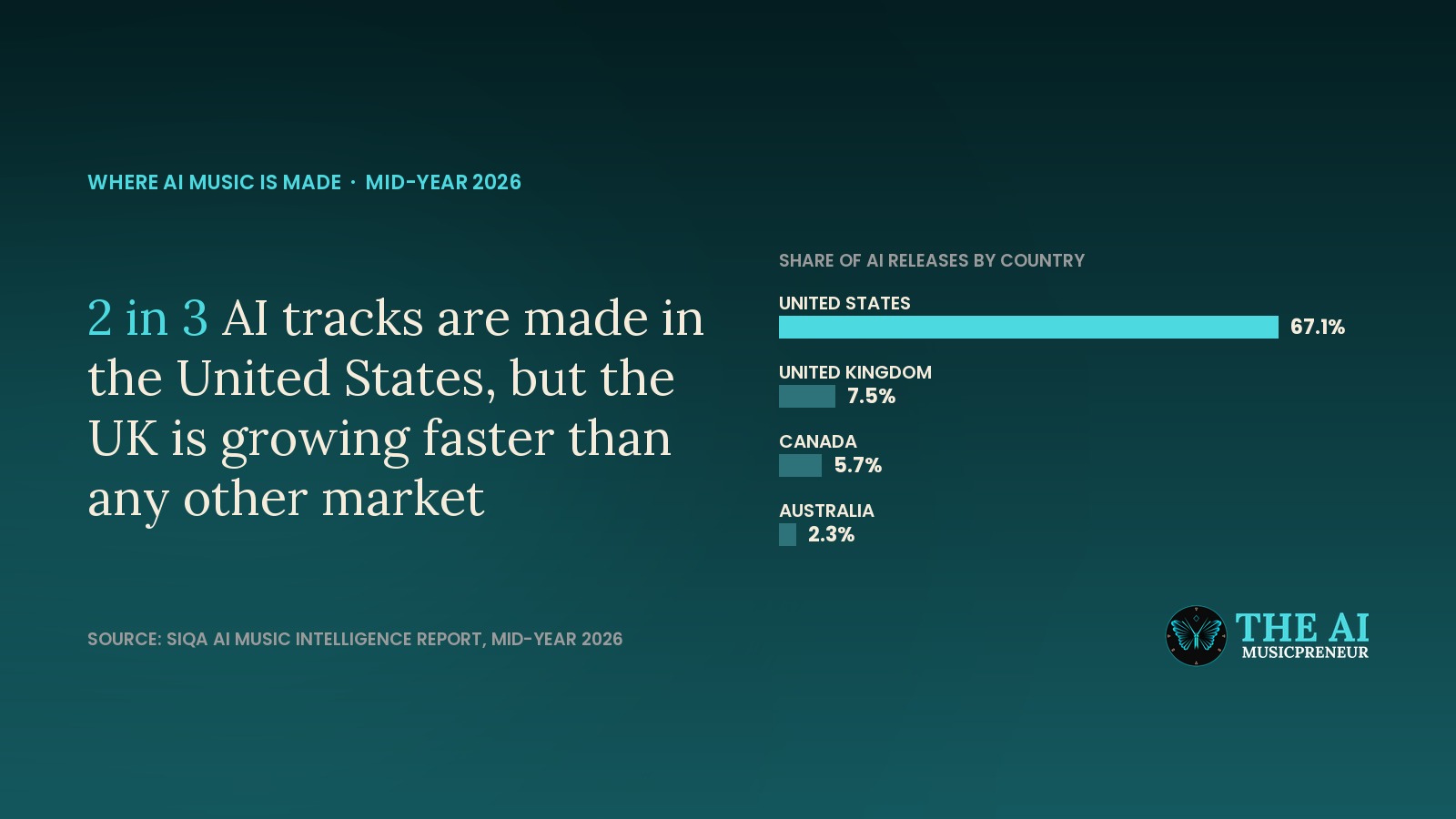
Only 13.9% of AI music is fully machine-made, and the share is falling
My stack My fav 6 tools for AI music after testing 70+
-
 ElevenMusic · Music generation
 -
 Moises · Stem separation
 -
 Controlla · Voice swap & cloning
 -
 Cryo Mix · Mixing + mastering
 -
 Neural Frames · Music videos
 -
 ONCE · Distribution
Some links are affiliate links — I earn a commission at no cost to you. Every tool here is one I run myself and truly believe in. This stack is proven.
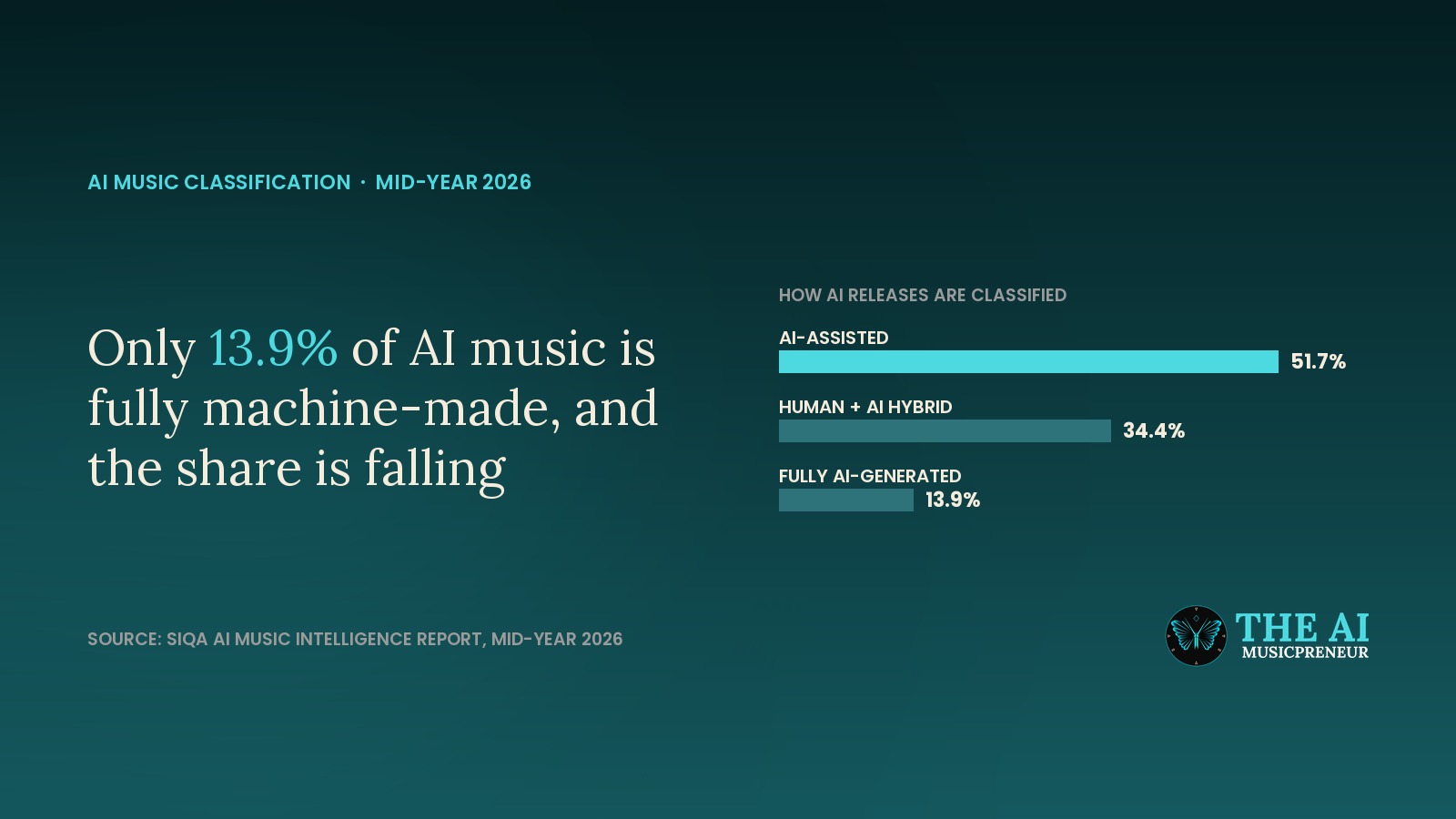
Fully AI-generated tracks made up 13.9% of AI music releases between April and August 2026, down from 19.2% in Q1. That number comes from the Sonic Intelligence Academy’s Mid-Year 2026 report, covering 1,743 verified releases from 886 artists.
The AI slop everyone argues about describes roughly 1 track in 7 here. The other 6 have a person in them.
What SIQA’s 3 AI music classification tiers mean
Every creator picks a tier when they submit, and SIQA verifies it before the track charts.
AI-Assisted means a human directs the work and AI tools enhance the output. Human + AI Hybrid means the artist uses AI to reproduce their own voice, so the vocal is generated but the voice model comes only from that artist. Fully AI-Generated means end-to-end machine generation with human curation.
All 3 moved in the same direction between the two reports:
- AI-Assisted: 48.4% in Q1, 51.7% at mid-year
- Human + AI Hybrid: 32.4% in Q1, 34.4% at mid-year
- Fully AI-Generated: 19.2% in Q1, 13.9% at mid-year
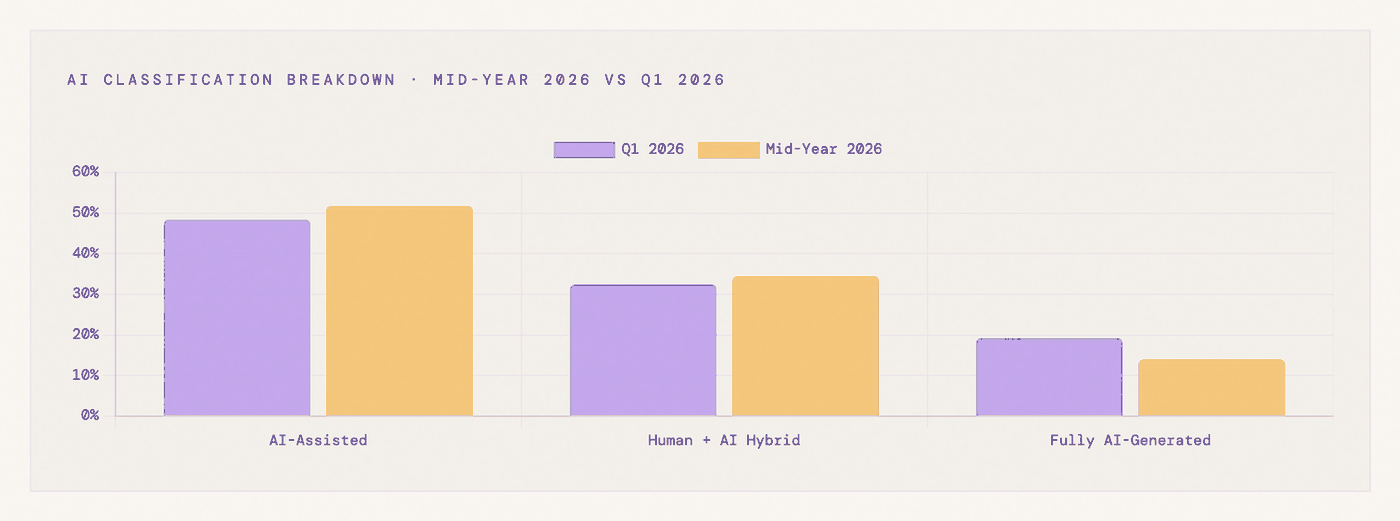
SIQA reads the combined 86.1% as releases involving meaningful human creative contribution, and frames the shift as the category maturing.
Why the 13.9% figure comes with a caveat worth stating
The tier is self-disclosed. Over the same months, declaring a track fully AI-generated got expensive.
In July, 11 major music companies proposed chart eligibility rules that would exclude most of what SIQA charts. On August 25, 5 days after this data window closed, ARIA shut fully AI-generated songs out of Australia’s official charts.
When a label costs you chart access, fewer people pick it. Both readings can be true at once: creators genuinely doing more of the work, and creators declaring carefully. The number still measures what creators claim, and the claim now carries a price.
What the 86% figure means for AI music policy
Almost every rule being drafted right now treats this category as one bucket. A song where a person wrote the lyric, directed the arrangement and used AI for the vocal gets the same tag as a track generated from one text prompt.
SIQA’s split says those are 86.1% and 13.9% of the category. Policies that ignore the difference are aimed at the smaller half and land on the larger one, and the people they land on are songwriters and singers who did the work.
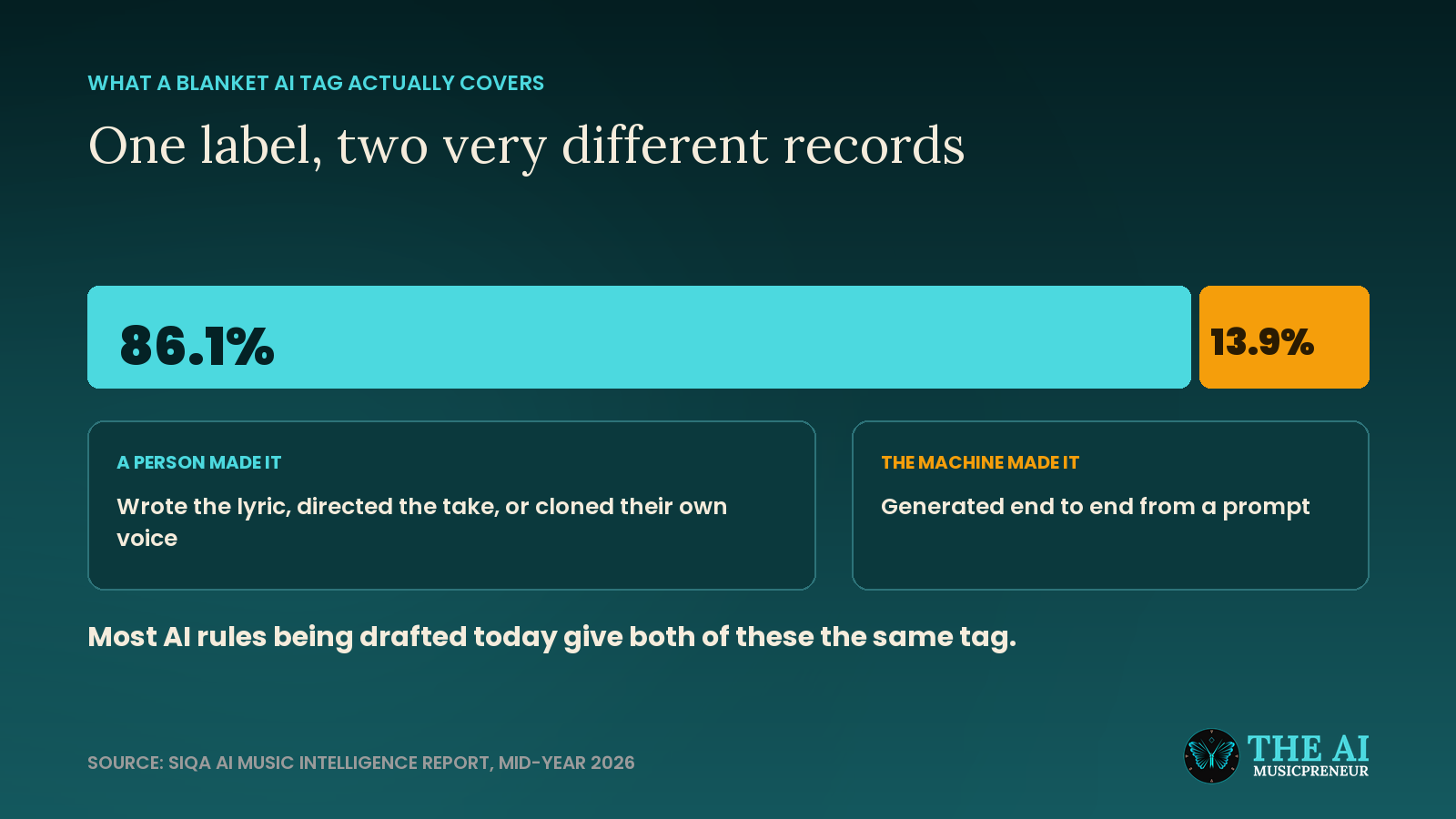
That is not an argument against disclosure, which is settled and reasonable. It is an argument about what the disclosure says. A tag that only reads “AI” tells a listener nothing about whether a human wrote the song, which is the thing most listeners actually want to know.
The self-voice cloning tier is where this gets hardest. 34.4% of releases now involve an artist reproducing their own voice, up from 32.4%. It is the most legally complex tier in the framework and the most likely route for an established artist to enter the category without changing what they sound like.
If you release music with AI in the chain, pick your tier honestly and keep the evidence: your lyric drafts, your session files, your voice model consent. Blanket policies will keep arriving, and the creators who can show their working are the ones who survive them intact.
Frequently asked questions
Why did fully AI-generated tracks drop between SIQA's Q1 and Mid-Year 2026 reports?
The share fell from 19.2% to 13.9% in one reporting period. SIQA attributes it to creators leaning further into human contribution as the category matures. The classification is self-disclosed, and during the same months the major labels proposed chart rules excluding fully AI-generated songs and ARIA banned them from the Australian charts, so part of the movement may be creators protecting chart access.
What does Human + AI Hybrid mean in SIQA's classification framework?
Human + AI Hybrid covers artists who use AI to reproduce their own voice. The vocal performance is AI-generated, but the voice model is built exclusively from the submitting artist. Self-voice cloning is the defining characteristic of the tier, which grew from 32.4% of releases in Q1 2026 to 34.4% at mid-year.
Is SIQA's AI music classification self-reported or independently verified?
Track classification is self-disclosed by the submitting creator under the SIQA Classification Framework, then verified by SIQA before a track enters the charts. Artist type, solo act or group, is also self-reported at submission. The report states plainly that the dataset represents a specific verified cohort rather than all AI music being created or released.
How do blanket AI labels treat AI-assisted and fully AI-generated music differently?
Most current labelling systems do not separate them at all. A song where a human wrote the lyrics and directed the production receives the same AI tag as a track generated end to end from a text prompt. SIQA's data puts the first group at 86.1% of releases and the second at 13.9%, which is the gap blanket policies currently ignore.
About the author

Covering AI music tools, industry shifts, and news for music creators and professionals. Twice-weekly newsletter at aimusicpreneur.com.