The AI Music Briefing #9: Sound of Fractures built a room the feed can't reach
The week of June 29 – July 5, 2026: TIDAL cuts royalties on fully-AI tracks, Australia calls AI training the largest IP theft in its history, Suno explores its first developer API, and Sound of Fractures builds a room the feed can't reach.
My stack My fav 6 tools for AI music after testing 70+
-
 ElevenMusic · Music generation
 -
 Moises · Stem separation
 -
 Controlla · Voice swap & cloning
 -
 Cryo Mix · Mixing + mastering
 -
 Neural Frames · Music videos
 -
 ONCE · Distribution
Some links are affiliate links — I earn a commission at no cost to you. Every tool here is one I run myself and truly believe in. This stack is proven.
Issue #9 · the week of June 29 – July 5, 2026 · ~7 min read. The Friday read for music industry professionals working at the intersection of AI and the traditional music business. Curated by Christopher Wieduwilt.
The industry moved to price AI music. One artist built a room instead.
The AI money question got concrete this week: who gets paid, who controls the tap, and what music is even for.
TIDAL will stop paying royalties on fully-AI tracks from July 15 and tag them for listeners. Australia’s whole music industry called unauthorized AI training the largest IP theft in its history. Google pitched a Content ID style system to track AI content across the web. And in a London room, the independent artist Sound of Fractures ran an immersive live night built for depth over reach, not for the feed. Four moves, one question underneath: as AI floods the pipes, what is the scarce thing worth paying for?
What’s in store:
- Top Story: Sound of Fractures builds “Alone Together,” and why the room is the counterweight to the feed
- TIDAL cuts royalties for 100% AI tracks from July 15
- Australia calls AI training the largest IP theft in its history
- Suno explores its first developer API
- Christopher’s Take
High Signal News: TIDAL’s pay line, Australia’s letter, and Suno’s API
TIDAL stops paying royalties on fully-AI tracks
TIDAL published a new AI policy on June 29, effective July 15. Tracks judged 100% AI keep streaming but lose royalties, get pulled from direct-to-fan sales, and carry a tag telling listeners the song was deemed fully AI. TIDAL will also use automated tools to remove AI tracks built to impersonate a real artist. Context: Deezer now logs 44% of daily uploads as AI.
What this means for you → For a label, a new pay line to classify catalog against. For a Suno-first creator, a fully-AI track on TIDAL now earns nothing and wears a label.
Australia’s music industry calls AI training the largest IP theft in its history
APRA AMCOS, ARIA, the Copyright Agency, AIR and others signed a joint open letter on June 30, after The Atlantic revealed millions of Australian and New Zealand works sat inside four AI training datasets. Kylie Minogue, Nick Cave, Tame Impala and Lorde are among those reported affected. The ask is narrow: consent and payment. Canberra ruled out an AI training exemption in October 2025, and the coalition wants that line enforced.
Google pitches a Content ID style system for AI copyright
Google’s white paper, “A Pragmatic Approach to AI Governance in America,” lobbies US policymakers for a middle path between heavy regulation and none. In the copyright section it floats a Content ID style system to track and manage AI-generated content. Google already runs Content ID on YouTube, so it has a stake in the outcome. Rights holders doubt standard takedown tools can cope with tens of thousands of AI tracks a day.
Suno explores its first developer API
Suno is building its first official developer API, opening with a curated group of partners. CPO Jack Brody announced it on LinkedIn on July 1 and pointed developers to an intake form, calling it a precursor to a “partner powered model.” It is the first time outside apps could plug straight into Suno’s models to send prompts and get finished audio back. No timeline yet.
What this means for you → Games, fan tools and DAW plugins could soon generate Suno audio inside their own products. Same infrastructure bet behind the $5.4B valuation.
Backstreet Boys move to trademark their spoken intro against AI deepfakes
BSB Entertainment filed a US sound-mark on June 24 for “Hi, we’re the Backstreet Boys,” spotted by Gerben IP. It puts the group alongside Taylor Swift and Lionel Richie, who filed voice-related marks this year. A trademark protects a brand signal, but the general tone of a singing voice usually cannot be trademarked, which is the gap cloning models exploit.
AI Music Lawsuit Tracker
RIAA v. Suno: Sony and Universal push toward 61,026 recordings
RIAA v. Suno: partly settled. Warner settled in November 2025; Sony and Universal are still litigating and are moving to expand the case to 61,026 recordings.
This week: No change this week.
RIAA v. Udio: judge denies Sony’s bid to add 30,442 recordings
RIAA v. Udio: mostly settled. Universal and Warner settled in late 2025; Sony alone is still litigating.
This week: Moved July 2. Judge Alvin K. Hellerstein denied Sony’s bid to add 30,442 recordings, keeping the case at 333 works. With statutory damages capped at $150,000 per work, that is the difference between a bounded number and a catastrophic one. Status conference set for July 10.
GEMA v. Suno: awaiting the Munich Regional Court verdict
GEMA v. Suno: awaiting verdict. The Munich Regional Court will rule on July 31, 2026.
This week: No change this week.
AFM v. Universal & Warner: contract suit awaiting a response
AFM v. Universal & Warner: freshly filed. The American Federation of Musicians sued on June 5, 2026; Universal and Warner have not yet responded in court.
This week: No change this week.
Artists v. Suno & Udio: nearly 1,300 creators back the class actions
Artists v. Suno & Udio: ongoing. Independent artists led by country musician Tony Justice are suing in class actions; the firm Hagens Berman joined and amended the Udio complaint in June. Nearly 1,300 creators back the campaign.
This week: No change this week (last moved June 22).
Jamendo v. Nvidia: newly filed in California federal court
Jamendo v. Nvidia: filed June 22, 2026 in the Northern District of California. No tracker page yet.
This week: No change this week.
→ Full case files and timelines
Top Story: Sound of Fractures built a room the feed can’t reach
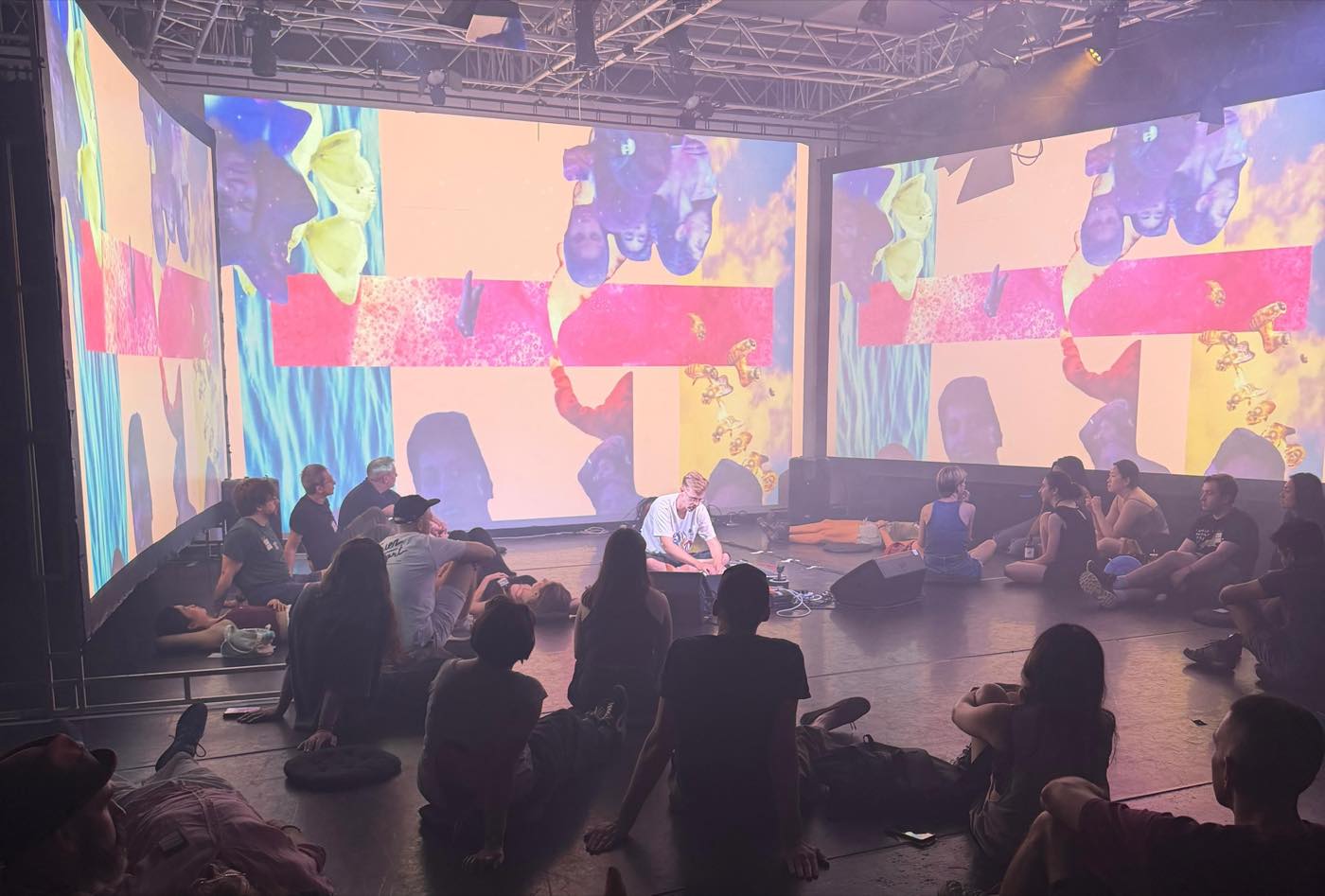
Sound of Fractures, the independent London artist, staged “Alone Together” in London in late June and wrote up the day on June 30. He built the whole thing around one idea: depth over reach.
Most of the music business right now is a fight over scale. Who gets paid, who owns the data, how much more of it there is. “Alone Together” asks a different question. Not how to move recorded music, but what people will show up for. The answer he got was presence.
The space ran on immersive screens and a live video team. Personal image sequences, called SCENES, flowed past with the music, some deep and some private, so different moments landed for different people. A welcome desk handed out name tags. People passed conversation cards, shared popcorn, sat and lay on the floor.
- A live set from Nica Albertson, who builds memory fragments from her own life into the work.
- A smaller pilot event ran first to test the format before the main night.
People did not have to stand and watch a performer. They could get lost in the visuals, dance, or talk to a stranger. Several compared it to a sound bath or to therapy, rare spaces where you get time with yourself. The artists moved through the room with everyone else.
“There was no wall. We were doing the thing with everyone else, not performing at them from behind a barrier,” Sound of Fractures wrote in his recap.
The feedback that landed hardest was not “you were amazing.” It was “thank you for creating a space for the things that happened to happen.” When the night ended, people stood outside talking, no one wanting to go home.
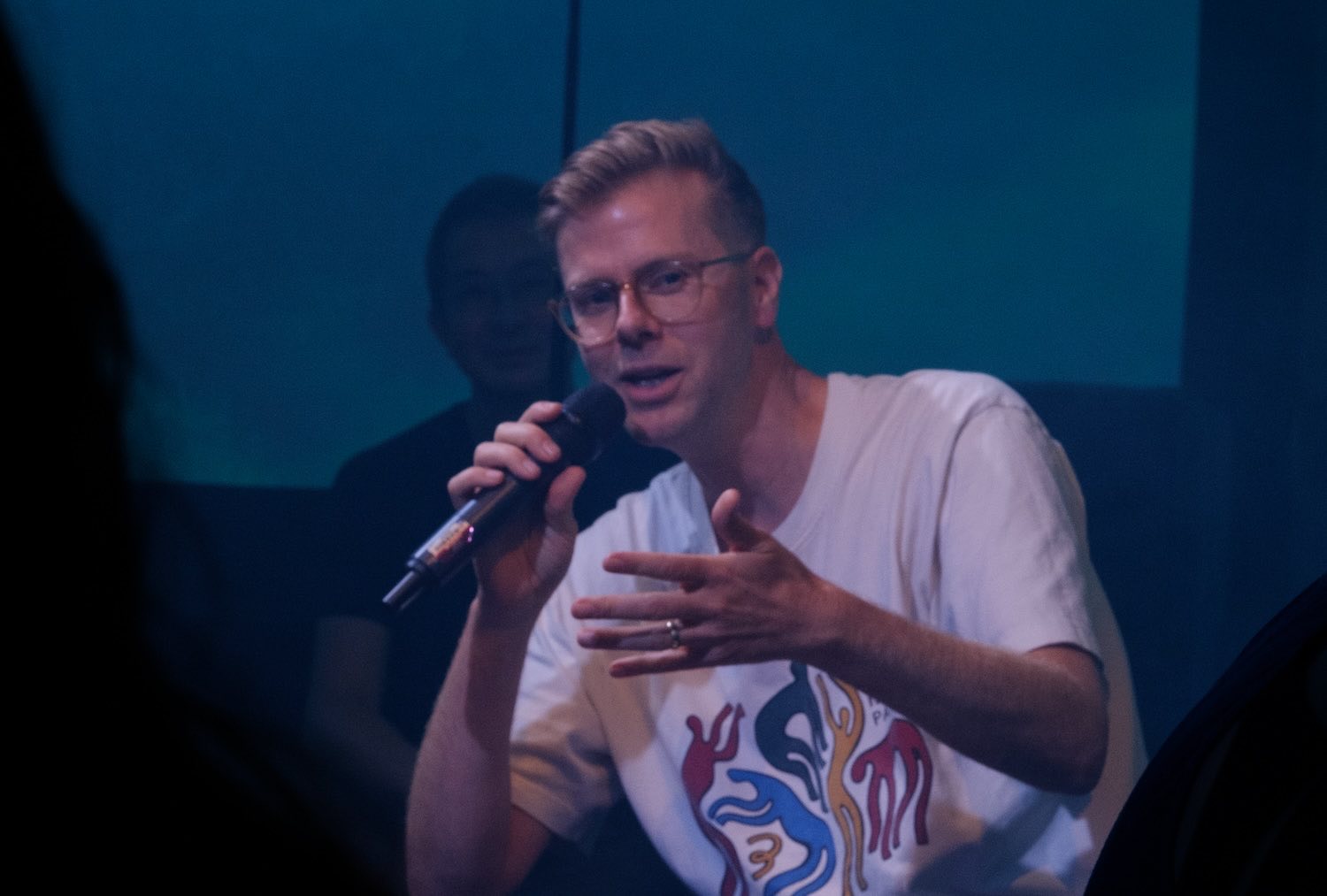
He runs fully independent, no label, no management, funded by patron grants (C.Y. Lee came on as executive producer) and paid Substack subscribers. A room like this is expensive and hard to repeat, and it leans on patronage more than ticket math. Whether the model scales past one committed artist is the open question.
When recorded music is everywhere and costs nothing, the scarce thing becomes a night people will not leave. Jamie built one. If a project like this speaks to you, reach out to him. Rooms like this run on people showing up.
Music Intelligence: Credits.fm, the MCP wave, SIQA’s plaque, and Eros
Credits.fm indexes 150M+ song credits, free and open
Notes.fm launched Credits.fm on June 30, a free open database of 150M+ song credits with an open API and MCP. It spans recordings, works and songwriters, and is aimed at the $1B+ in royalties that go unclaimed every year. Founder Tim Luckow calls it the “AWS layer” for attribution. It is the plumbing under this whole issue: you cannot pay or label AI music you cannot attribute.
Viberate and Credits.fm make it three MCP launches in three weeks
Viberate (11M+ artists) and Credits.fm (150M+ credits) both shipped MCP servers this week, after OpenStage last week. Artist data, credits and fan data are all turning into plain-language questions inside Claude, ChatGPT and Gemini. Three weeks, three launches. The distribution layer for music data is moving inside AI assistants.
“Now the only differentiator is the size of your imagination and how well you can translate that into questions,” Vasja Veber, Viberate co-founder.
SIQA hands its first AI chart plaque to Xania Monet
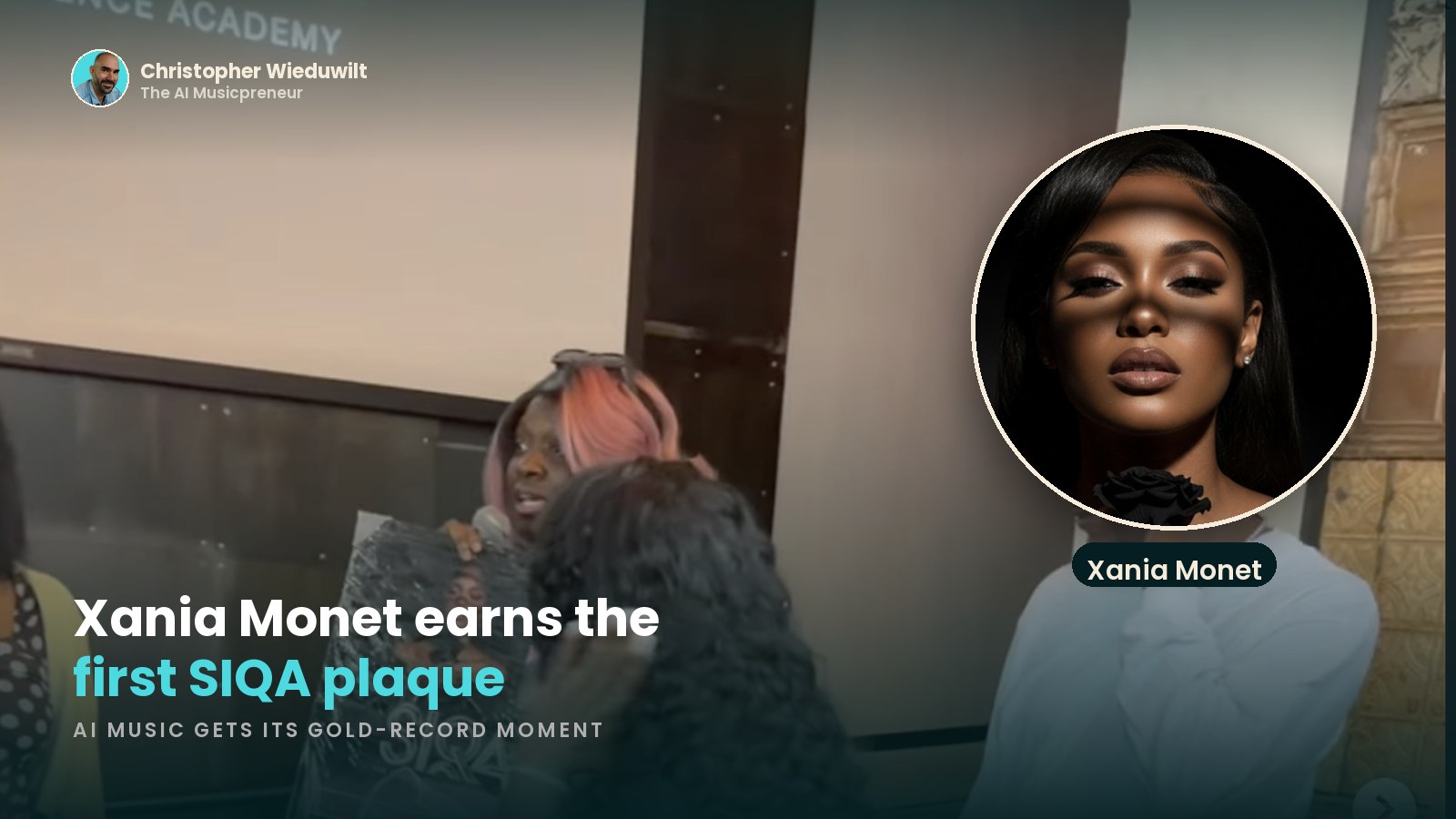
SIQA, billed as the first global AI music charts, started giving artists plaques for chart performance, gold-record style but built for AI acts. Xania Monet got the first one; her “How Was I Supposed To Know?” sat at No. 3 on the SIQA Top 100 the week of June 23. The Artist Index added 6 new AI acts the same week. You will not find this on MBW or Hypebot. (Disclosure: I sit on SIQA’s Creative Advisory Council; I do not run it.)
Eros Music Worlds builds an AI label around the Mohammed Rafi catalog
Eros Innovation launched Eros Music Worlds, an AI label with 7 AI-native acts, and signed a perpetual deal with the family of playback legend Mohammed Rafi. It covers new recordings, an ABBA Voyage style concert, and a Rafi academy. Most AI music news this year is lawsuits. This is someone building a roster around AI, on a non-Western catalog, first album set for July 31.
Artist Index: 6 new AI acts, from Xania Monet to Breaking Rust
All 6 joined the Artist Index this week.
Xania Monet: first AI act on a Billboard radio chart
Xania Monet is the first AI act on a Billboard radio chart, with a ~$3M Hallwood Media deal, and now SIQA’s first plaque winner.
Nova Solé: faceless AI R&B at 524k monthly listeners
Nova Solé is a faceless AI R&B act; “Already Her” sits on the SIQA Top 100, with ~524k Spotify monthly listeners.
Solomon Ray: AI gospel at No. 3 on Billboard Hot Gospel Songs
Solomon Ray is an AI gospel act by rapper Christopher Townsend; “Find Your Rest” hit No. 3 on Billboard Hot Gospel Songs.
Nyqki Niqole: No. 1 on the SIQA AI Gospel chart
Nyqki Niqole is a faceless AI gospel act; “Girl, I Am Anointed” holds No. 1 on the SIQA AI Gospel chart.
Yunna Serene: a 14-week SIQA Top 100 run
Yunna Serene is a faceless AI R&B act; “soft girl era” sits at No. 2 on the SIQA Top 100 across a 14-week run.
Breaking Rust: AI country topping Billboard Country Digital Song Sales
Breaking Rust is an AI country act; “Walk My Walk” topped Billboard Country Digital Song Sales.
→ Browse the full Artist Index
My Take: the industry priced AI music, Jamie built presence

I run an AI music newsletter, so here’s the honest part. I love what AI gives creators. Use it for mixing, mastering, stem separation, vocal cleanup. Use it to write and record. I mean it.
But this week made something clear. While the industry argued about who pays for AI tracks and who owns the training data, Jamie built a room people didn’t want to leave. No feed. No metrics. Only presence.
I’ve known Jamie since the Music NFT days, back when we shared the same X spaces. I met him at a web3 conference in Portugal a few years ago and watched him perform. He’s gifted, and he sees music as something you build a whole world around.
That’s the whole reason I run this outlet: to point at the work I believe in. Jamie’s is that work. If it speaks to you, go find him.
One thing to do this weekend: check the Innovate UK createch grant
If you build AI music tools in the UK, Innovate UK opened a competition putting up to £10m into createch startups, with music named as one of four sectors. Grants cover projects costing £100k to £500k, open to UK micro, small and medium companies, for work that could reach market within 12 months. It is a grant, not an equity check. Rare non-dilutive money for tool builders, worth a look before the window closes.
About The AI Music Briefing
The AI Music Briefing is a weekly Friday read for music industry professionals working at the intersection of AI and the traditional music business. Curated and written by Christopher Wieduwilt, founder of The AI Musicpreneur. Browse every issue of the briefing.
Got a tip, a story, or a partnership idea? Reach out any time. Every message lands directly in my inbox.
Christopher
About the author
Covering AI music tools, industry shifts, and news for music creators and professionals. Twice-weekly newsletter at aimusicpreneur.com.