The AI Music Briefing #8: Anyone can ship an AI mixing tool now
The week of June 22–28, 2026, when the AI music fight moved underneath the tools: a flood of vibe-coded mixing tools, two new lawsuits against Nvidia and Udio, SZA's 238 scraped tracks, and 31 creator groups demanding consent before labels sign AI deals.
My stack My fav 6 tools for AI music after testing 70+
-
 ElevenMusic · Music generation
 -
 Moises · Stem separation
 -
 Controlla · Voice swap & cloning
 -
 Cryo Mix · Mixing + mastering
 -
 Neural Frames · Music videos
 -
 ONCE · Distribution
Some links are affiliate links — I earn a commission at no cost to you. Every tool here is one I run myself and truly believe in. This stack is proven.
Issue #8 · the week of June 22–28, 2026 · ~7 min read. The Friday read for music industry professionals working at the intersection of AI and the traditional music business. Curated by Christopher Wieduwilt.
The week the fight moved underneath the tools
This week the AI music question moved underneath the tools: who owns the audio and the data they run on?
David Ronan of RoEx called out a wave of vibe-coded mixing tools that never hear a note, the same week three rivals shipped models that read the audio itself. 31 creator groups told labels to stop signing AI deals over artists’ heads, and SZA found 238 of her tracks in a training set. Two new lawsuits landed: Jamendo sued Nvidia, and a $260 billion settlement firm joined the independent artists’ case against Suno and Udio. The tools got cheap, so the fight moved to what they’re built on.
What’s in store:
- Top Story: why the real audio models just got more valuable, not less
- OpenStage puts your fan data inside Claude, ChatGPT, and Gemini
- The Lawsuit Tracker: two new cases this week
- Music Intelligence: AI is winning on Roblox, on the metric that counts
- Christopher’s Take: the one input you can’t prompt
High Signal News: creator consent, SZA, and the AI tool flood
31 creator organizations demand consent before labels sign AI deals
31 groups representing artists, songwriters, and managers signed an open letter on June 22, coordinated by the European Music Managers Alliance, with the Featured Artists Coalition, the Ivors Academy, and the MMF among them. They want three things before labels sign more AI deals with Suno, Udio, KLAY, and Spotify: real consent instead of default opt-ins, fair pay, and transparency on the terms.
What this means for you → Label execs, the opt-in-by-default model is now a public fight. Creators, there’s an organized push to get you a seat before the next deal closes.
SZA found 238 of her tracks in an AI training set
Using The Atlantic’s AI Watchdog tool, SZA found 238 of her songs in the datasets training AI music models, part of a reported 12 million tracks used without permission. On Instagram she called musicians who back unlicensed training “disgusting” and named Diplo, who denied her claim that he holds a Suno stake, saying “the villain isn’t the tech.”
OpenStage puts fan data inside Claude, ChatGPT, and Gemini
OpenStage, the fan-data platform behind Paul McCartney and Bad Bunny, launched an MCP on June 25 that connects an artist’s live fan graph to Claude, ChatGPT, or Gemini. You ask plain questions and get work back. In one early test, a manager’s single prompt surfaced that an artist’s fanbase had tripled in one city over six months. It already powers 600+ artists and 30 million fans.
Deezer’s Remix Lab restyles tracks and insists it isn’t AI
Deezer’s new Remix Lab lets users restyle tracks from opted-in artists like Céline Dion (genre, tempo, pitch, reverb, EQ) at the stem level, built on the Spleeter tool Deezer open-sourced in 2019. Deezer says it generates no new audio and is not AI-powered. Every remixed stream stays credited to the original recording. It launched first in France.
Yamaha Creator Pass adds bundled DAWs and a $9.99 starter tier
Three months after its SXSW beta, Yamaha dropped Creator Pass to a $9.99 starter tier, down from $14.99, and started bundling free DAWs: Cubase 15 AI on monthly plans, Ableton Live 12 Lite on yearly. The $39.99 Pro tier adds Output Co-Producer and 10 Groover credits. It reads as a direct shot at Apple’s $12.99 Creator Studio from January.
Reactional Music wins a $2.8M EU grant for in-game music
Reactional Music, the Stockholm company, won a €2.5 million ($2.8 million) European Innovation Council grant, with up to €6.5 million more in equity possible. Its engine personalizes a game’s music in real time without touching the master recording, and it licenses a pre-cleared song catalog, so a real track drops into a game as easily as a sound effect.
Mureka rebrands as the first ‘AI-native music platform’
Mureka announced on June 22 it’s merging generation with listening, discovery, and remixing in one place, with a V10 model due in Q3 2026. The pitch closes the loop between making a song and hearing it. It ran as partner content on Digital Music News, so read it as Mureka’s own framing, not an outside verdict.
Top Story: why the AI mixing tool flood made real audio models more valuable

David Ronan builds AI mixing software at RoEx, so when he called the field “properly in the era of vibe-coded sh*te” in a June post, it carried weight. He keeps seeing tools that call themselves AI mixing, then pick EQ and compression straight from the instrument labels in your session. The model never hears a note.
The easy read is that AI made these tools trivial to build, so the category is about to commoditize. I read it the other way. The flood of look-alike tools made the companies that process real audio worth more, not less. When looking like a product costs zero, the value moves to what you can’t prompt.
A vibe-coded mixer reads “bass” and “kick” off your track labels and hands back numbers. It’s the same as ringing a mix engineer, telling them you have a bass and a kick, and asking how to EQ them, without them ever hearing the song. A real mix is a stack of judgment calls that live in the ear, not in the word “bass.”
- RoEx is a Queen Mary University of London spin-out with its mixing systems in the patent process.
- AudioShake works with Disney and ESPN across 40+ enterprise clients; Music AI, the company behind Moises, crossed 70 million users.
Look at what shipped the same week Ronan posted. AudioShake pulled a clean lead vocal out of a stems-free 1990 mix. Modulate launched a detection API that flags AI vocals from the audio in 4-second windows. RTM Audio’s UAI detector runs separate vocal and production checks on the signal. Three launches, one thing in common: every one of them listens to the audio.
“That’s not mixing. That’s a guess with a nice UI,” David Ronan, Founder and CEO of RoEx, wrote.
Not every tool needs a research lab. A producer who vibe-codes a helper for their own tracks, who already knows the sound they want, gets real use out of it. The line is whether you’re using the tool or selling it. Hand a prompt-baked mix to paying musicians across genres and loudness targets, and one template can’t hold.
For the next 6 to 12 months, app stores fill with AI mixers that are an LLM and a landing page, then most quietly die. The ones still standing will be the companies that treated the audio model as the product and the interface as the wrapper: RoEx, AudioShake, Music AI, LANDR. Read the full breakdown.
Music Intelligence: Roblox engagement and gaming’s blind spot
AI tracks are 46% of Roblox’s top music but earn 58% of the likes
Audioscape studied the 1,000 most-liked DistroKid tracks on Roblox: AI made 46% of them but earned 58% of the likes, and founder Sean Varah says 66% of the Roblox Top 100 is AI. A like there is an active save inside a game, not an autoplay stream, so it reads taste more cleanly than a stream. The driver is genre demand, not novelty: K-Pop is the most-searched genre, and AI supplies it fastest. One all-AI act, Beyond Bassline, has pulled 248,000 previews on 810 YouTube subscribers. This is the number you won’t find on MBW or Hypebot.
Games are the music industry’s blind spot
Put two of this week’s data points together. AI music over-indexes on engagement inside Roblox, and Reactional just won $2.8 million to make pre-cleared songs drop into any game like a sound effect. The industry watches Spotify and TikTok. The measured listening, and soon the money, is quietly moving to surfaces it mostly ignores.
AI Music Lawsuit Tracker
Artists v. Suno & Udio: Hagens Berman joins, nearly 1,300 creators back the campaign
Artists v. Suno & Udio: ongoing. Independent artists, led by country musician Tony Justice, are suing Suno and Udio in class actions separate from the major-label cases. Nearly 1,300 creators back the campaign.
This week: June 22, Hagens Berman, the firm behind a tobacco settlement it values at $260 billion, joined as co-counsel and filed an amended complaint against Udio in New York.
Jamendo v. Nvidia: new suit seeks at least $20.3M over training data
Jamendo v. Nvidia: new. Jamendo, the licensing platform owned by Winamp Group, sued Nvidia in California federal court over AI audio training.
This week: June 22, Jamendo claims Nvidia trained its Fugatto and Audio Flamingo models on the MTG-Jamendo dataset, released for non-commercial research only, and seeks at least $20.3 million.
RIAA v. Suno: Sony and Universal move to expand to 61,026 recordings
RIAA v. Suno: partly settled. Warner settled in November 2025; Sony and Universal are still litigating and are moving to expand the case to 61,026 recordings.
This week: No change this week.
RIAA v. Udio: Sony alone litigates as the DMCA claim proceeds
RIAA v. Udio: mostly settled. Universal and Warner settled in late 2025; Sony alone is still litigating, and a judge let its DMCA claim proceed.
This week: No change this week.
GEMA v. Suno: awaiting the Munich Regional Court verdict
GEMA v. Suno: awaiting verdict. The Munich Regional Court rules on July 31, 2026.
This week: No change this week.
AFM v. Universal & Warner: contract suit awaiting a response
AFM v. Universal & Warner: freshly filed. The AFM sued on June 5, 2026, and Universal and Warner have not yet responded in court.
This week: No change this week.
→ Full case files and timelines
My Take: the wrapper went free, so the moat is what you can’t prompt

I keep coming back to one line from the Top Story: the cost of looking like a product dropped to zero, but the cost of being one didn’t move.
Watch where that lands across the whole week. A vibe-coded mixer clones in a weekend, but RoEx and AudioShake spent years teaching a machine to hear. OpenStage wires fan data into Claude in an afternoon, but the 30 million fan records behind it took a decade to earn. The consent letter and SZA are fighting over the same scarce thing: the real catalogs underneath all of it.
So here’s my read. The wrapper is free now, and free things flood. What stays scarce is the audio, the data, and the trust you can’t prompt your way into. I think the next year sorts this whole market on that one line. Build on something real, or get cloned by the next person with a landing page.
One thing to do this weekend: run one stem through a real-audio tool
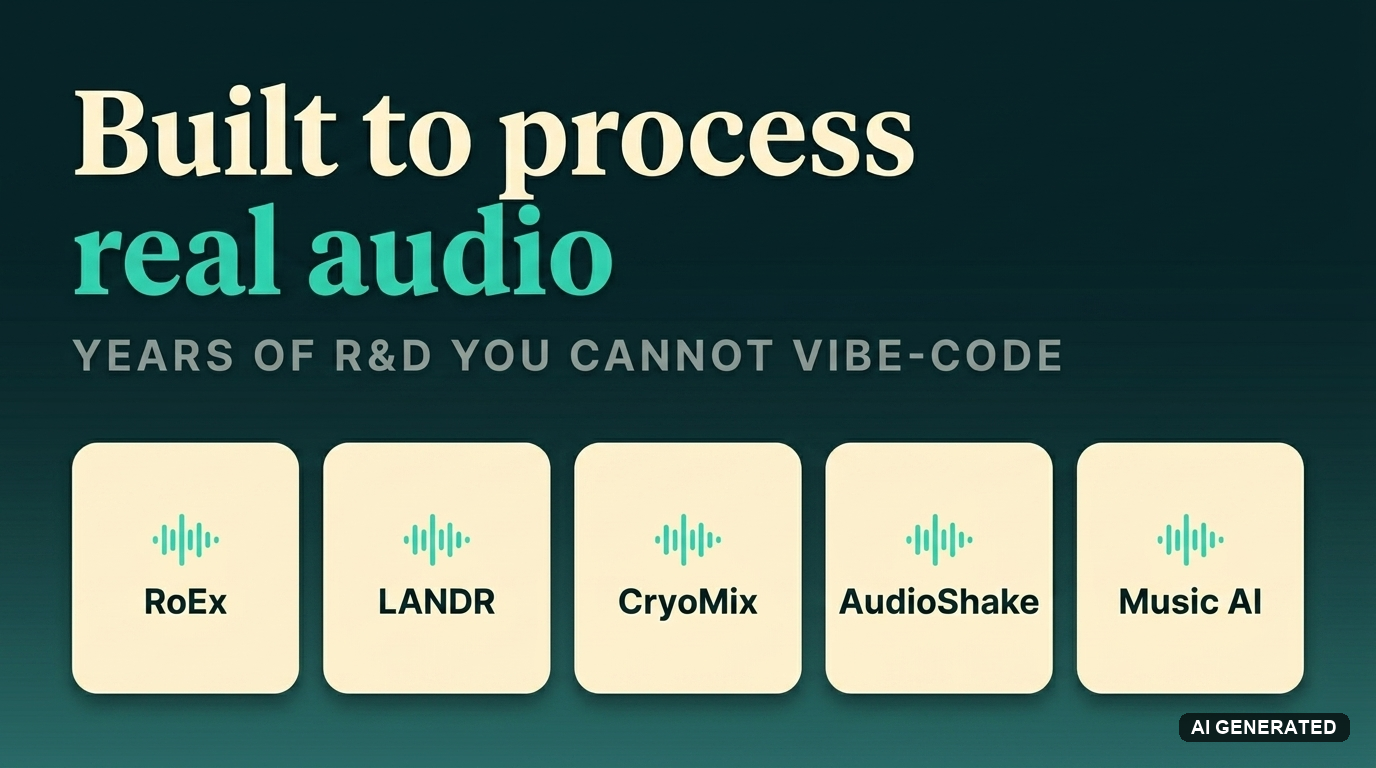
Pick one track you know inside out. Run a stem or the full master through a tool that actually analyzes audio: AudioShake or Moises for stem separation, RoEx for a mix or LANDR for a master. Then compare the result to any “AI” tool that reads your track labels and guesses. You’re training the only thing the flood can’t copy: an ear that knows when a mix listened to the song, and when it filled in a template. Twenty minutes, and you’ll hear the difference the rest of this issue is about.
About The AI Music Briefing
The AI Music Briefing is a weekly Friday read for music industry professionals working at the intersection of AI and the traditional music business. Curated and written by Christopher Wieduwilt, founder of The AI Musicpreneur. Browse every issue of the briefing.
Got a tip, a story, or a partnership idea? Reach out any time. Every message lands directly in my inbox.
Christopher
About the author
Covering AI music tools, industry shifts, and news for music creators and professionals. Twice-weekly newsletter at aimusicpreneur.com.