





UAI by RTM Audio
UAI runs separate vocal and production checks, flags a track only when both agree, and issues a signed certificate bound to the ISRC for every verdict.
What is UAI by RTM Audio and how does it work?
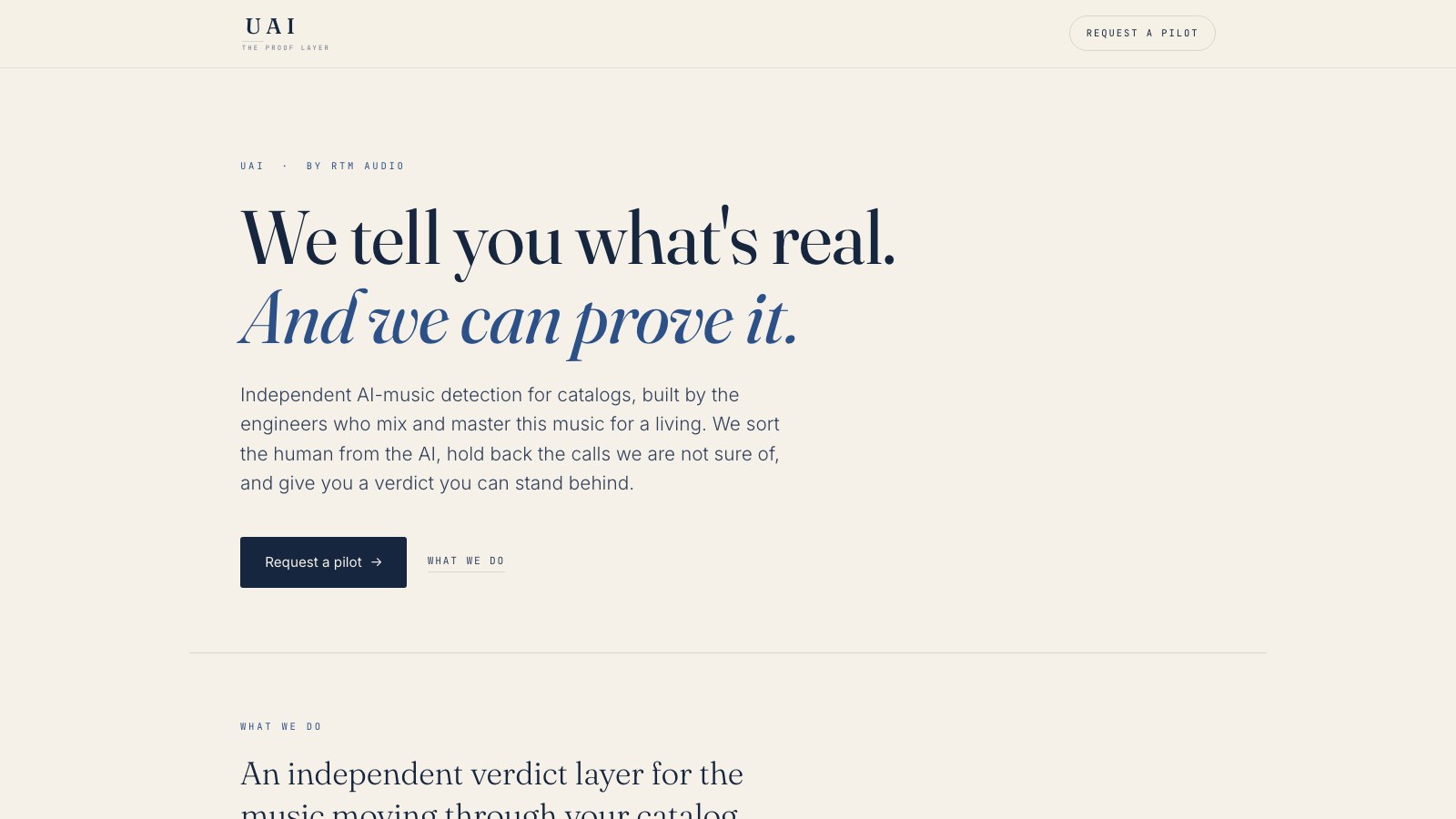
UAI is an AI music detection service from RTM Audio, a Los Angeles company founded by mixing and mastering engineers rather than by a machine-learning team. Its own description of itself is “the proof layer”, and the product is built around producing evidence a catalogue owner can act on, not a score on a screen.
The company positions it as independent detection for catalogues, “built by the engineers who mix and master this music for a living”. Among the AI music detection tools tracked here, it is the one whose output is designed to be filed rather than read.
How it works:
- A track is submitted through a pilot integration
- Two independent measurements run on it, one on the production and one on the vocal
- A hard AI flag issues only when both measurements agree
- Tracks the system cannot confidently call are held back rather than forced into a verdict
- Every verdict produces a cryptographically signed certificate bound to the track’s ISRC
RTM Audio’s founding team is unusual for the category: Ohad Nissim, a Grammy-nominated mastering engineer, serves as CTO, and two-time Grammy winner Teezio as CEO, alongside Calin Enache and music attorney Matt Buser.
How much does UAI by RTM Audio cost?
RTM Audio does not publish pricing. Access runs through a pilot request.
| Plan | Price | What you get |
|---|---|---|
| Pilot | Not published, request required | Catalogue detection with signed certificates |
Pricing changes frequently, and none is public here. Verify current terms at UAI by RTM Audio. The absence of a self-serve tier means an individual artist checking a single track has no obvious route in, which is worth knowing before you invest time in a request.
What is in a UAI certificate?
The certificate is the product. Rather than returning a probability a reader has to trust, UAI issues a signed record for each verdict.
- Cryptographically signed, so the verdict carries a verifiable origin rather than being a screenshot
- Bound to the track’s ISRC, tying the result to a specific recording rather than an uploaded file
- Formatted for EU AI Act disclosure, matching the transparency obligation live since August 2026
- Exportable to DDEX metadata, so the result travels through the standard music supply chain
- Issued per verdict, which is what makes the output filable rather than advisory
The compliance angle is the reason this design exists now. My coverage of the EU AI Act transparency rules sets out the disclosure obligation those certificates are formatted against, and the launch coverage of UAI covers the dual-check design in more detail.
What UAI does not tell you
The dual-check architecture targets false positives specifically, and RTM Audio reports a 0.06% false-positive rate across 8,236 masters in internal validation, with five tracks hard-flagged. That figure is more specific than most in this category because the sample size is attached to it. It remains a vendor figure produced on a private set.
- The validation set is not public, so the figure is not independently reproducible
- Detection reads the finished master, so it cannot see who played, wrote, or arranged anything
- A signed certificate makes a verdict verifiable, not correct: the signature attests to who issued the result, not to whether the result is right
- Holding back uncertain calls reduces false positives and leaves a set of tracks with no verdict at all
That last trade-off is the honest cost of the design. A system that refuses to guess produces fewer wrong answers and more missing ones.
What are some use cases for UAI by RTM Audio?
- Catalogue certification before a distribution deal: a signed per-track record rather than an internal spreadsheet.
- Meeting EU disclosure obligations: certificate output formatted for the transparency rules already in force.
- Passing detection results down the supply chain: DDEX export moves the verdict with the metadata instead of stranding it in a dashboard.
- Resolving a disputed release: an ISRC-bound signed record is stronger evidence than a screenshot of a detector score, which is what the Fenix Flexin “Rubberz” dispute turned on.
- Chart eligibility submissions: proposed AI chart rules depend on how a track was made, and a certificate is a portable answer.
- Screening acquisitions: checking a catalogue for generated content before buying it.
The design suits organisations that need to show their work later. For a one-off check on a single track, the certificate is more machinery than the job requires.
Is UAI by RTM Audio free?
No. Access runs through a pilot request and RTM Audio does not publish pricing.
How does UAI decide a track is AI-generated?
It runs two independent measurements, one on the production and one on the vocal, and issues a hard AI flag only when both agree. Tracks where the checks disagree are held back rather than flagged.
What is RTM Audio’s reported false positive rate?
The company reports 0.06% across 8,236 masters in internal validation, with five tracks hard-flagged. This is a vendor figure from a private test set.
Can a UAI certificate be verified by someone else?
The certificate is cryptographically signed and bound to the track’s ISRC, which is what makes it independently checkable rather than a screenshot. Confirm the verification method with RTM Audio for your own workflow.
Who founded RTM Audio?
Mixing and mastering engineers Ohad Nissim, Teezio, and Calin Enache, alongside music attorney Matt Buser. Nissim is a Grammy-nominated mastering engineer and serves as CTO; Teezio, a two-time Grammy winner, is CEO.