SoundPatrol launched an AI takedown agent, and every request still needs a human approval
My stack My fav 6 tools for AI music after testing 70+
-
 ElevenMusic · Music generation
 -
 Moises · Stem separation
 -
 Controlla · Voice swap & cloning
 -
 Cryo Mix · Mixing + mastering
 -
 Neural Frames · Music videos
 -
 ONCE · Distribution
Some links are affiliate links — I earn a commission at no cost to you. Every tool here is one I run myself and truly believe in. This stack is proven.
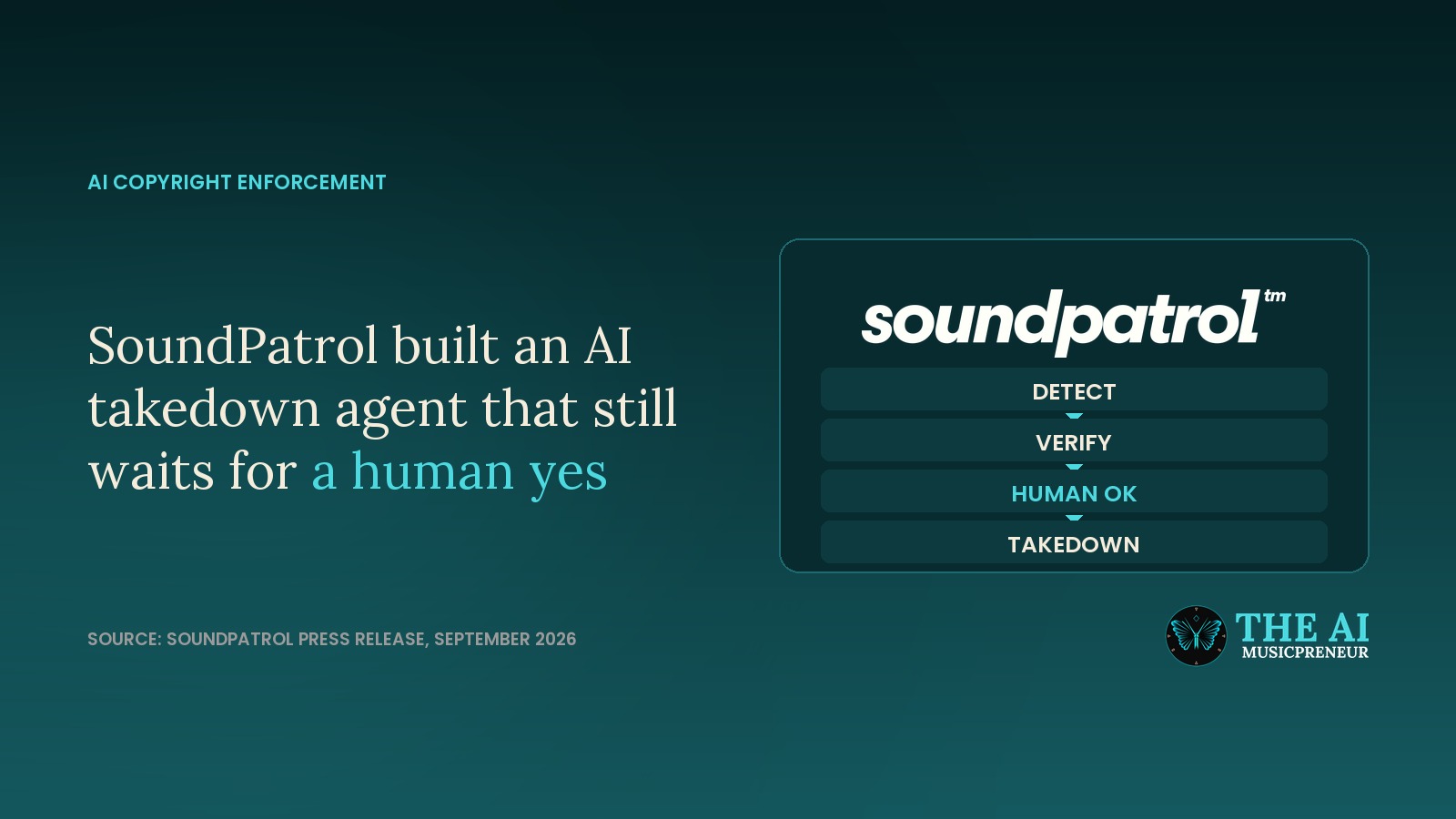
SoundPatrol introduced an AI takedown agent for music copyright infringement, software that finds a suspected infringing file, verifies it, then prepares, queues and tracks the removal request with the platform hosting it. The Santa Monica lab, co-founded by Michael Ovitz and Stanford adjunct professor Walter De Brouwer, already sells the detection half: its neural fingerprinting models went live with Universal Music Group and Sony Music in September 2025. The new piece is what happens after a match. One constraint sits in the middle of it: a person has to approve every request before it sends.
That matters because the volume argument is settled. Deezer says it flags tens of thousands of fully AI-generated uploads a day, and the enforcement side of the industry has not scaled anywhere near that fast.
What SoundPatrol’s takedown agent does after a fingerprint match
Detection produces a list. Somebody then has to look at each item, decide it is worth acting on, write the notice, send it to the right platform, and chase the status. That last stretch is where rights holders lose time, and it is the stretch SoundPatrol says the agent takes over. The company describes it as being able to jumpstart, automate and scale the work of identifying, verifying and removing infringing music content across digital platforms.
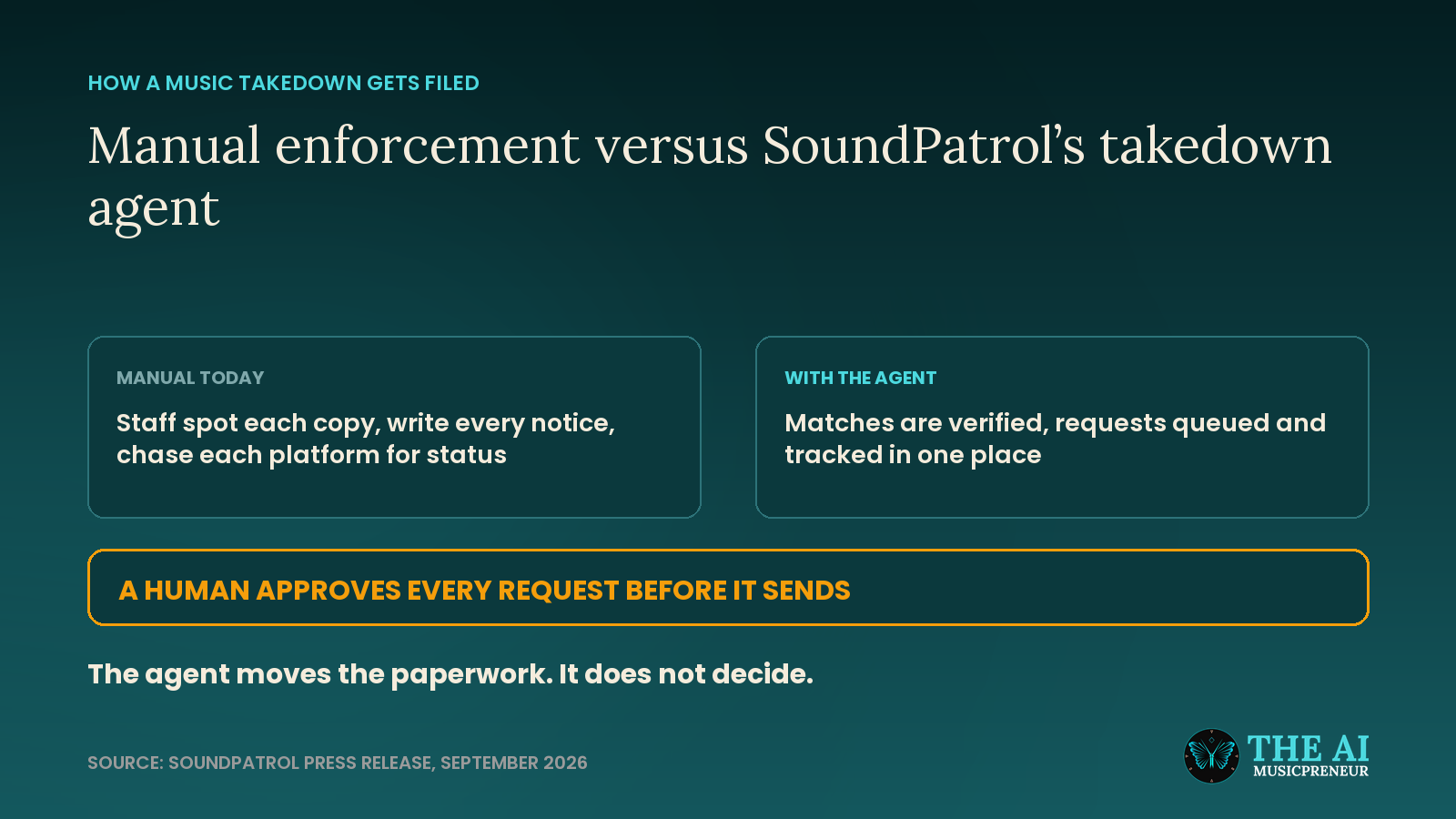
Detection alone isn’t enough. Rights holders need the ability to act quickly and at scale. SoundPatrol’s new takedown agent closes that gap by bringing automation and intelligence into the enforcement process.
The detection layer underneath is the part that already has label buy-in. SoundPatrol’s neural fingerprinting reads musical semantics rather than matching a file against a reference copy, which is how it claims to catch covers, remixes and generative rewrites that classic fingerprinting misses. My earlier coverage of Deezer licensing its own detector showed the same pattern: detection gets productised first, enforcement follows years later.
Why SoundPatrol keeps a person approving every takedown
Automated enforcement has a failure mode, and it is not a rumour. Wrongful takedowns hit the wrong uploader, and a system that files at machine speed makes mistakes at machine speed too. Keeping a human on the approve button is SoundPatrol’s answer, and it also keeps the legal responsibility where it already sits, with the rights holder that signs the notice.
What the announcement leaves open: there is no launch date, no pricing, no named rights holder running it in production, and no accuracy figure for the verification step. For a lab whose customers are the same majors currently suing distributors over AI uploads, those numbers are the ones that decide whether this becomes infrastructure or a demo. Worth noting too: SoundPatrol is being sued by Lucas Keller and Oak Felder, who say they helped build the copyright-detection software behind the company without being paid for it, a case I covered in the $5M Milk & Honey complaint.
For independent artists, none of this is a product they can buy yet. Enforcement tooling gets built for catalogs big enough to justify the licence, which is why the IFPI Streaming Integrity Initiative matters more for indies right now: it pushes the checks upstream to distributors, before an infringing upload ever needs a takedown.
Frequently asked questions
What is the SoundPatrol takedown agent?
The SoundPatrol takedown agent is software that takes a suspected music copyright infringement, verifies it, then prepares, queues and tracks the removal request with the platform hosting the file. It sits on top of SoundPatrol's neural fingerprinting detection rather than replacing it. A human has to approve each request before it goes out.
Does the SoundPatrol takedown agent file takedowns automatically?
No. SoundPatrol says the agent automates the administrative workflow of a takedown request, but all requests must be approved by a human before proceeding. The agent handles the drafting, queueing and status tracking, and the rights holder still makes the call on each individual case.
Who founded SoundPatrol?
SoundPatrol Inc. is a Santa Monica research lab co-founded by Michael Ovitz and Stanford adjunct professor Walter De Brouwer, who serves as CEO. The lab works on large music models, neural fingerprinting, audio forensics and provenance technology, and announced a neural fingerprinting collaboration with Universal Music Group and Sony Music in September 2025.
How is SoundPatrol's neural fingerprinting different from normal audio fingerprinting?
Traditional fingerprinting matches a recording against a reference copy, so a cover, a remix or an AI rework can slip past it. SoundPatrol's neural fingerprinting uses embeddings that capture musical semantics, which lets it flag transformations of a work rather than only exact copies. That is the detection layer the new takedown agent acts on.
About the author

Covering AI music tools, industry shifts, and news for music creators and professionals. Twice-weekly newsletter at aimusicpreneur.com.