AudioShake now writes the first draft of a cue sheet inside Music Reports' Cuetrak
My stack My fav 6 tools for AI music after testing 70+
-
 ElevenMusic · Music generation
 -
 Moises · Stem separation
 -
 Controlla · Voice swap & cloning
 -
 Cryo Mix · Mixing + mastering
 -
 Neural Frames · Music videos
 -
 ONCE · Distribution
Some links are affiliate links — I earn a commission at no cost to you. Every tool here is one I run myself and truly believe in. This stack is proven.
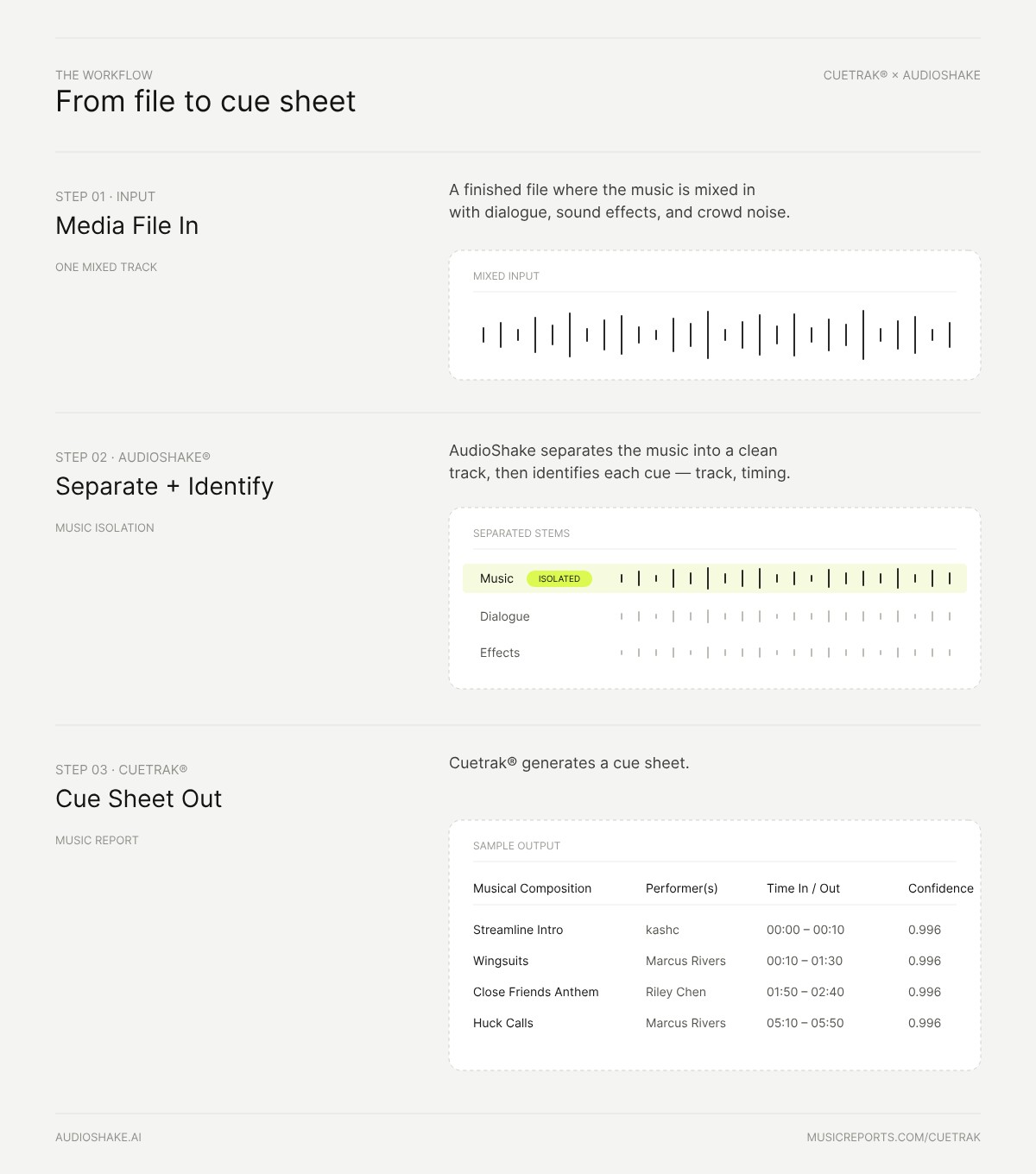
Music Reports has wired AudioShake into Cuetrak, its cue sheet platform. A user uploads a media file and gets a draft cue sheet back instead of starting from an empty page.
The work this removes is the part that used to take the longest. Someone had to sit with the content, find every piece of music by ear, and write down what it was and how long it ran.
A cue sheet is the log of every piece of music in a production, with timings and rights holders. Performing rights organisations use it to decide who gets paid, so a cue nobody wrote down generates no payment for anyone.
How AudioShake identifies a cue buried in a finished mix
The reason this was hard is that finished audio is crowded. Music sits under dialogue, under sound effects, under crowd noise and commentary, and recognition systems get confused when all of it arrives at once.
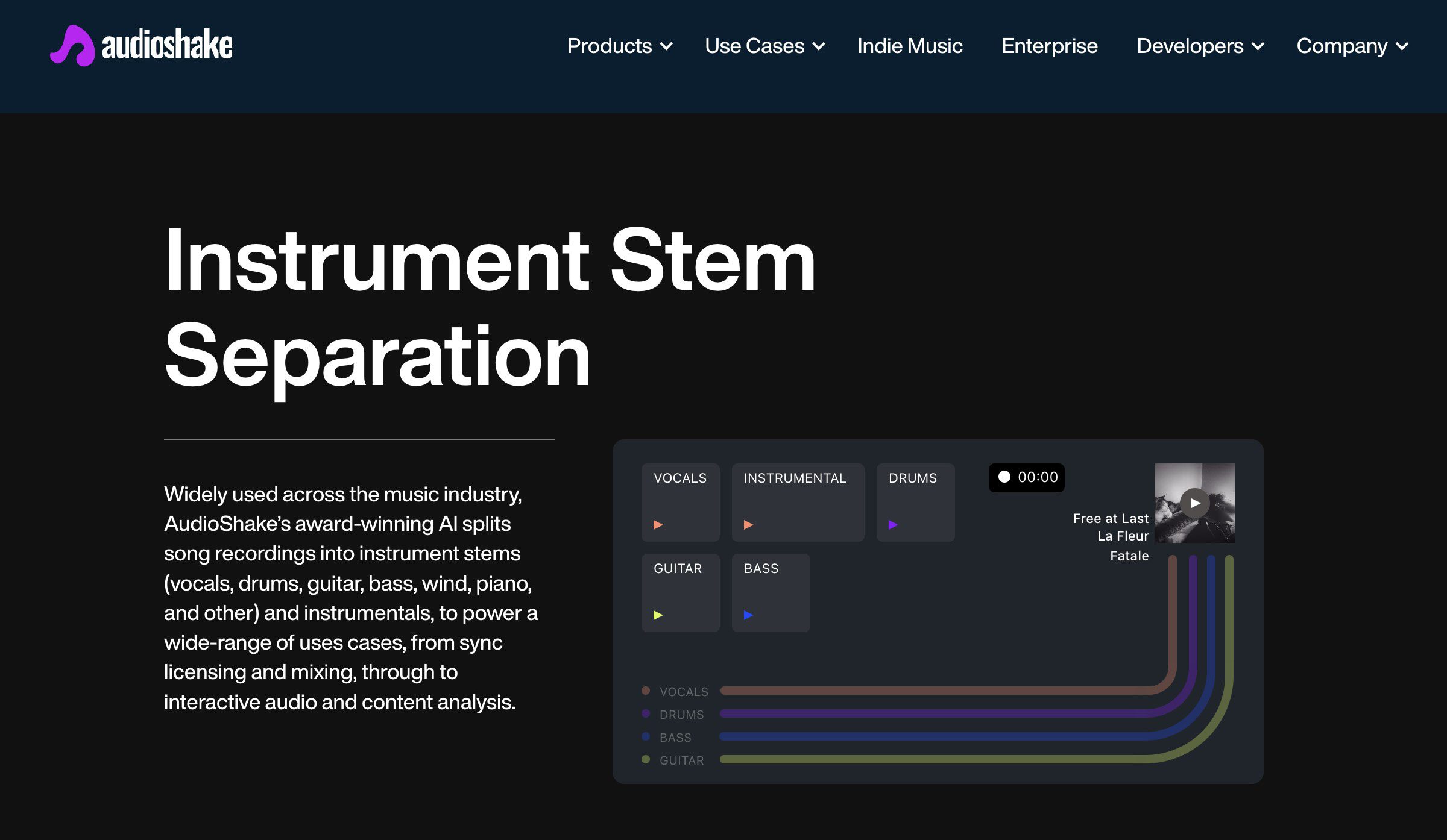
AudioShake separates the music out of the mix first. It then detects where music occurs, identifies the recording in each cue, and returns track information, timing and duration through its Copyright Compliance System.
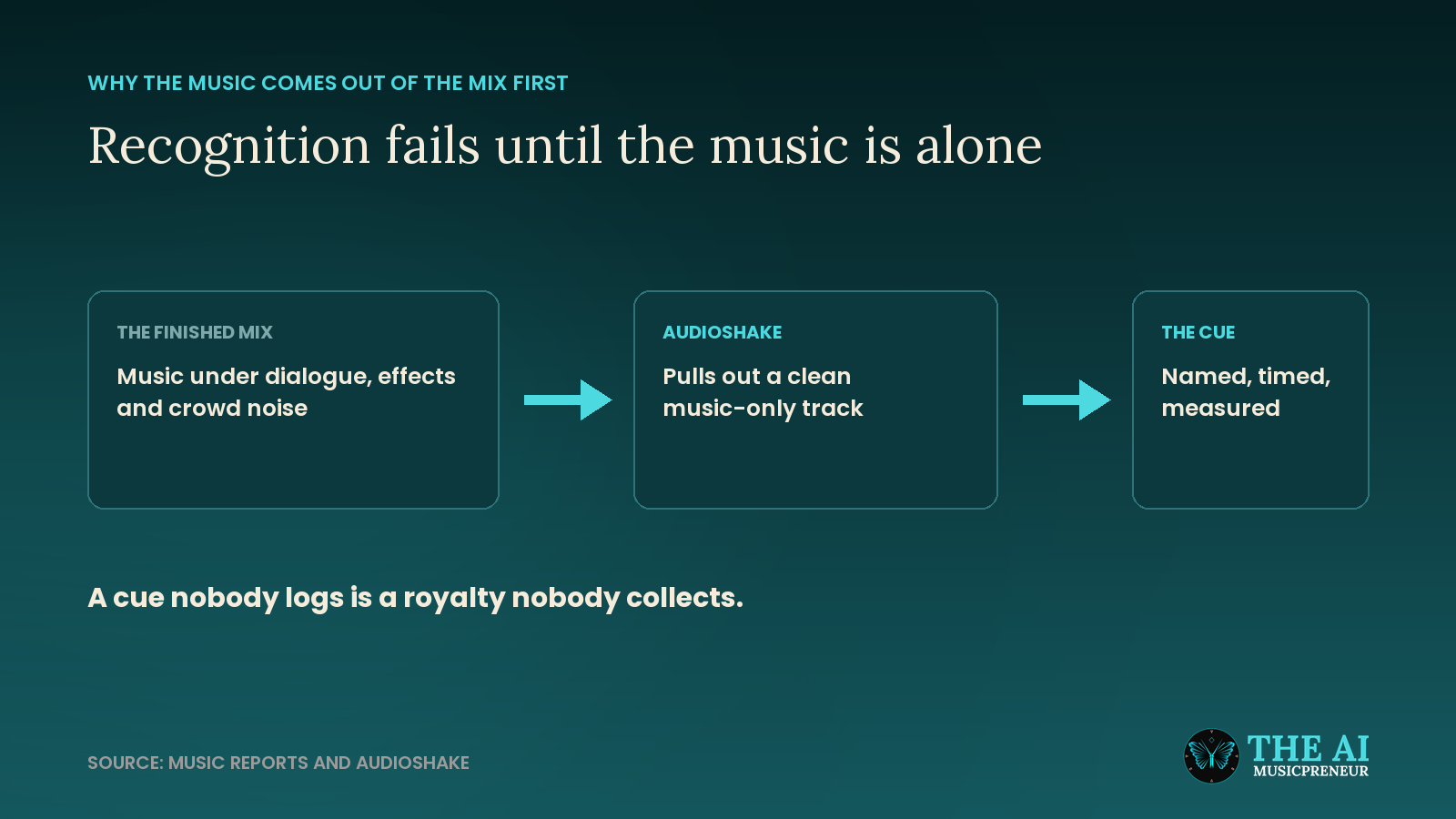
Cuetrak takes that data, adds the matching publishing information, and stages it as a cue sheet ready for review and distribution.
What Jason Walker says the integration changes
“Cue sheets are only as good as the data behind them, and identifying the recordings inside a piece of content has always been the hardest part of that work,” said Jason Walker, CEO of Music Reports.
He framed the gain as starting position rather than speed: a Cuetrak user can “upload a file and start from an accurate picture of what’s actually in it”.
The cases AudioShake’s founder Jessica Powell singled out are the awkward ones. A two-hour broadcast with hundreds of cues. Archival footage with no usable metadata. Noisy content where the music was never going to be easy to hear.
Where this sits next to AudioShake’s May 2026 launch
This is not a new product. AudioShake launched the Copyright Compliance System in May 2026, and Music Reports was already named as a live customer then, alongside ESPN and NFL Films.
What changed in September is that the capability became a button inside Cuetrak. Existing clients switch it on through their Music Reports contact, rather than building against an API themselves.
One caveat on sourcing. The Digital Music News piece announcing this is labelled as created in collaboration with Music Reports, so treat the framing as the vendors’ own. The mechanism is verifiable, the workflow claims are not independently tested.
Frequently asked questions
What does the AudioShake integration do inside Music Reports' Cuetrak?
A Cuetrak user uploads a media file and AudioShake isolates the music from the rest of the mix, detects where music occurs, and identifies the recording in each cue. It returns track information, timing and duration. Cuetrak then adds the publishing data and stages a draft cue sheet for review.
Why is separating the music first necessary to identify a cue?
In a finished mix, music sits under dialogue, sound effects, narration and crowd noise. Recognition systems struggle when those layers compete with the music. AudioShake pulls a clean music-only version out of the mix, so the identification step runs on the music rather than the whole soundtrack.
Who can use the AudioShake-powered cue sheet workflow in Cuetrak?
Existing Cuetrak clients, who enable it in the platform by asking their Music Reports contact. AudioShake also sells the underlying Copyright Compliance System directly through an API and SDK for teams building their own rights or reporting workflows.
What is a cue sheet and why do missing cues cost money?
A cue sheet is the log of every piece of music used in a production, with timings and rights holders, and performing rights organisations use it to decide who gets paid. A cue that nobody logged generates no payment, so the money sits unallocated in what the industry calls the black box.
About the author

Covering AI music tools, industry shifts, and news for music creators and professionals. Twice-weekly newsletter at aimusicpreneur.com.