AudioShake launches Copyright Compliance System, one week after BMI buys Soundmouse
My stack My fav 6 tools for AI music after testing 70+
-
 ElevenMusic · Music generation
 -
 Moises · Stem separation
 -
 Controlla · Voice swap & cloning
 -
 Cryo Mix · Mixing + mastering
 -
 Neural Frames · Music videos
 -
 ONCE · Distribution
Some links are affiliate links — I earn a commission at no cost to you. Every tool here is one I run myself and truly believe in. This stack is proven.
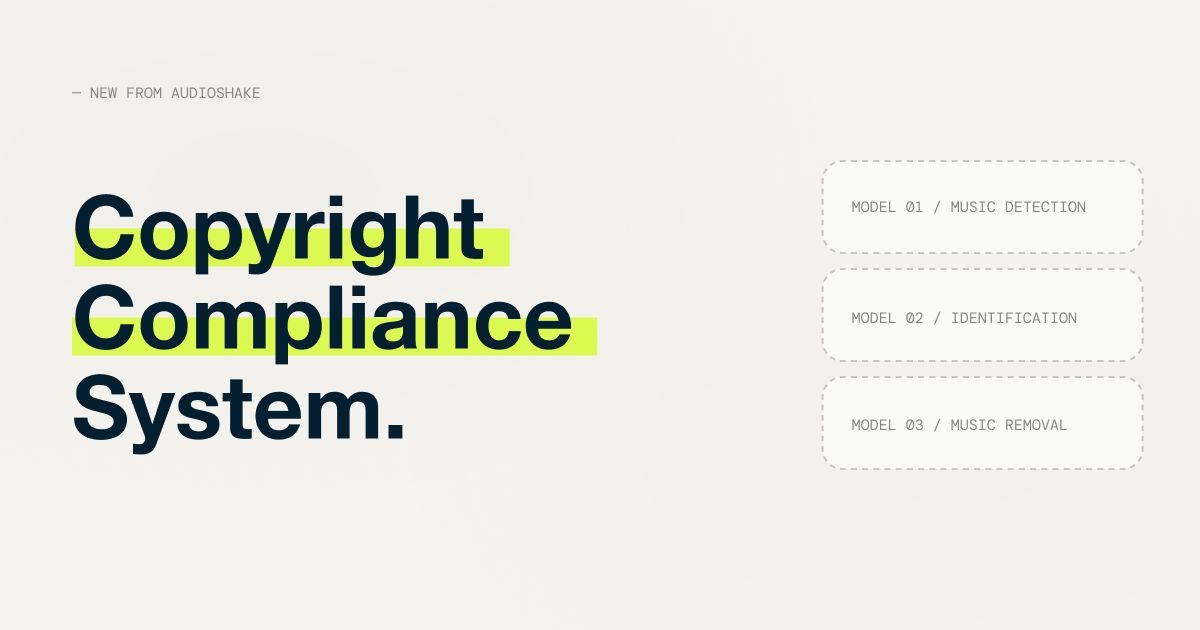
AudioShake launched its Copyright Compliance System on May 26, 2026. The new platform fuses three jobs that used to need separate vendors: detecting music inside a media file, identifying the composition and rights holder, and stripping the music cleanly while keeping dialogue and effects. CEO Jessica Powell announced the launch on the company’s LinkedIn, with ESPN, NFL Films, Music Reports Inc, CrunchLabs, Jaywalker Music, and amp sound branding already running on the API. The timing is sharp. It lands exactly one week after BMI agreed to buy Soundmouse from Orfium to consolidate the cue sheet market behind a single PRO.
How the three-step pipeline works
The Copyright Compliance System is modular. Teams can run the full pipeline or call any single module from inside an existing workflow. Detection flags music inside any file. Identification names the composition and the rights holder, then auto-generates cue sheets at the file level. Removal strips the music while preserving dialogue, crowd noise, and effects, running on AudioShake’s NVIDIA Dynamo-Triton stack through the company’s Inception partnership.
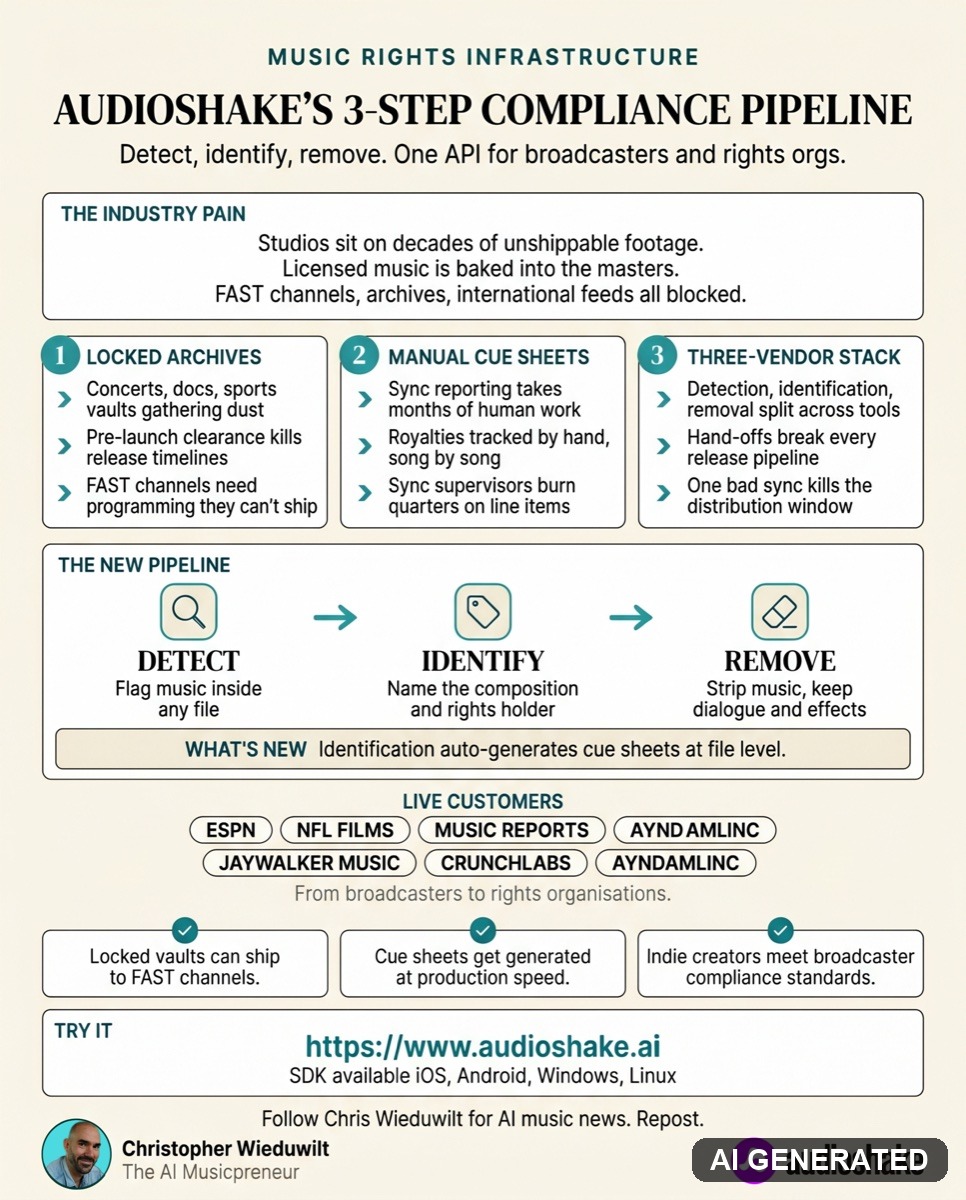
The new layer versus the December 2025 SDK is identification. December shipped detection and real-time removal. The 2026 release wires in artist, song title, album, label, release date, and ISRC per detected segment, then exports cue sheets in formats compatible with ASCAP, BMI, SESAC, and PRS submissions. Music Reports Inc, which launched its own cloud cue sheet product Cuetrak in April, is named as a formal partner on the identification pipeline.
Beyond the headlines: where the moat actually sits
The industry pain is concrete. Studios, broadcasters, and sports leagues sit on decades of footage they cannot release because licensed music is baked into the master. FAST channels alone are projected to reach $18B in annual revenue by 2028 across 1,500-plus US channels and roughly 6,000 globally, and every uncleared track stalls a feed. Sync rights reporting has historically taken months of human work, song by song. Soundmouse, the platform BMI is acquiring, claims its audio recognition cuts that admin by 83 percent. AudioShake is targeting the same workflow with a different commercial shape.
Identification is the actual shift. The same step that lets ESPN clear a vault archive is the one that lets a rights organisation surface uncleared sync uses that previously went unpaid. The customer list reflects both sides of the trade, spanning broadcasters (ESPN, NFL Films, CrunchLabs) and rights infrastructure (Music Reports Inc, Jaywalker Music). One of those case studies is concrete: Jaywalker replaced more than 200 expired tracks across legacy TV catalogs using the pipeline.
What the launch actually changes:
- Three-vendor stacks collapse. Detection, identification, and removal were historically separate procurement contracts across players like ACRCloud, Audible Magic, and Vobile-owned Pex. One API now replaces all three for the broadcaster compliance case.
- Cue sheets move from quarterly manual report to file-level API output. Royalty tracking becomes a programmatic feed, not a sync supervisor’s spreadsheet.
- The platform layer stays open. BMI’s Soundmouse buy consolidates cue sheets inside a PRO. AudioShake is keeping the API neutral so any rights platform, including Music Reports’ Cuetrak, can plug in.
What this means for music creators and supervisors
If you are an indie creator producing for broadcaster compliance standards, this lowers your floor. Compliance has been a paid-vendor problem. The AudioShake API and SDK move it into reach for distribution-tier creators without legal teams or vendor contracts. Same identification and removal capabilities sit behind indie.audioshake.ai for the consumer tier.
If you run a music supervision shop, cue sheet generation is the part of your workflow that is about to be automated first. The labor disappears. The judgment, the negotiation, and the rights-clearance relationships do not. Where this gets uncomfortable is on the back-cataloging side. Programmatic identification at file level means rights orgs can scan years of social distribution that previously went unreported, then bill against it.
The take
The story underneath the press release is not the three-step API. It is the timing. One week after BMI moves to consolidate cue sheets behind a PRO, AudioShake is positioning identification plus cue sheet generation as an open layer any platform can call. The Powell line from her December 2025 Sports Video Group interview still tracks: AudioShake’s tools are for partners “to reimagine what’s possible with their existing content.” Identification is what makes the existing content shippable. That is the part that changes who gets paid, and how fast.
Frequently asked questions
What is the AudioShake Copyright Compliance System?
The AudioShake Copyright Compliance System is a single API pipeline that detects copyrighted music inside any media file, identifies the composition and rights holder, and removes the music while keeping dialogue, crowd noise, and effects intact. Teams can run the full stack or call any single module from inside an existing workflow.
What does AudioShake's Copyright Compliance System identify per music segment?
For every detected segment, the AudioShake Copyright Compliance System returns the artist, song title, album, label, release date, and ISRC. The output exports in formats compatible with ASCAP, BMI, SESAC, and PRS cue sheet submissions. Music Reports Inc is a formal partner on the identification pipeline.
How is the AudioShake Copyright Compliance System different from the December 2025 SDK?
The December 2025 SDK shipped real-time music detection and removal. The May 2026 Copyright Compliance System layers identification on top, which is what auto-generates the cue sheet output. Detection and removal already existed in the SDK. Identification is the new piece in the 2026 release.
Which broadcasters and rights organisations use AudioShake's Copyright Compliance System?
ESPN, NFL Films, CrunchLabs, Jaywalker Music, Music Reports Inc, and amp sound branding are running on the AudioShake Copyright Compliance System in production. The ICP is broadcasters, sports leagues, FAST channel operators, sync rights organisations, and distributors prepping content for international markets.
How does the AudioShake Copyright Compliance System compare to BMI's Soundmouse acquisition?
BMI agreed to acquire Soundmouse from Orfium on May 19, 2026, to consolidate cue sheet management inside a single PRO. AudioShake's launch one week later positions identification plus cue sheet generation as an open API any rights platform can plug into, including BMI competitor Music Reports and its Cuetrak product.
About the author

Covering AI music tools, industry shifts, and news for music creators and professionals. Twice-weekly newsletter at aimusicpreneur.com.