Tyrese Gibson put Claude and ChatGPT on a voice call to chase royalties from 7,500 companies

My stack My fav 6 tools for AI music after testing 70+
-
 ElevenMusic · Music generation
-
 Moises · Stem separation
-
 Controlla · Voice swap & cloning
-
 Cryo Mix · Mixing + mastering
-
 Neural Frames · Music videos
-
 ONCE · Distribution
Some links are affiliate links — I earn a commission at no cost to you. Every tool here is one I run myself and truly believe in. This stack is proven.
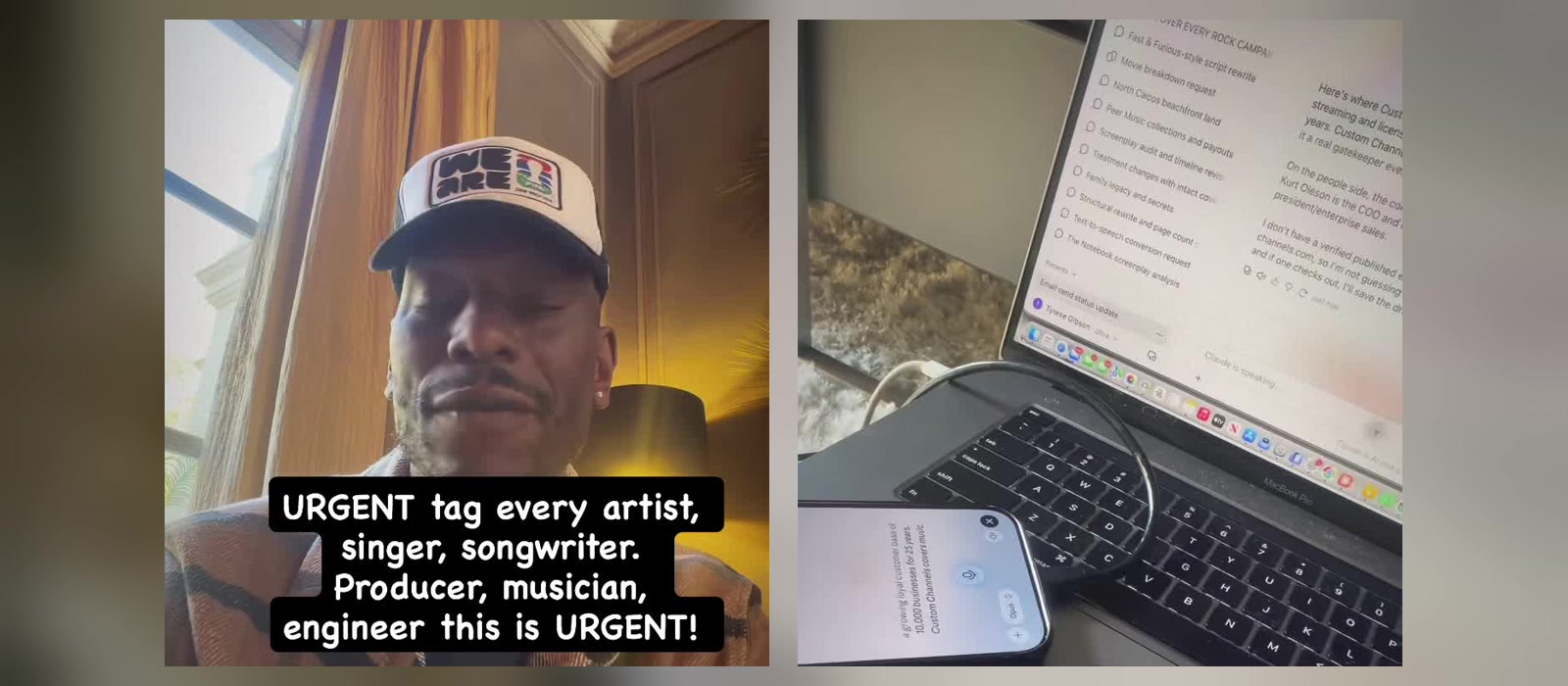
Tyrese Gibson has 3 AI assistants talking to each other in his office, and he says they don’t stop at night. In a 14-minute Instagram video posted on November 16, 2026, he shows Claude on his MacBook, Claude on his iPhone and ChatGPT running what he calls “the royalty campaign”.
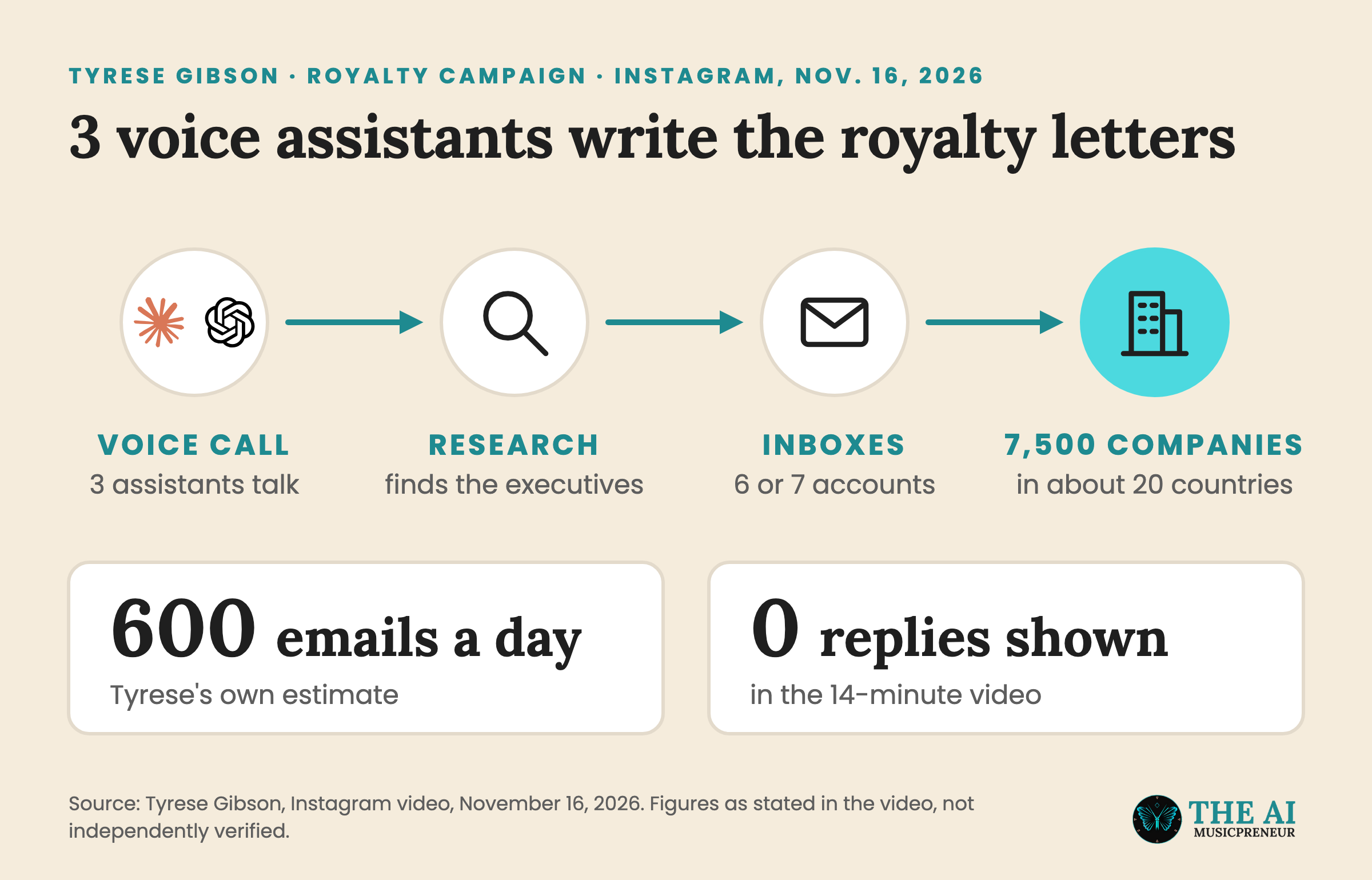
The goal is to find every company that has used his music, films and face, and ask each one what it paid and who it paid. He says the list holds about 7,500 companies, and that the assistants send about 600 emails a day from 6 or 7 inboxes.
“I am currently using AI in a way that nobody would ever think to use AI,” Gibson says at the start, with a caption telling every artist, songwriter, producer and engineer that it’s urgent. He’s been on the pro-AI side before: in August he defended an AI song against Bette Midler in her comments.
What Tyrese Gibson’s Claude and ChatGPT setup shows on camera
I watched the full video and paused on every screen. Here’s what is actually visible:
- The MacBook runs the Claude desktop app in voice mode, signed in as Tyrese Gibson on Claude’s Ultra plan, with a pinned chat that starts “TURN OVER EVERY ROCK CAMPAI…” and another called “Peer Music collections and payouts”.
- The iPhone runs the Claude app in voice mode, with Opus selected as the model.
- ChatGPT runs in voice mode too, but its device never shows clearly on camera.
Each assistant introduces itself when he asks. “Claude MacBook” says it leads research and drafting, “finding the right executives and building the letters”. The ChatGPT voice says it keeps “the threads straight” and checks earlier outreach so nobody gets emailed twice. “Claude iPhone” drafts letters to what the group calls gatekeepers.
The gatekeepers are the plan’s shortcut. Claude explains that companies supplying music and films to thousands of hotels, stores, airlines and karaoke bars at once are worth more than any single venue: “Reach one gatekeeper, and you can account for thousands of uses.”
It's not an attack, it's transparency.
What the video doesn’t show is how the assistants get their work done. Anthropic’s help center says Claude’s voice mode can use web search and connected tools like Gmail, which would fit the assistants talking about saved drafts and outreach history. But nobody on screen names a connector, an instruction file or a data source, and no sent email or reply is shown. The same goes for Gibson’s claim that one AI “takes over the desktop” to restart a dropped call.
Where royalties for Tyrese Gibson’s songs in hotels and stores come from
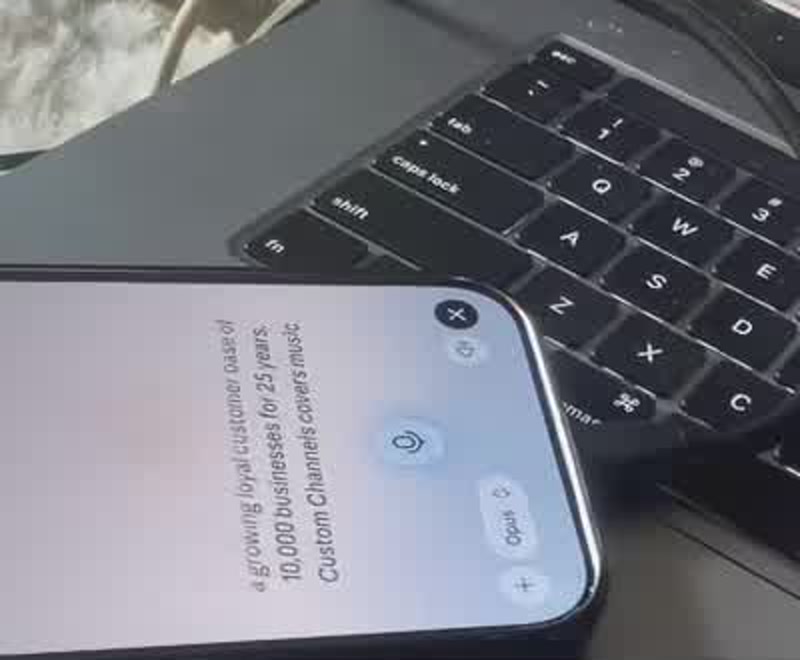
The most useful moment in the video is a live check on one gatekeeper. Claude looks up Custom Channels, a Colorado business music service, and reads out its leaders: Joe Comer and Kurt Oleson, who bought the company in 2025. Most of that checks out, although I couldn’t confirm the “10,000 businesses” figure Claude quotes.
What Claude doesn’t mention is on Custom Channels’ own help center. The company says its monthly fee includes licences from ASCAP, BMI, SESAC, GMR and SoundExchange. So in the US, a song playing in a hotel lobby through Custom Channels has already been paid for, through 2 pipes:
- The song itself goes through ASCAP, BMI, SESAC and GMR, which pay registered songwriters and publishers.
- The recording goes through SoundExchange, which collects from background music services under a statutory licence and pays the registered labels and artists.
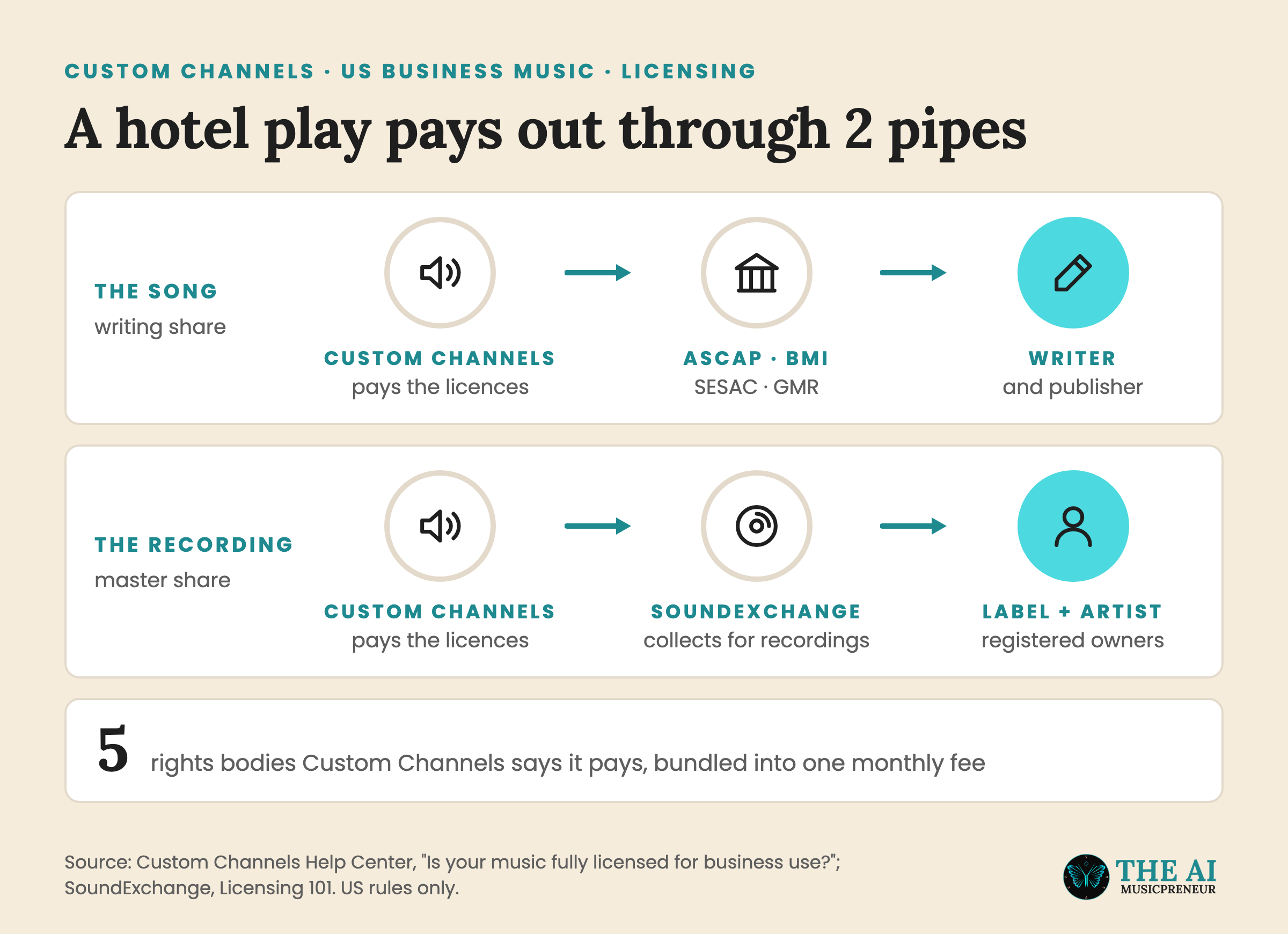
That changes what a letter to Custom Channels can achieve. The likely answer to “what did you pay, and who did you pay” is the list of collecting bodies. Whether that money reaches Gibson then depends on his registrations with them, not on the supplier.
Film and TV money moves through other channels again. Gibson himself says actors “might just know about Screen Actors Guild”, and the assistants mention drafts to hotel and in-flight entertainment suppliers. Collecting bodies already handle billions: CISAC counted a record €15.5bn in creator royalties for 2025.
Gibson ends the video confident. “It’s gonna be a good Christmas,” he says. If you want to try a smaller version of this yourself, start with the Claude connectors musicians actually use, and look up how your own PRO and SoundExchange registrations stand before you write to anyone.
Frequently asked questions
What AI tools is Tyrese Gibson using for his royalty campaign?
In his November 16, 2026 Instagram video, Tyrese Gibson runs the Claude desktop app in voice mode on a MacBook, the Claude iPhone app in voice mode with Opus selected, and ChatGPT in voice mode. He hasn't said which connectors, instruction files or data sources the assistants use.
How many companies is Tyrese Gibson's AI royalty campaign contacting?
Tyrese Gibson says his team mapped about 7,500 companies in roughly 20 countries, including streaming services, film studios, distributors and businesses that supply music to hotels and airlines. He says the assistants send about 600 emails a day from 6 or 7 email accounts. None of those emails or replies appear in the video.
Does Custom Channels pay royalties for the music it streams into businesses?
Custom Channels says its monthly fee includes licences from ASCAP, BMI, SESAC, GMR and SoundExchange. That means the money for US business plays goes to those collecting bodies, which then pay registered writers, publishers, labels and artists.
Can Claude's voice mode use Gmail and web search?
Yes. Anthropic's help center says Claude's voice mode can use web search and connected tools like Gmail, Google Calendar, Google Docs and Slack, and that connected tools work the same way as in text chat.
About the author
Covering AI music tools, industry shifts, and news for music creators and professionals. Twice-weekly newsletter at aimusicpreneur.com.