Udio lost 60% of its traffic after going legal. Suno grew.
My stack My fav 6 tools for AI music after testing 70+
-
 ElevenMusic · Music generation
 -
 Moises · Stem separation
 -
 Controlla · Voice swap & cloning
 -
 Cryo Mix · Mixing + mastering
 -
 Neural Frames · Music videos
 -
 ONCE · Distribution
Some links are affiliate links — I earn a commission at no cost to you. Every tool here is one I run myself and truly believe in. This stack is proven.
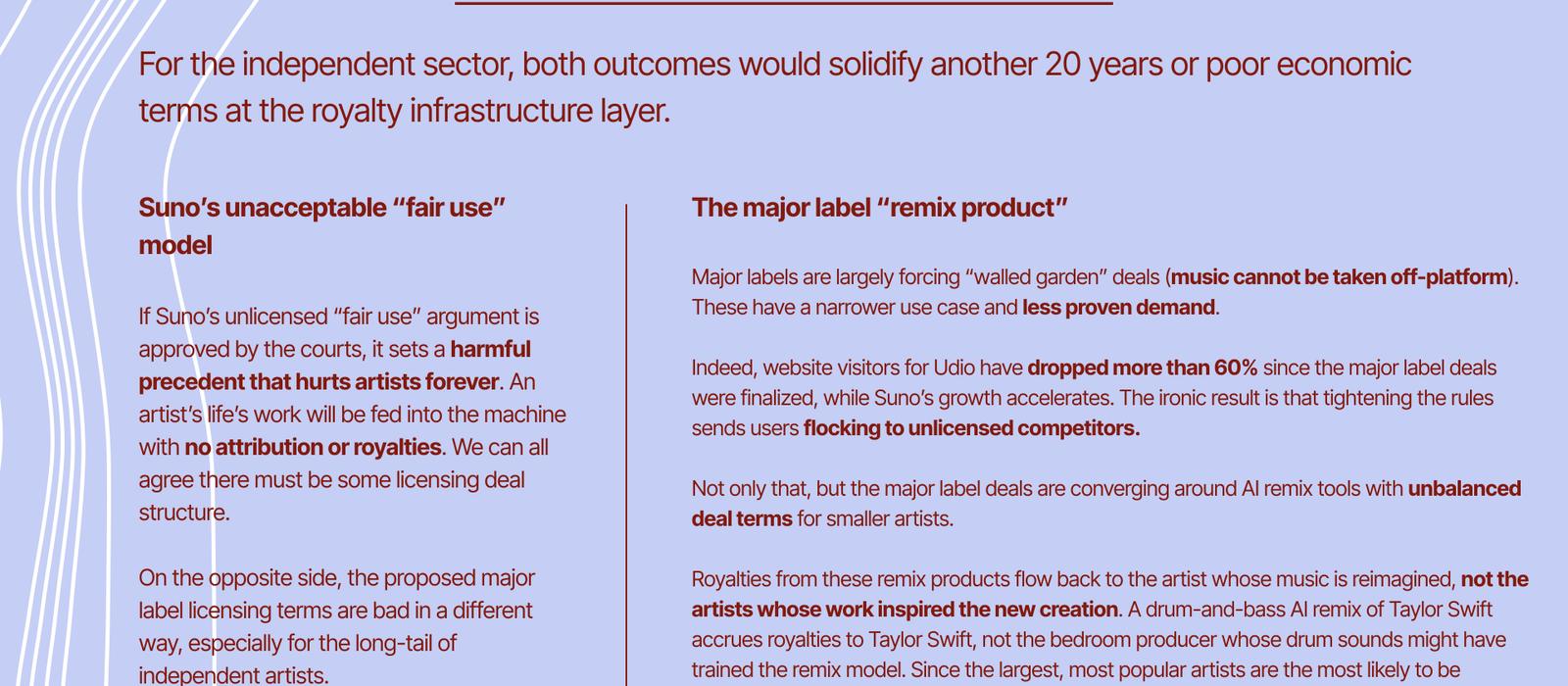
The story the industry tells itself is that Udio did the right thing and Suno didn’t. Udio settled with Universal and Warner, licensed the catalog, and rebuilt its product around consent. Suno kept arguing fair use and kept getting sued.
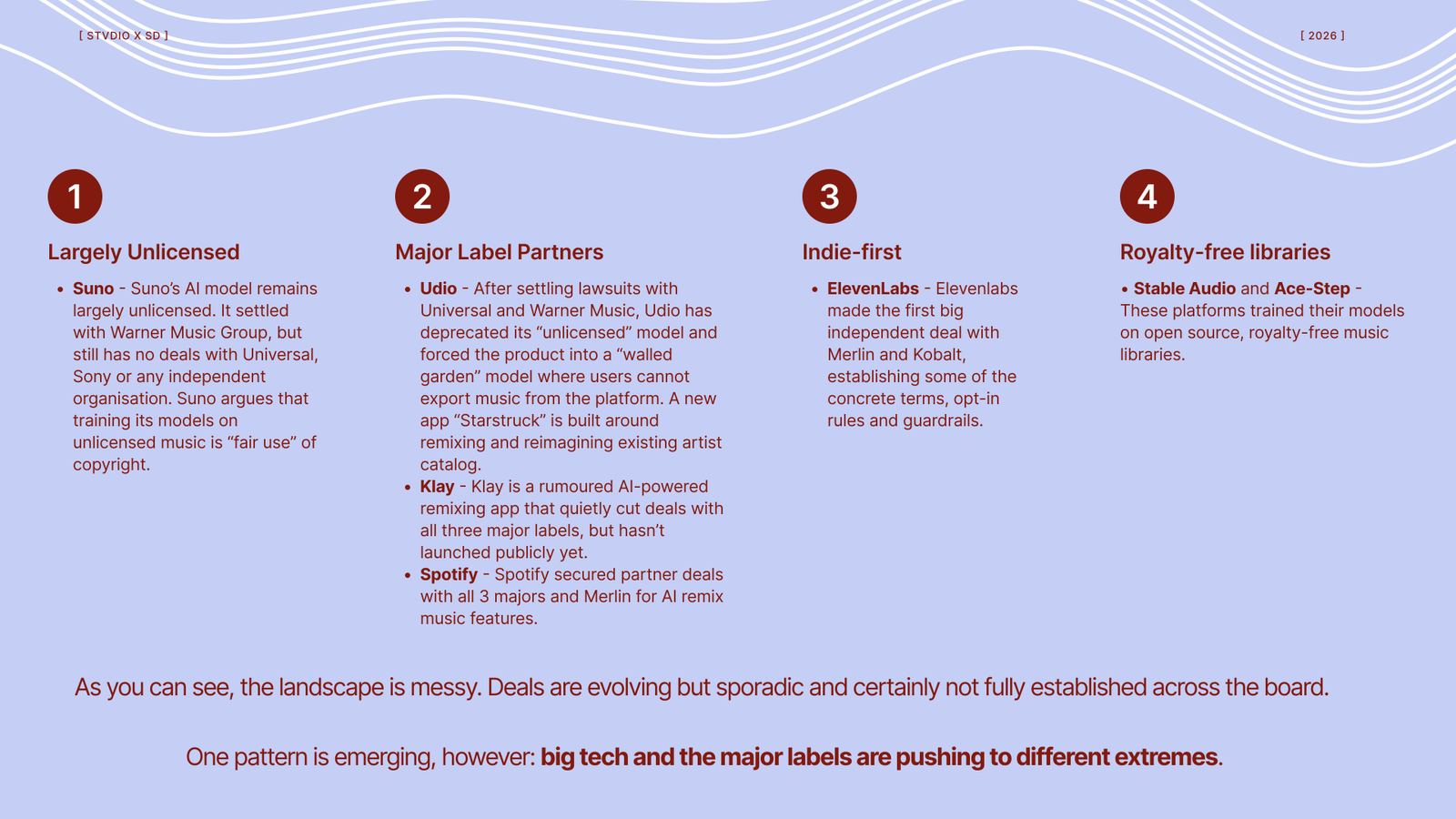
Then the Independent Music 2026 report put a number on what happened next. Udio’s website visitors dropped more than 60% after the label deals were finalised. Suno’s growth accelerated. Doing the right thing, on the terms the majors set, emptied the room.
What Udio gave up to get licensed
The deals came with a product. That’s the part that gets lost.
When Udio settled with Warner and Universal, it retired the model it had trained without permission and moved to what the report calls a walled garden. You can make music inside Udio. You can’t take it out. No download, no stems, no dropping the track into your DAW or your distributor.
A new app called Starstruck sits alongside it, built around remixing and reimagining existing artist catalog, which the AFM has already pulled into its lawsuit against the labels.
Suno went the other way. It settled with Warner and signed a global deal with BMG, but its model stays largely unlicensed, it still argues fair use, and the downloads never stopped. This week it picked up a lawsuit from Canada’s SOCAN over exactly those outputs.
Why the 60% number is the report’s, and what I can and can’t verify
I need to be straight about the number before I build on it.
The report says Udio’s visitors dropped more than 60% since the deals were finalised. It doesn’t name the traffic source, and Udio hasn’t published its own figures. I can’t verify it, and I’ve looked. What I can say is that it matches everything else in view: a product that stopped letting people keep what they made, and a competitor that never stopped.
So treat the 60% as a claim from a credible report, not a measured fact. The shape of the argument survives even if the number lands at 40.
The walled garden failed because it solved the labels’ problem, not the user’s
Here’s the uncomfortable part for the people who cheered the Udio deals, and I was one of them.
The deals solved a legal problem. Universal and Warner got paid, got control over what their catalog trains, and got a product built around their biggest artists. None of that touches the reason a person opens an AI music tool, which is to make a thing they can use.
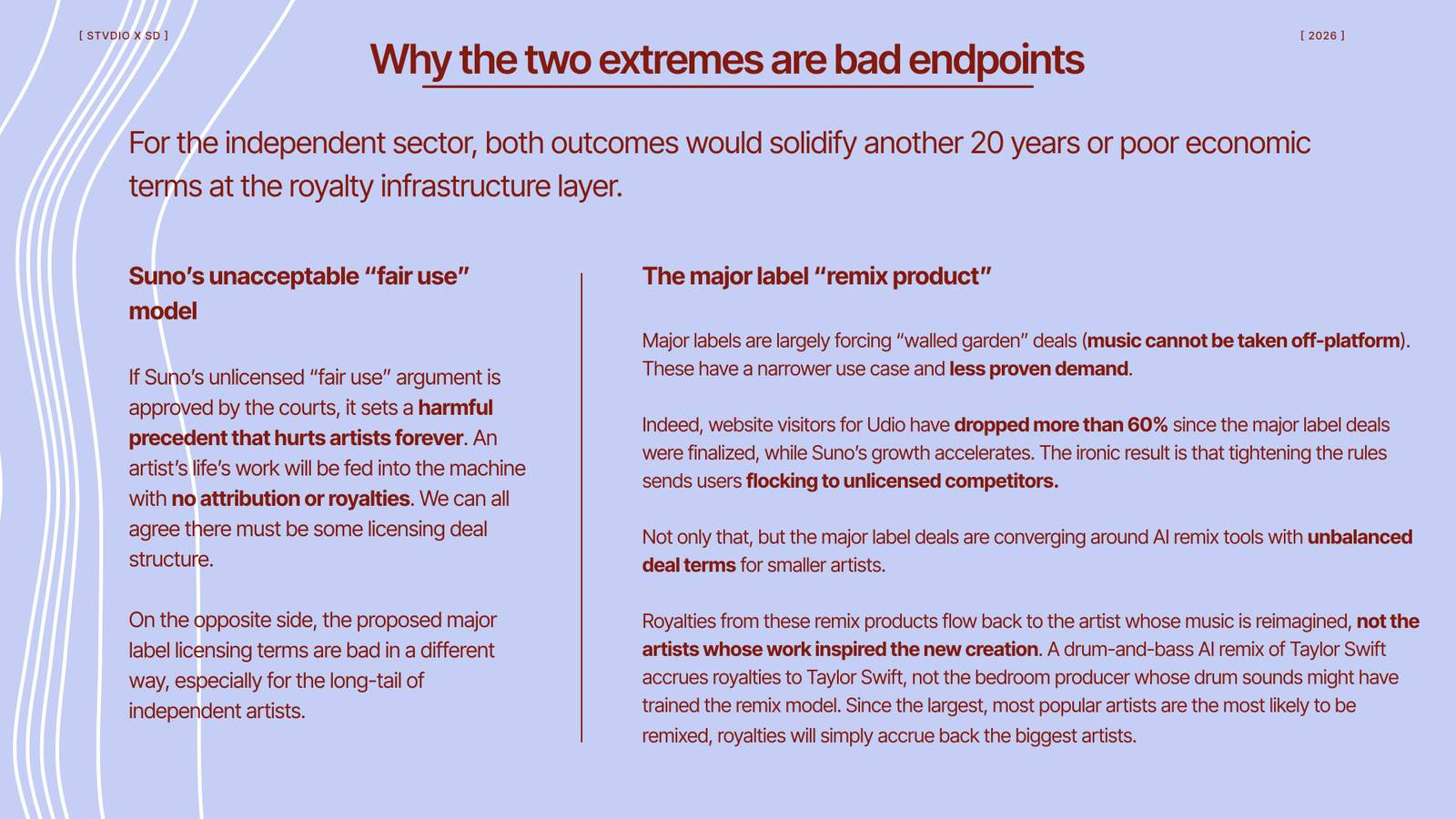
The royalty flow makes it worse. Under the remix deals the report describes, a drum and bass AI remix of Taylor Swift pays Taylor Swift, not the bedroom producer whose drum sounds may have trained the remix model. The most-remixed artists are the biggest ones, so the money pools at the top by design.
The ironic result is that tightening the rules sends users flocking to unlicensed competitors.
The case that Suno’s growth proves nothing, and where it’s right
The counterargument writes itself. Of course the unlicensed tool grew. Free always beats fair, users don’t care about consent, and a traffic chart says nothing about what’s legal or what lasts.
Most of that is true. Suno is carrying lawsuits from three collecting societies, the majors, indie labels and now a class of artists suing over their identities. The GEMA ruling in Munich went against it. A growth curve built on unsettled law is not a business model, and I wouldn’t bet a catalog on it.
Where the counterargument fails is the conclusion it wants you to draw, which is that the walled garden was the only alternative. It wasn’t. ElevenLabs licensed from Merlin and Kobalt on opt-in terms with no export restriction and no legal overhang, and the report says new products can build on top of that model. Licensed and useful was available. The majors chose licensed and locked.
Where this goes, and what I’d watch
I’ve said for a year that you can’t vote a technology away, and that the artists who do well serve both the cautious and the all-in rather than picking a tribe. This stat is what that looks like in a traffic chart. The cautious got a licensed tool they can’t use. The all-in got an unlicensed tool they can. Neither got the thing that should exist.
Three things will tell you whether that changes:
- Whether Udio adds export back, in any form, to the licensed product
- Whether the NMPA’s industry-wide Udio and Klay terms keep the same walled shape
- Whether the ElevenLabs opt-in rate among independents moves off its current floor
For your own work, the practical read hasn’t changed. A tool that keeps your output is worth more than a tool that keeps your conscience clean and your files hostage, and the one that does both is the one to go looking for. Right now that isn’t Udio, and it isn’t Suno either.
Frequently asked questions
Why did Udio's traffic drop after its Universal and Warner deals?
The Independent Music 2026 report attributes the drop of more than 60% in website visitors to the product changes that came with the deals. Udio retired its unlicensed model and moved to a walled garden, meaning users can no longer export the music they make, and the report says that narrower product has less proven demand.
What is Udio's walled garden model?
After settling with Universal and Warner, Udio deprecated its earlier model and rebuilt the product so that generated music stays on the platform. Users can listen, share and remix inside Udio but cannot download the audio for use elsewhere. The report also notes a new remix app called Starstruck built around reimagining existing artist catalog.
Is the Udio 60% traffic drop figure verified?
No. The figure comes from the Independent Music 2026 report by Stvdio and Secretly Distribution, which does not name the traffic data source. It's consistent with the product changes and with Suno's reported growth, but treat it as the report's estimate, not a measured number from Udio.
Who do royalties go to when someone makes an AI remix of a major label song?
Under the major label remix deals the report describes, royalties flow to the artist whose song is being remixed. The report's example is a drum and bass AI remix of Taylor Swift, which pays Taylor Swift and not the producer whose drum sounds may have trained the remix model. Because the biggest artists get remixed most, the money concentrates at the top.
About the author

Covering AI music tools, industry shifts, and news for music creators and professionals. Twice-weekly newsletter at aimusicpreneur.com.