Clinton Sparks and Johnny Gillespie hold a patent on AI mixing. Here's who actually needs a licence
My stack My fav 6 tools for AI music after testing 70+
-
 ElevenMusic · Music generation
 -
 Moises · Stem separation
 -
 Controlla · Voice swap & cloning
 -
 Cryo Mix · Mixing + mastering
 -
 Neural Frames · Music videos
 -
 ONCE · Distribution
Some links are affiliate links — I earn a commission at no cost to you. Every tool here is one I run myself and truly believe in. This stack is proven.
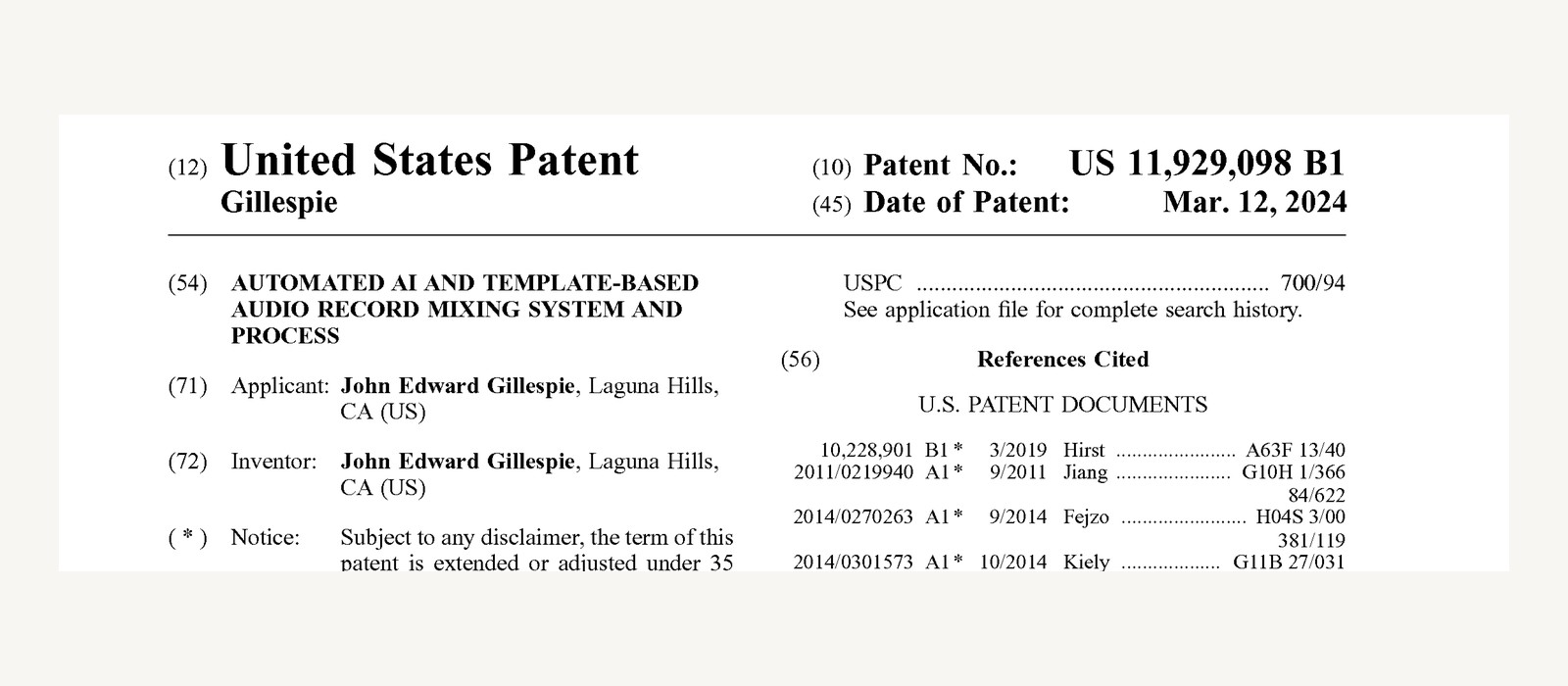
Grammy-nominated producer Clinton Sparks and technology strategist Johnny Gillespie own a US patent on using AI to mix music, and last week it picked up a fresh round of trade coverage. The patent is real. It is US 11,929,098, and the United States Patent and Trademark Office granted it on 12 March 2024.
It’s a mixing patent, so it covers AI doing the mixing of ordinary recorded tracks. That has nothing to do with mixing AI-generated songs. Which raises the question the coverage skipped: if 2 people own a patent on AI mixing, does every AI mixing and mastering tool now need a licence to stay compliant?
So I pulled the full patent from the USPTO and read all 17 claims. Almost nobody needs one, and the reason turns into a 4-step test you can run on any tool you use.
One detail to fix before anything else. The patent names John Edward Gillespie of Laguna Hills, California as the sole inventor. Sparks is listed as a co-owner, which is a different role from having invented the thing.
What US Patent 11,929,098 claims
A patent doesn’t protect an idea. It protects what its claims describe, and a competitor infringes only by doing every step one claim lists. Miss one step and you’re outside it.
This patent has 2 claims that stand on their own. The other 15 hang off those 2 and narrow them further.
Claim 1 is a process, and it’s a long one. A user uploads recorded tracks through a musician interface into a cloud service. They pick a file. They go to a template area and choose a sound template. They set extra options, like which instrument should sit forward. They hit a mixing tool, a time code unit lines up the timing across the tracks, an AI module builds the mixed master, and the service hands back a file to download.
Claim 6 is the same product written as a system, listing 9 parts that all have to be present, from the cloud server and the template database through to encrypted storage for the user’s audio. One dependent claim puts a blockchain in the storage layer.
That’s a specific product, described in detail, rather than a fence around AI mixing as a concept.
Strip out the legal wording and claim 1 turns into a 4-part test. A tool is caught only if it does all 4:
- Your audio goes up to a cloud service, not just onto your own computer.
- The service mixes your separate tracks and hands back a finished mix.
- You open a library of stored sound templates and pick one, and that pick drives the mix.
- It lines up the timing of your tracks and gives you a master to download.
Miss one of the 4 and you’re outside the patent. Not probably fine. Outside.
Why LANDR, Ozone and eMastered aren’t exposed
Step 2 rules most of them out on its own. The claims describe multi-track mixing, where you hand over the separate recorded parts of a song and the service balances them against each other.
Most tools people picture here do mastering instead, the final polish on an already-mixed stereo file. LANDR launched its mastering service in 2014 and eMastered followed in 2018. iZotope Ozone is older still and runs on your own machine, so it fails step 1 before anyone reaches the template library.
Then there’s timing. The Gillespie patent claims priority to a provisional filing from 20 January 2021, and automated multi-track mixing was patented and shipping years earlier. LANDR filed US 9,654,869, on autonomous multi-track audio processing, on 7 May 2013 with Queen Mary University of London. It’s still active and runs to 2033.
Older public work like that is called prior art, and it’s what a patent gets tested against. US law adds a second shield, 35 U.S.C. 273, protecting anyone already selling the same thing more than a year before the patent was filed. That covers every mixing and mastering service shipping before 2020.
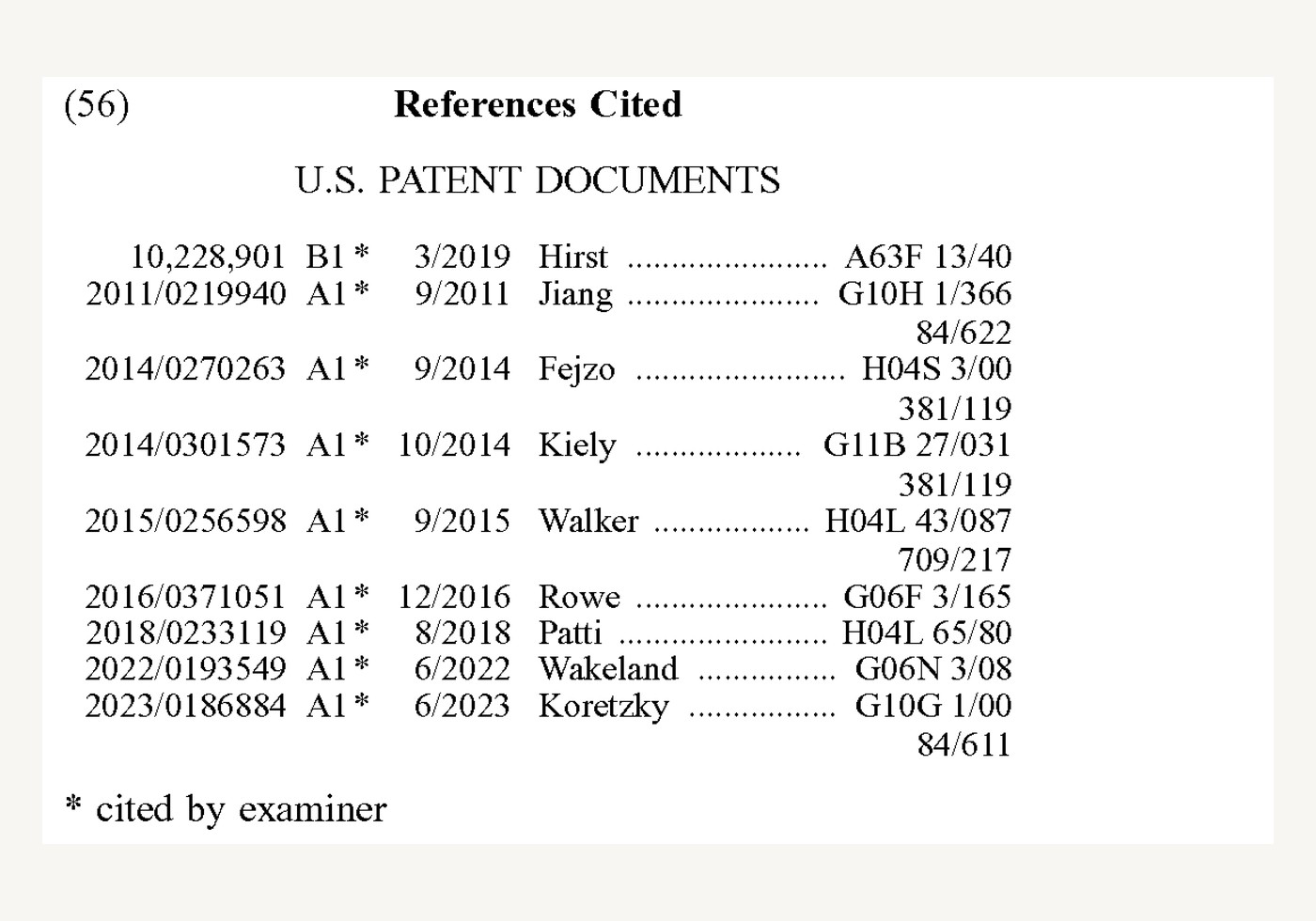
The face of the patent lists 9 references, every one found by the examiner rather than submitted by the applicant. LANDR’s 2013 filing isn’t among them. Neither is US 9,304,988 on automatic audio production, nor US 9,640,163 on automatic multi-channel mixing from stems. The full search record sits in the application file, so I can’t say the examiner never ran across them. I can say the closest work in the field isn’t printed on the patent.
Do Forte AI, Cryo Mix and RoEx need a licence?
Mastering tools are the easy case. The tools that actually mix sit in the patent’s own territory, so they’re worth running through the same 4 steps one at a time.
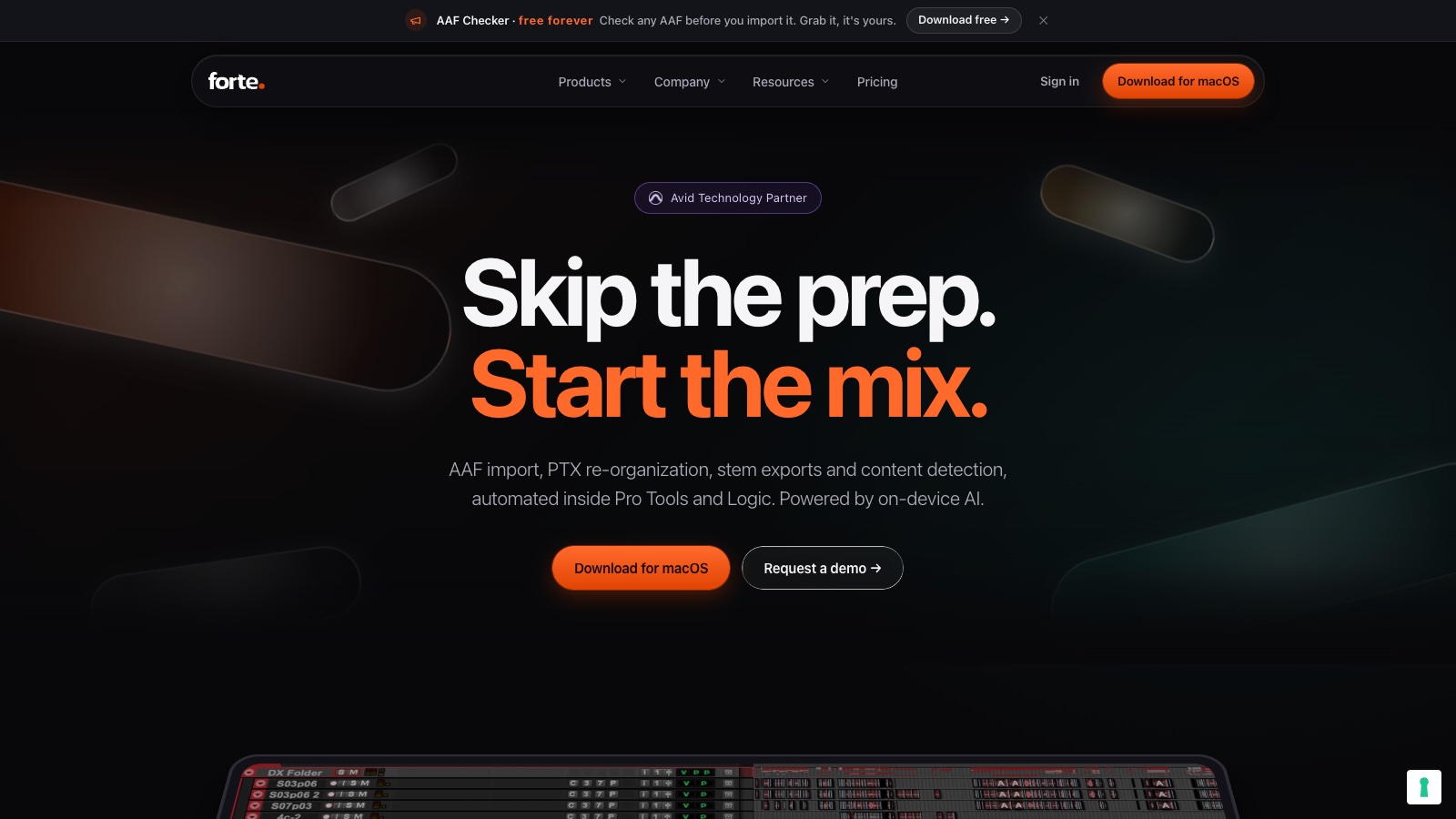
Forte AI misses 2 of them. It runs on your own Mac and never uploads your audio, so step 1 fails on the spot. It also does no mixing: it recognizes your raw tracks, names and color-codes them, and routes them into a session so you can start. The template involved is your own DAW template, not a library the company keeps.
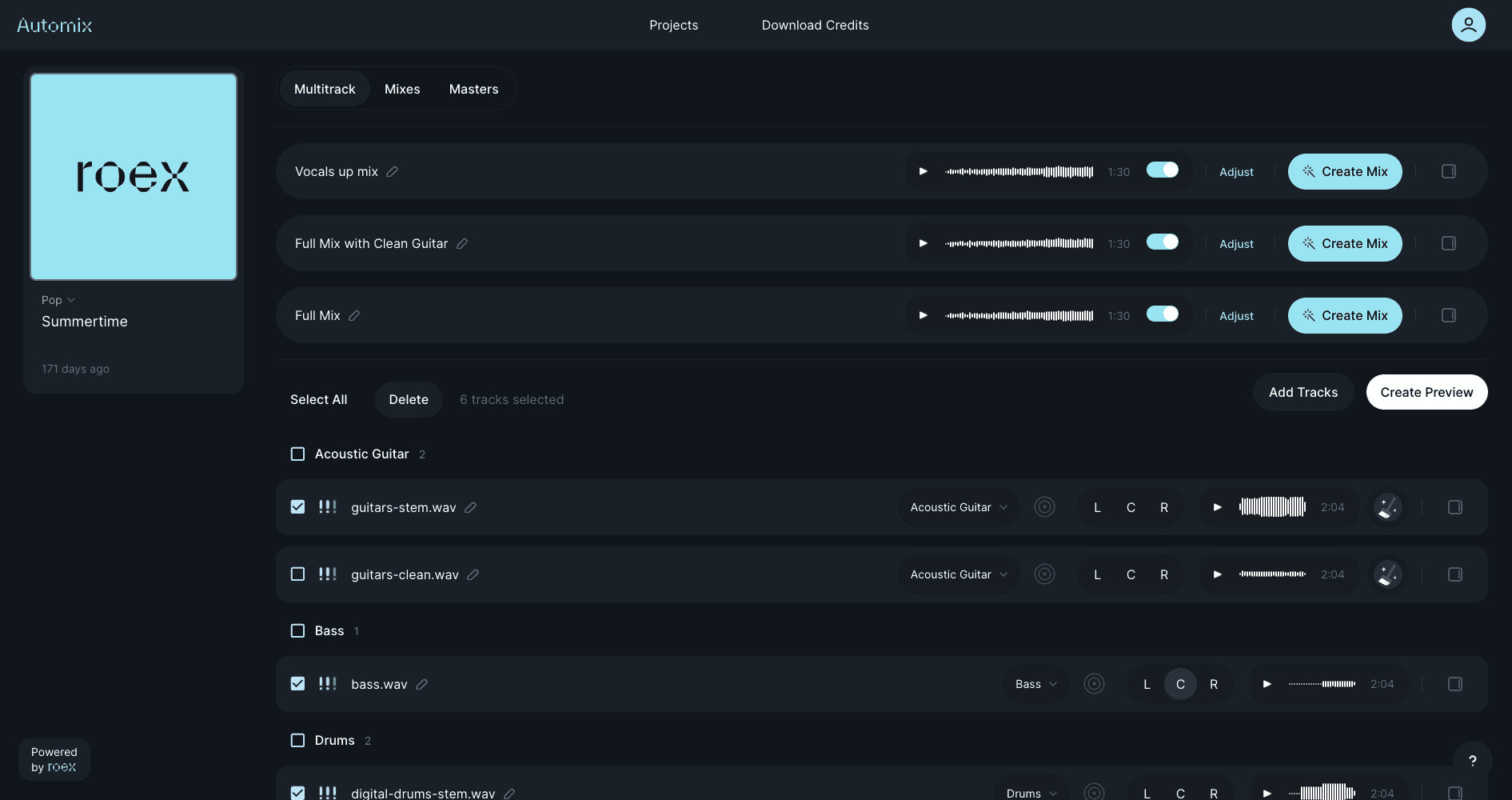
RoEx Automix misses step 3. You upload stems and Automix analyzes each one, then sets levels, EQ, panning and dynamics itself. There’s no template shelf to browse. Reference track mastering gets close, but handing it a song you like isn’t picking from a stored library of mixes. RoEx also grew out of Queen Mary University of London research, the same lab behind LANDR’s 2013 patent.
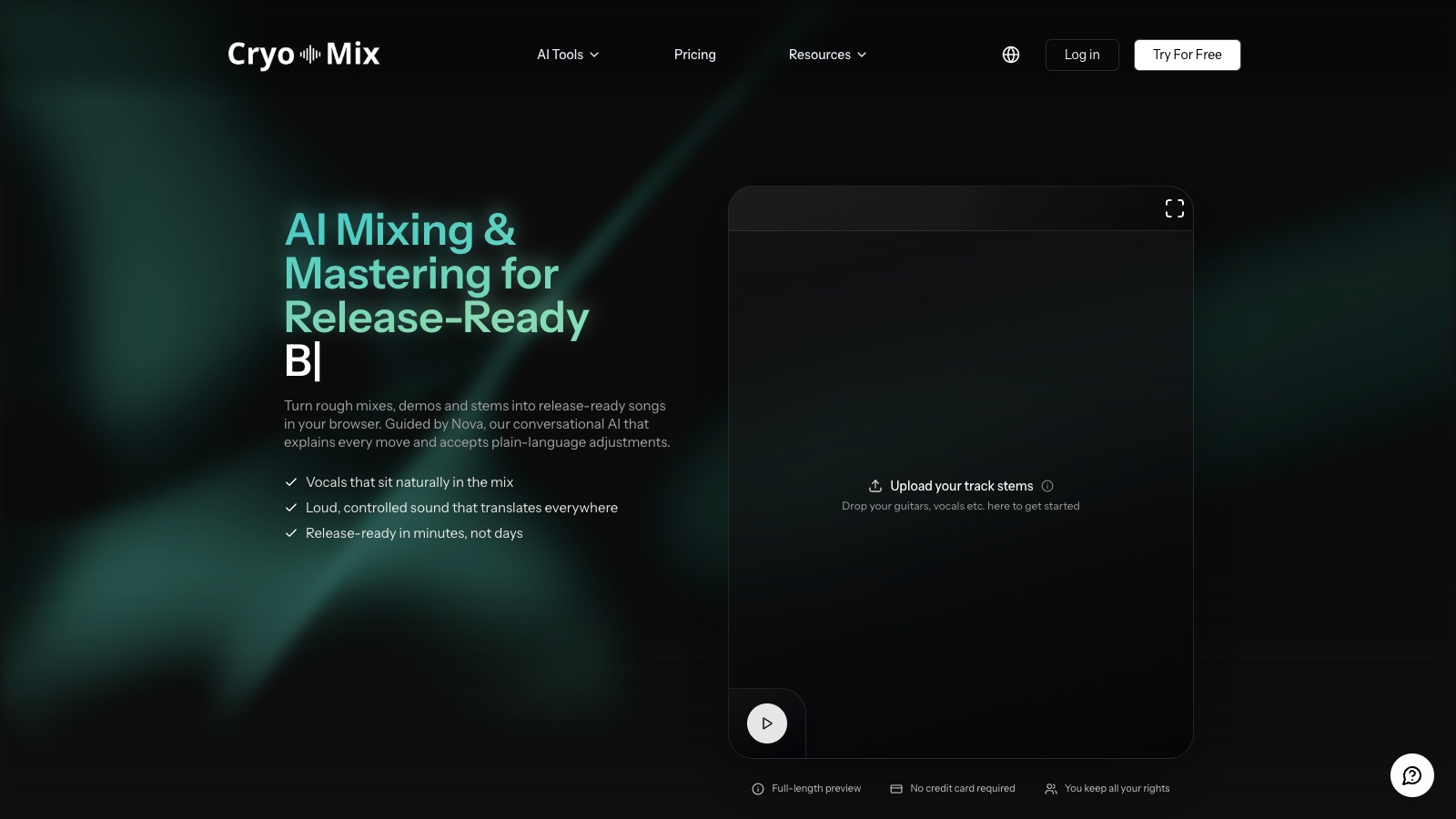
Cryo Mix is the closest call of the 3. It runs in the browser, takes up to 32 stems, mixes and masters them, and lets you download the result. It also has a community preset library of genre starting points, the nearest thing here to stored sound templates. What keeps it at arm’s length is the order of operations: the mix is driven by telling the Nova agent your genre and the sound you want, with presets as a refinement afterwards. The patent wants the template pick to be what sets the mix.
One protection none of the 3 can use: they’re all too new for the head start rule, which needs commercial sales from before 2020. What keeps them clear is the claim mismatch and the older patents sitting behind them.
How Music IP Holdings turns patents into licence fees
One company in music is running the licensing play this patent isn’t, and the contrast explains everything.
Music IP Holdings, the venture between Universal Music Group and Liquidax Capital, holds more than 24 issued or allowed patents with over 50 pending. It started with 15 filings in 2025, licensed the portfolio to Udio and GRAI in August 2026, and opened a public application the same day.
Technology that generates music, transforms audio into new structures, uses novel audio workflows, or analyzes and decomposes music needs a licence.
That works because of density. Facing 74 filings spread across every stage of a pipeline, designing around all of them costs more than paying. Facing 1 patent with 2 narrow claims, you drop the template library or restructure the upload flow and you’re clear.
Universal has a second advantage patents alone don’t give. AI platforms need its recordings licensed regardless, so the patent licence rides along on a negotiation already happening. Gillespie and Sparks have nothing equivalent to trade.
The case for taking the patent seriously anyway
I could be too dismissive here, so here’s the strongest version of the other side.
Narrow claims are still enforceable claims. The 4 steps above aren’t exotic, and a new AI mixing startup could hit all of them by accident: put the service in the cloud, take stem uploads, offer a browsable library of genre mixes, sync and return a master. That’s a reasonable product to build, and it lands inside claim 1 without anyone reading a patent first.
Defending against one is expensive even when you win. Challenging a patent at the patent office runs into the hundreds of thousands of dollars, which is why small companies settle claims they’d probably beat.
Individually held patents also get sold. If InMix, the product Gillespie and Sparks built around this, doesn’t find its market, the patent can move to a firm whose whole business is sending letters. That’s the scenario I’d watch, and it would show up first as a change in the assignment record.
For now, neither owner has said they intend to license anyone. The announcement, from April 2026, reads like it was written for artists rather than licensees.
What to watch next in AI mixing patents
The question worth asking runs the other direction. Whether Universal eventually charges LANDR, rather than whether 2 individuals can.
Music IP Holdings says a licence is needed for technology that analyzes or decomposes music. Read plainly, that reaches stem separation, audio analysis and the mixing tools built on top of them. LANDR does that. Ozone does that. RoEx does that. None of them have announced a patent deal.
Copyright licensing settles what a model gets to learn from. A patent licence settles whether the product gets to exist, and there’s no fair use argument on that side of the fight. Two years of AI music coverage went to training data. The next argument is about plumbing, and the majors spent those same 2 years quietly buying it.
Frequently asked questions
What does US Patent 11,929,098 cover?
It covers a cloud service that mixes recorded audio using stored sound templates. A user uploads their recorded tracks, picks a template from a template library, sets a few options, and an AI module time-syncs the tracks and returns a finished mixed master to download. The patent has 17 claims and 2 of them are independent, one written as a process and one as a system with 9 required parts.
Do LANDR and iZotope Ozone need a licence for the Sparks and Gillespie AI mixing patent?
Nothing in the public record says they do, and the claims point the other way. Both independent claims describe multi-track mixing on a cloud platform with a user-navigable template library. LANDR and Ozone are mastering tools that work on a finished stereo file rather than uploaded multi-track sessions, and Ozone runs locally instead of as a cloud service, so it misses the cloud limitation outright.
Do AI mixing tools like RoEx, Cryo Mix and Forte AI need a patent licence?
Nothing in the public record says they do. Claim 1 catches a tool only if it does 4 things together: takes your audio into a cloud service, mixes your separate tracks, has you pick from a stored library of sound templates, and returns a synced master to download. Forte AI runs on your own Mac and does no mixing. RoEx Automix analyzes your stems instead of offering a template library. Cryo Mix comes closest because it has a preset library, but its mix is driven by the Nova chat rather than by the template pick.
Is Clinton Sparks the inventor of the AI mixing patent?
No. The face of US Patent 11,929,098 names John Edward Gillespie of Laguna Hills, California as both the applicant and the sole inventor. Clinton Sparks is listed as a co-assignee, which means he holds an ownership share in the patent. Owning a patent and inventing it are separate things on a patent document.
When was the Clinton Sparks and Johnny Gillespie AI mixing patent granted?
The United States Patent and Trademark Office granted it on 12 March 2024. The application was filed on 25 August 2021 and claims priority back to a provisional application filed on 20 January 2021. A press release announcing the patent went out on 14 April 2026, and trade coverage picked it up again in September 2026.
About the author

Covering AI music tools, industry shifts, and news for music creators and professionals. Twice-weekly newsletter at aimusicpreneur.com.