Voice-Swap becomes the first AI voice company in DDEX, to build consent data for AI vocals
My stack My fav 6 tools for AI music after testing 70+
-
 ElevenMusic · Music generation
 -
 Moises · Stem separation
 -
 Controlla · Voice swap & cloning
 -
 Cryo Mix · Mixing + mastering
 -
 Neural Frames · Music videos
 -
 ONCE · Distribution
Some links are affiliate links — I earn a commission at no cost to you. Every tool here is one I run myself and truly believe in. This stack is proven.
Voice-Swap, the London AI voice company, joined DDEX as a Full Member on September 24, 2026. DDEX writes the data formats labels, distributors and streaming services use to swap release and rights information, and Voice-Swap says it’s the first dedicated AI voice company in that work.
Voice-Swap wants to help write the fields that say whose voice is on an AI vocal, which model made it, who said yes, and what that yes covers. The announcement lists “voice-model identity, consent and authorisation metadata, usage-scoped permissions, provenance and rights reporting.”
For now that’s a plan Voice-Swap brings to DDEX, with no timeline attached.
What is DDEX?
DDEX (Digital Data Exchange) is a not-for-profit membership organisation, formed in 2006, that writes the standard formats the music business uses to send data about works, tracks and releases. DDEX says its formats are the de facto standard for music metadata.
In plain words: every company fills in the same form the same way, so a label’s system and Spotify’s system can read each other’s files. The 2 standards you’d meet first:
- ERN (Electronic Release Notification): a label or distributor sends it to a streaming service, with the release, its tracks and where and when it can go live.
- DSR (Digital Sales Reporting): the streaming service sends it back to the rights owner, with the sales and usage data.
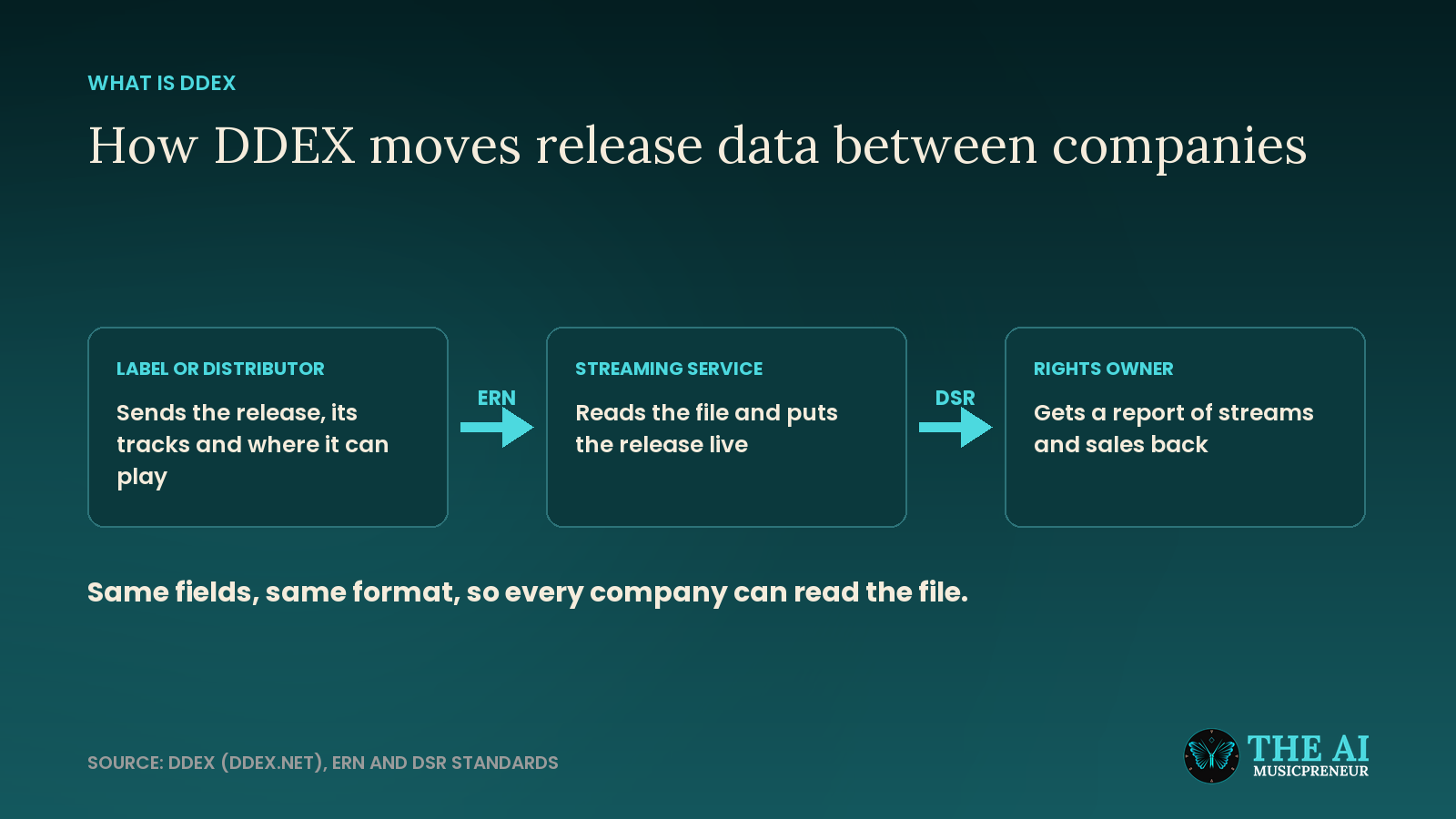
The standards are free, and you don’t need to be a member to use them. On the day Voice-Swap joined, DDEX also published a new one, the Entity Cluster Message Suite, for grouping related recordings.
What Voice-Swap wants to add to DDEX standards
DDEX already carries one kind of AI data. In September 2025, Spotify said it was helping develop a DDEX standard for AI disclosures in music credits, showing whether AI was used on vocals, instrumentation or post-production. That data comes in through labels and distributors, which I compared in my AI music distribution guide.
Voice-Swap’s announcement names what disclosure leaves open: “Transparency can identify the presence of AI. It cannot, by itself, establish whether a particular voice was authorised, whether that permission is still valid, or whether the resulting use falls within the scope originally granted.”
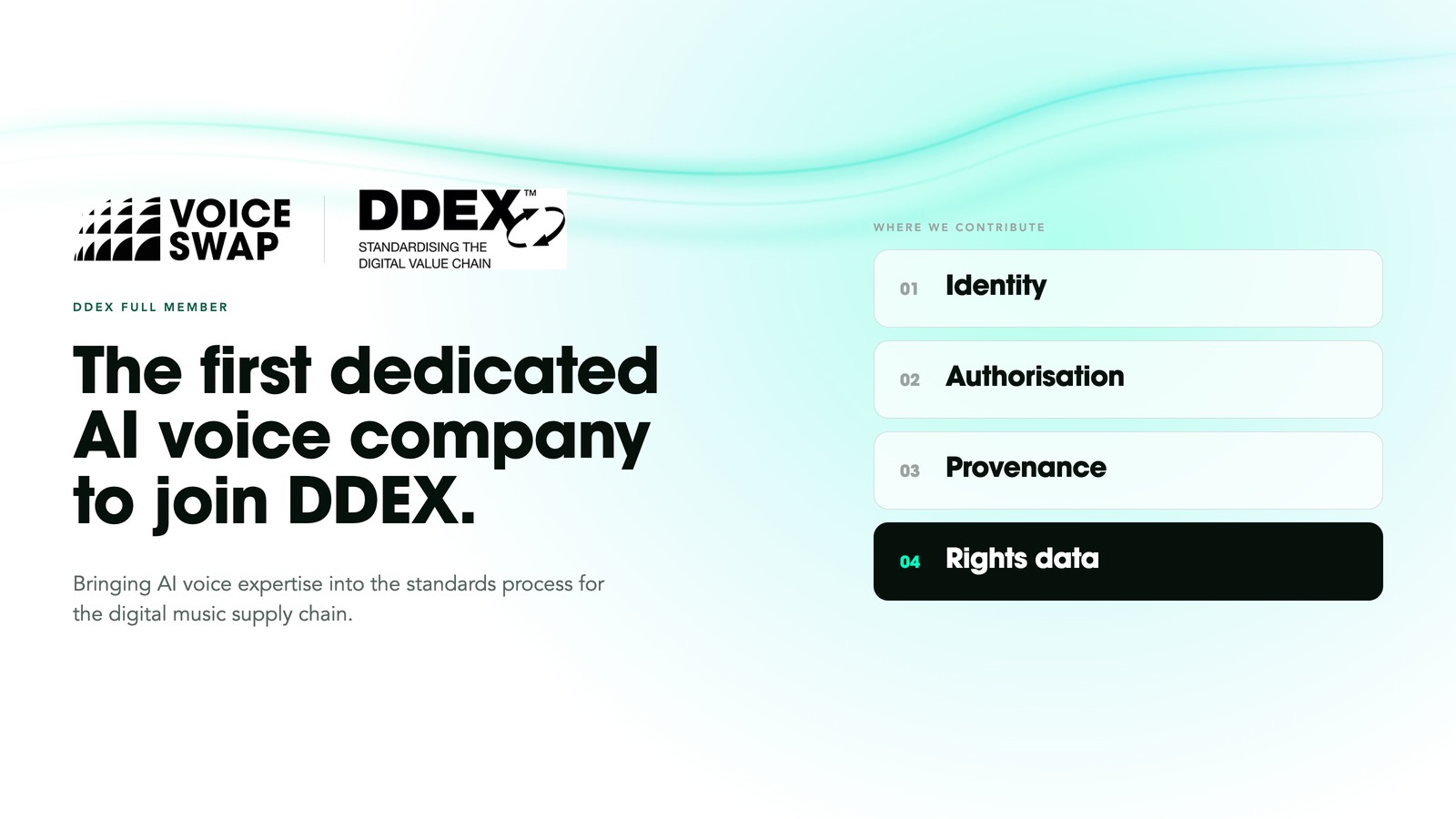
So Voice-Swap wants any company down the chain to be able to confirm 4 things: the model used, the identity represented, the authority behind it and the permitted scope of use.
The industry needs to know whose identity is represented, which model was used, who authorised that use and whether it remains within the permitted scope.
DDEX secretariat Mark Isherwood said Voice-Swap “will clearly provide a particular focus on AI voice expertise.”
How Voice-Swap wants consent data to travel with an AI vocal
Michael Pelczynski, Voice-Swap’s chief strategy and impact officer, laid out the mechanics in an August 27 post on the EU AI Act. Since August 2, 2026, Article 50 of the Act requires AI audio tools to mark their output as AI in a machine-readable way (tools on the market before then get until December 2). His line on it: “A label is not a license.”
He splits responsible voice infrastructure into 3 layers, each a question:
- Transparency: “Was AI involved?”
- Authorization: “Was this identity permitted to be represented by this model?”
- Accountability: “Was this particular output generated within the approved scope, and can that be demonstrated?”
In Voice-Swap’s model, permissions set the approved purpose, channel, territory and term, and travel with every output through model IDs and machine-readable provenance. Each authorised use should come down to one line: “This vocal derives from model X, representing person Y, under authorization Z, valid for use category A.”
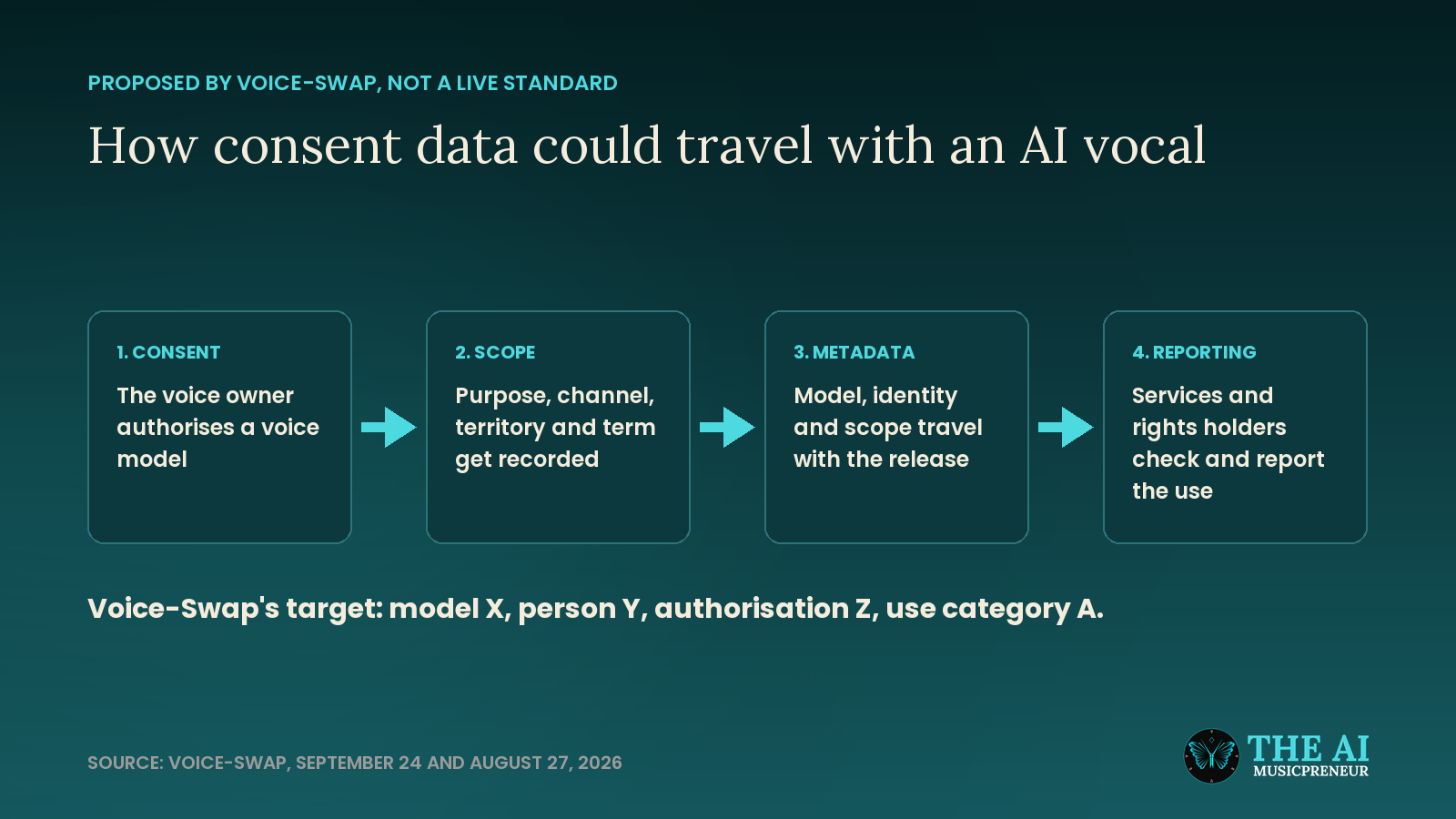
That line only works if every company in the chain can read it, which is why Voice-Swap took it to DDEX. Neither Voice-Swap nor DDEX has said when AI voice consent fields could land in a DDEX standard.
Voice-Swap’s 2026 before DDEX: WIPO, Voiceover_Studio and instant voice cloning
Voice-Swap is led by CEO Ausrine Skarnulyte and builds artist-approved voice models you can use in your DAW through its VST plugin. It’s also a SoundCloud partner, as Digital Music News points out.
Before DDEX, Voice-Swap’s 2026 looked like this:
- March 20, 2026: Voice-Swap joined WIPO’s Technical Exchange Network as one of 90 original members, next to Google, Anthropic, Universal Music Group and Warner Music Group.
- April 16, 2026: it launched Voiceover_Studio, a text-to-speech product for creators, advertisers and marketing teams.
- August 26, 2026: it switched on Instant Voice Clones, which build a voice from 10 to 20 seconds of speech.
As a Full Member, Voice-Swap can now sit in DDEX’s technical working groups and comment on draft standards before they’re final.
Frequently asked questions
What does DDEX Full Membership give Voice-Swap?
A DDEX Full Member can send people to the technical working group meetings and plenary meetings, propose a working group chair or co-chair, and comment on Committee Draft Standards. It also gets a free Implementation Licence and a DDEX Party Identifier. Full Member fees are set by revenue band.
Do you have to be a DDEX member to use the ERN and DSR standards?
No. DDEX standards such as the ERN release message and the DSR sales report are free for anyone in the industry to implement, and DDEX says you don't need to be a member to use them. Membership gives a company a seat in the working groups that write the standards.
How is Voice-Swap's DDEX consent proposal different from Spotify's DDEX AI credits?
The DDEX AI credits standard Spotify said it was helping develop in September 2025 shows where AI was used in a track, such as vocals, instrumentation or post-production. Voice-Swap wants the data to also show whose voice a model represents, who authorised it and which uses that permission covers. Voice-Swap's version is a proposal for future standards work, not a live standard.
What is the DDEX Entity Cluster Message Suite published on September 24, 2026?
The Entity Cluster Message Suite (ECM) is a DDEX standard developed by its Music Recognition Technology Working Group. It lets companies exchange groups of related recordings: all sound recordings and music videos of the same musical work, and recordings with different ISRCs that should be treated as the same recording.
About the author

Covering AI music tools, industry shifts, and news for music creators and professionals. Twice-weekly newsletter at aimusicpreneur.com.