How to write an artist bio: 5 steps, examples and a template for musicians

SIQA Summit, LA, 12th November 2026 Ozzy Osbourne's former bassist is sharing a stage with Suno. I'm moderating:
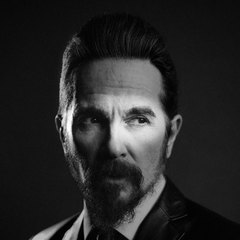
Blasko
Bassist (Ozzy Osbourne, Rob Zombie)

Sam Berger
Artist Partnerships at Suno

RoccStar
Grammy Award-winning producer and songwriter
Drake Murphy
A&R at PlayPulse / Create Music Group

Janie Jennings
Founder, Creative's Flow Ecosystem

Chris Wieduwilt
Moderator
Limited capacity only
Here’s how to write an artist bio in about an hour: dump every fact, write one hook line, describe your sound with one comparison, add one story with real numbers, then cut it into 3 lengths.
That last part is where most musicians stop short.
A curator reading your playlist pitch, a fan on your Spotify profile and a journalist opening your press kit all need a different bio. Same facts, different length.
Below: the 5 steps, a real Spotify bio, my own, a copy-paste template for all 3 lengths, an AI prompt, and the 6 mistakes that get a pitch skipped.
What is an artist bio, and where does a musician need one?
An artist bio (also called an artist biography, or a band bio if you’re in a group) is a short text that tells a stranger who you are, what your music sounds like and why it’s worth a listen. Musicians use it on Spotify, Instagram, in press kits, press releases, playlist pitches and on their website, usually in 3 lengths.
You’ll paste it into more places than you think:
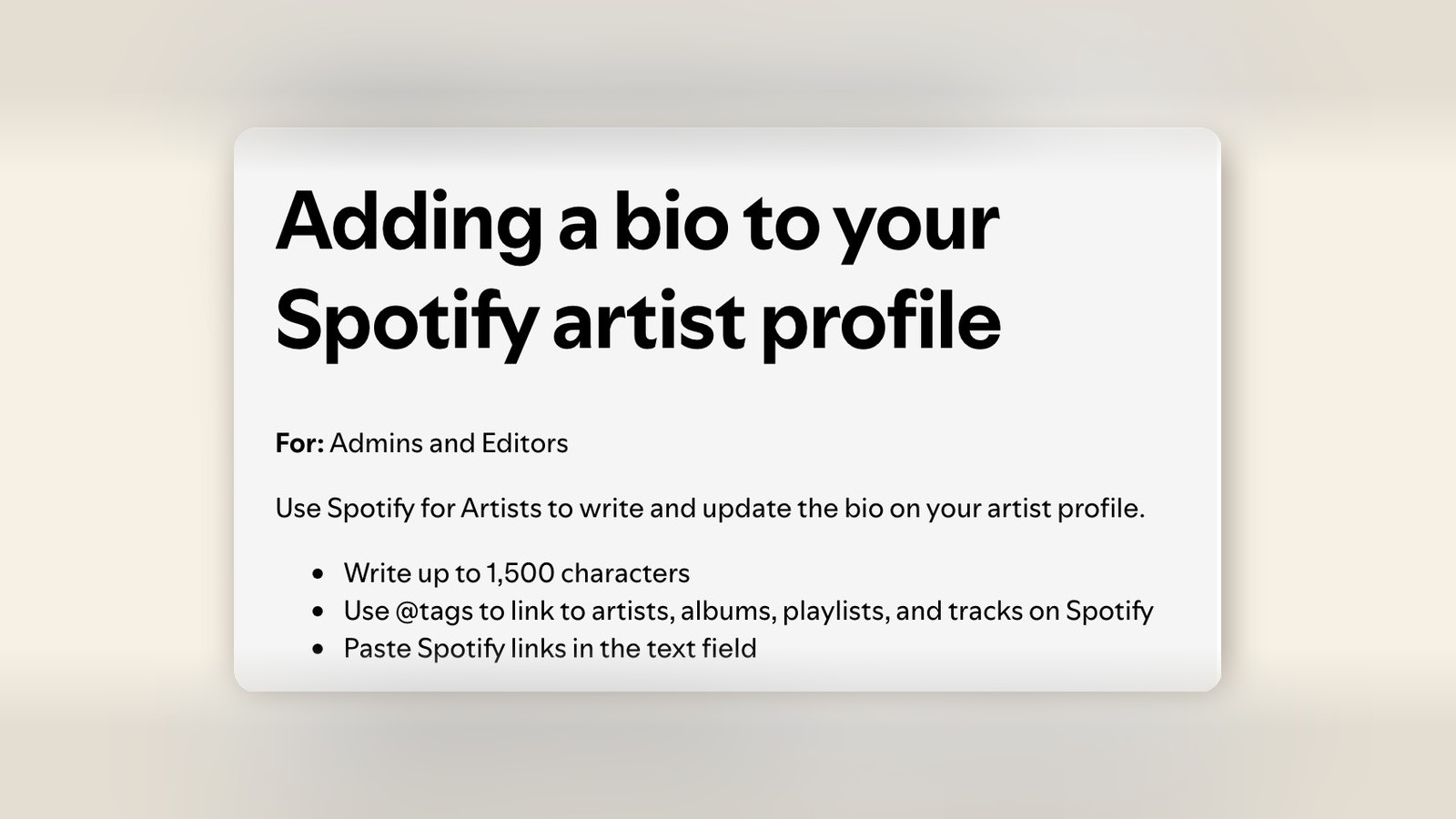
- Your Spotify artist profile, where Spotify for Artists gives you up to 1,500 characters.
- Instagram, TikTok and SoundCloud profiles, where you get one or two lines.
- Your EPK and every music press release you send.
- Playlist pitches, festival applications and the About page on your website.
One exception: Apple Music. You can’t type your own bio there. The Apple Music for Artists FAQ says Apple sources artist biographies from Xperi, and that Xperi doesn’t guarantee an update.
So for most places, the bio is yours to write. Next question: how long?
How long should an artist bio be? Short, medium and long
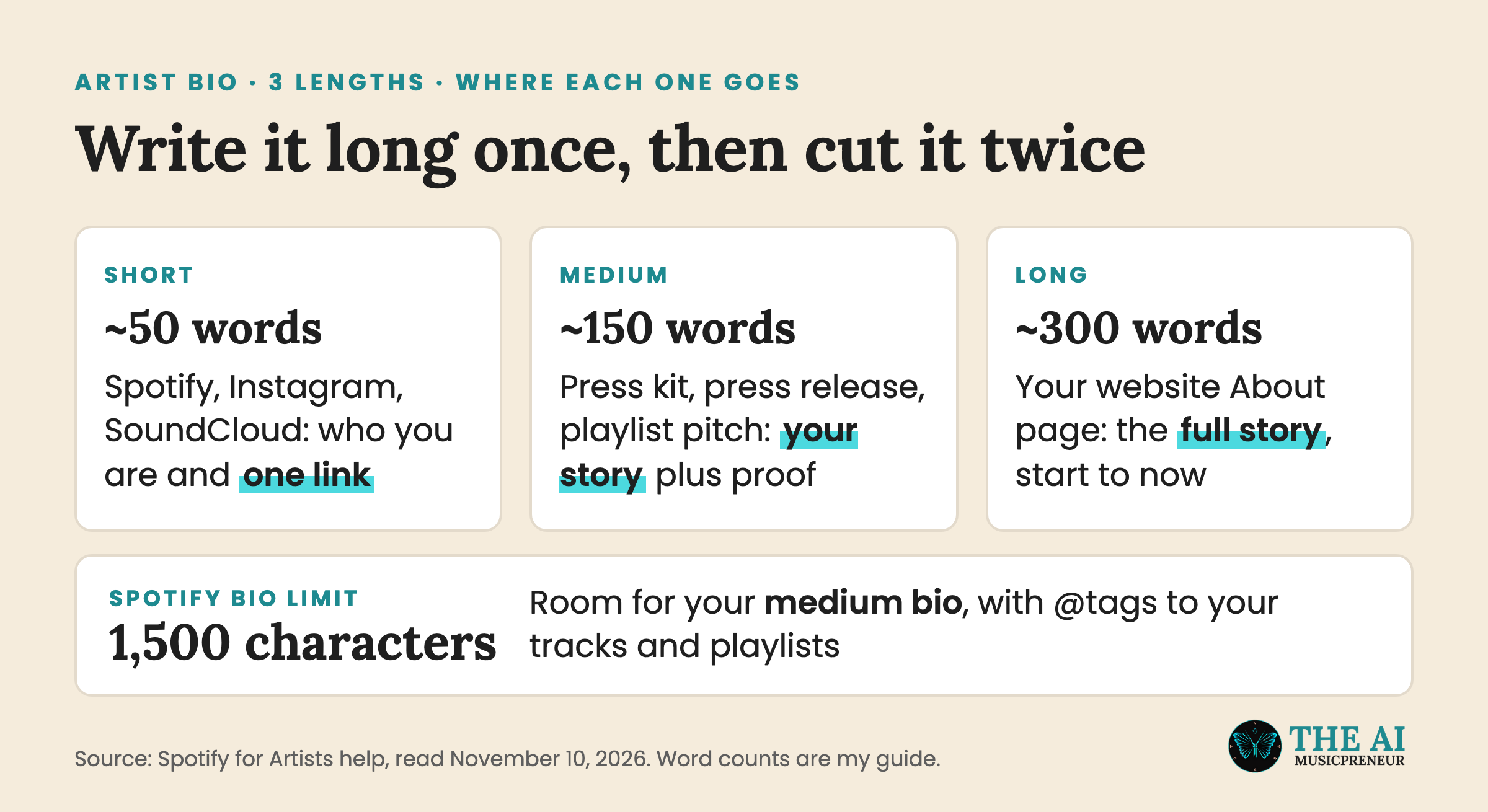
Write 3 versions: about 50 words, about 150 words and about 300 words.
The word counts are my guide, not a platform rule. What matters is that each length does one job:
- Short (about 50 words): Spotify, Instagram, SoundCloud. Who you are, what you sound like, one link.
- Medium (about 150 words): press kit, press release, playlist and blog pitches. Your story plus 2 or 3 facts that prove it.
- Long (about 300 words): the About page on your website. The full story, from where you started to what’s next.
Spotify’s 1,500 characters is roughly 200 to 250 words, so your medium bio fits with room for a couple of @tags to your latest release.
Always write the long one first. Cutting a good long bio down is easy. Stretching a short one never works.
How to write an artist bio in 5 steps
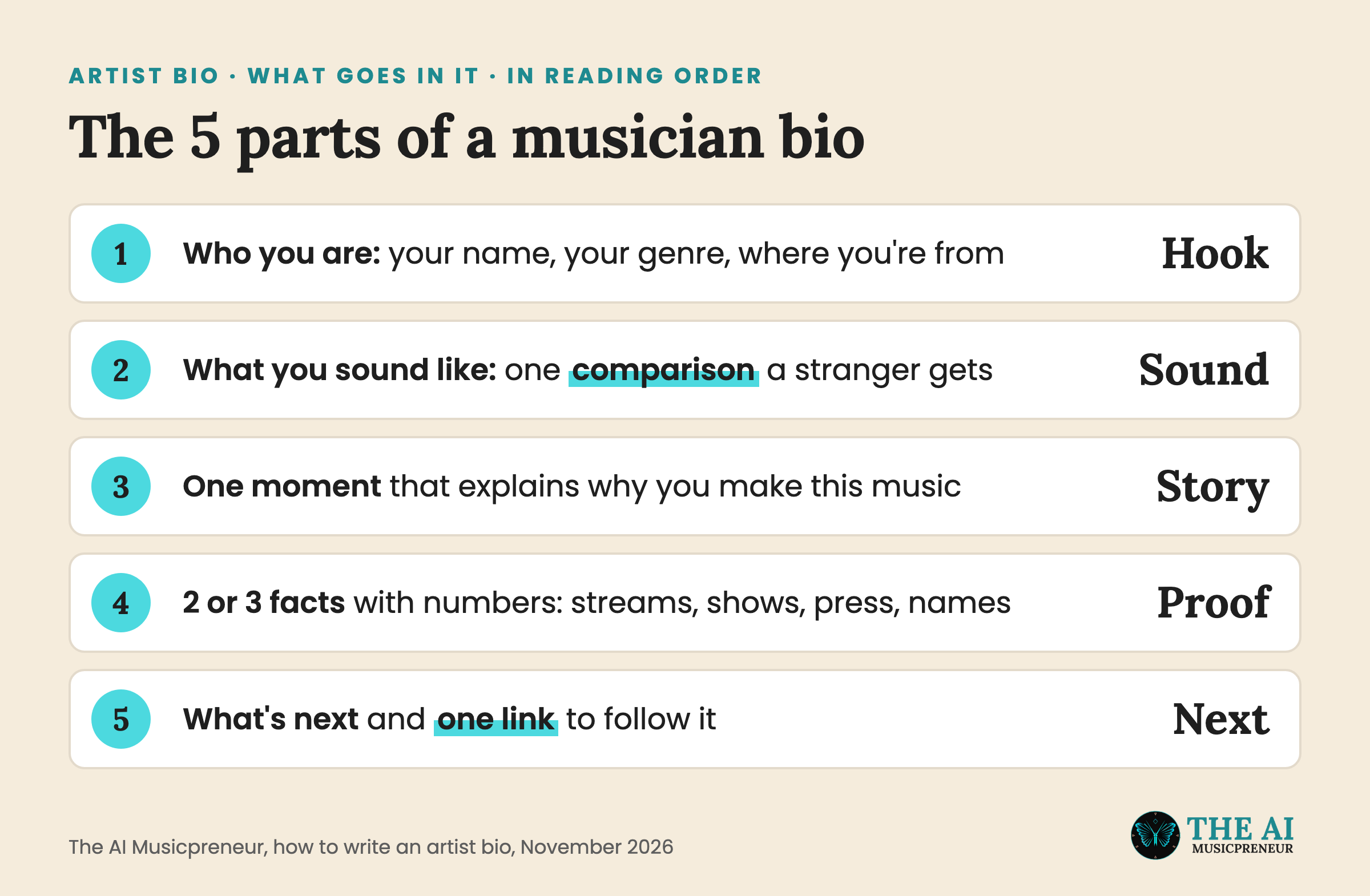
Every good musician bio has the same 5 parts in the same order: a hook, your sound, a story, proof, and what’s next. The steps below build them one at a time.
Step 1: Brain-dump every fact about your music
Open a blank note and write down everything, in any order:
- Your artist name, real name if you use it, genre and hometown.
- The artists you get compared to, and the ones you actually listen to.
- Releases, streams, followers, shows, tours, press, collaborators.
- The moment you knew you wanted to make music.
Don’t edit anything yet. This list is the raw material for all 3 versions, and it’s also what you’ll paste into an AI tool later.
Step 2: Write the hook line: name, genre, place
Your first sentence has one job: a stranger should know who you are in 5 seconds.
Name, genre, place. That’s it.
“[Artist name] is a [genre] artist from [city].” It sounds plain, and that’s the point. Curators skim, so your hook line might be the only one they read before pressing play.
Step 3: Describe your sound with one comparison
“Unique sound” tells nobody anything. Every artist thinks their sound is unique.
A comparison does the work in 6 words: “for fans of [artist] and [artist]”, or a scene, a decade, a city. Pick names the reader already knows, and pick ones you’re honestly close to. A curator who hears the opposite of what you promised won’t open your next email.
Step 4: Add one story and 2 or 3 facts with numbers
Now pick one moment from your brain dump: the one that explains why you make this music.
Then add proof. 2 or 3 facts, each with a number or a name: streams, shows, a tour, a playlist, a press quote, a collaborator.
Only use numbers you can prove. Plays, followers and fans are 3 different numbers, and mixing them up is the fastest way to lose a journalist’s trust (more on that in the examples below).
Step 5: Cut the long bio down to medium and short
Write the long version first, around 300 words, using all 4 parts so far plus what’s next: your upcoming release, tour or project.
Then cut:
- Medium: keep the hook, the sound, one story and your 2 best facts. About 150 words.
- Short: keep the hook, the sound and one fact. End with one link. About 50 words.
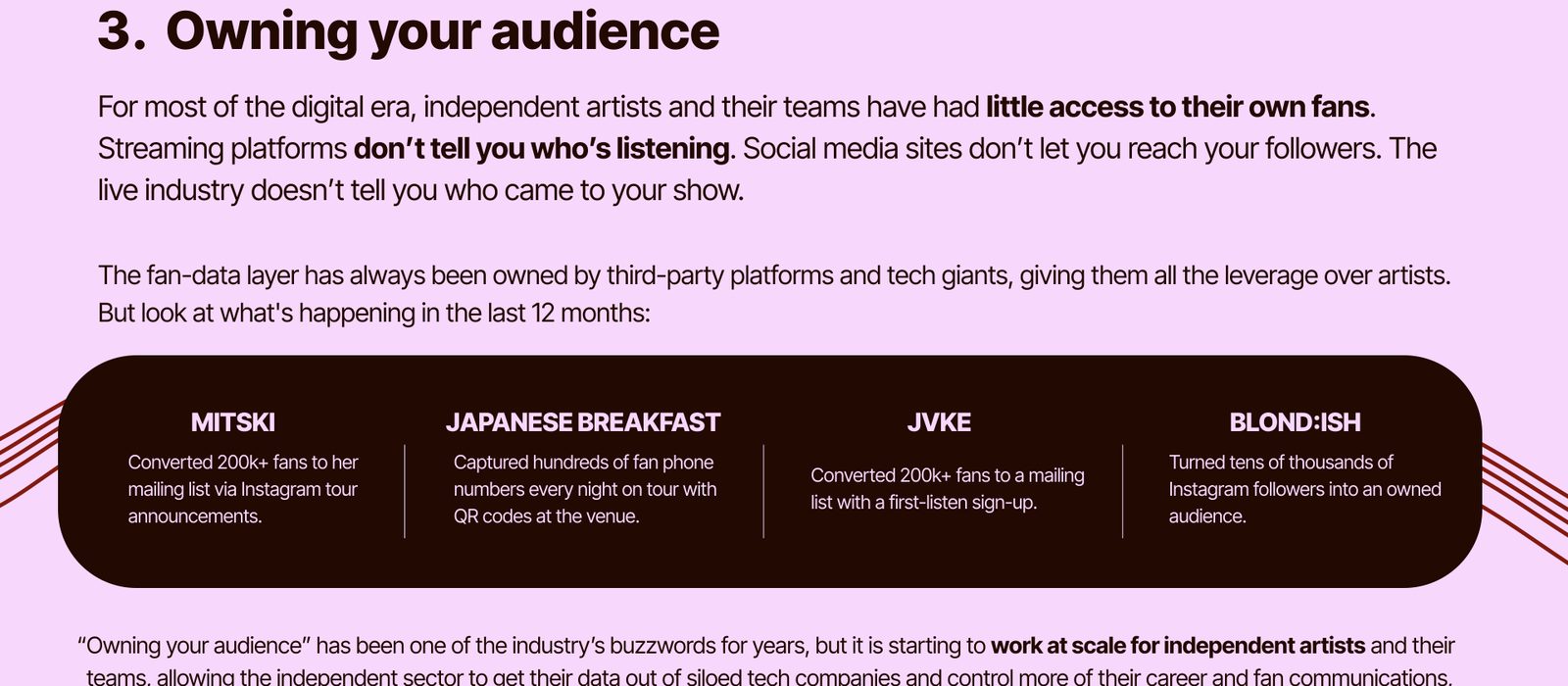
Every version ends the same way, with one place to go next. For most artists that should be your email list, because a follower can disappear and a subscriber stays yours. Here’s how 4 artists moved 200,000+ fans onto lists they own.
Artist bio examples: a real Spotify bio and my own
Here are 2 real examples, one from a working independent artist and one from me.
Nic D’s Spotify bio: a short musician bio example
In September 2024, Nic D’s Spotify profile showed 420,194 followers and a 23-word bio:
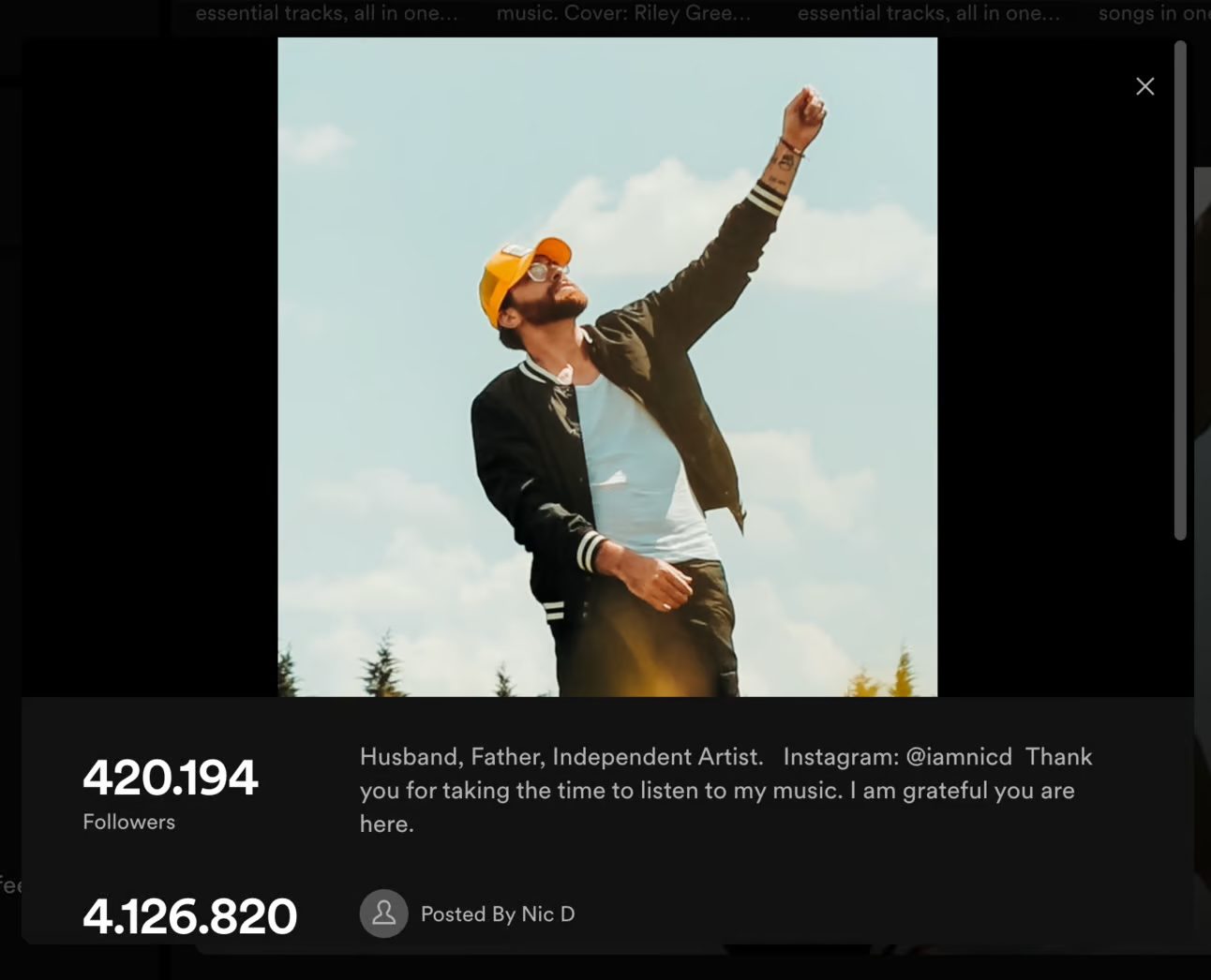
“Husband, Father, Independent Artist. Instagram: @iamnicd Thank you for taking the time to listen to my music. I am grateful you are here.”
It works because it does 3 things in 23 words:
- 3 roles a fan can relate to, including “Independent Artist”.
- One link, to the place he wants you to go next.
- One line of thanks that sounds like a person, not a press release.
His bio may have changed since then. The structure is the part to copy.
My own musician bio, built only from facts I can prove
I’ve played guitar for over 20 years. My solo project, A Crush On Yesterday, reached 500,000 plays on Myspace, and close to 20,000 to 30,000 people followed it there. In 2010 I toured the US coast to coast.
A short bio from those facts:
Guitarist for 20+ years. My solo project A Crush On Yesterday reached
500,000 plays on Myspace. In 2010 I toured the US coast to coast.
New music and the story behind it: [link to my email list]
Here’s the mistake I caught in my own writing: a talk script I drafted this year said I “lost 500,000 fans overnight”. That’s wrong. It was 500,000 plays and 20,000 to 30,000 followers.
The 500,000 still made it into the bio. It just says plays, because that’s what it was.
And the reason I had to rebuild after Myspace collapsed: I had no email list. That’s why every bio version on this page ends with one link, and why mine points to my list.
Artist bio template: copy-paste versions for all 3 lengths
These music bio templates follow the 5 parts above. Fill in the brackets with facts from your brain dump, and delete any line you can’t fill honestly.
Short artist bio template (Spotify, Instagram, about 50 words):
[Artist name] is a [genre] artist from [city]. For fans of [artist]
and [artist]. [One fact with a number, e.g. "1M streams on 'Song'"].
New music first: [one link].
Medium artist bio template (press kit, pitches, about 150 words):
[Artist name] is a [genre] artist from [city], for fans of [artist]
and [artist].

[One story: the moment that explains why you make this music, in 2 or 3
sentences.]

[Fact 1 with a number or a name.] [Fact 2 with a number or a name.]

[What's next: the release, tour or project, with a date.]
[Contact or link.]
Long artist bio template (website About page, about 300 words):
Paragraph 1: Hook line, then your sound in one comparison.
Paragraph 2: Where you started and the moment it clicked.
Paragraph 3: What you've done since: releases, shows, press, numbers.
Paragraph 4: What you're making now and what's next, with a date.
Last line: one link (your email list) and a booking or press contact.
The long template has no fill-in sentences on purpose. That’s the version where your own voice matters most.
How to write a musician bio with AI without it sounding like AI
AI is good at turning a messy brain dump into a clean first draft. It’s bad at sounding like you, and it loves words like “captivating” and “genre-bending”.
So use it for the draft, then edit hard. Paste this prompt into Claude or ChatGPT, with your brain dump underneath:
You are helping a musician write their artist bio.

Using ONLY the facts below, write 3 versions:
1. Short: about 50 words, for Spotify and Instagram, ending with this link: [link]
2. Medium: about 150 words, third person, for a press kit
3. Long: about 300 words, for a website About page

Rules:
- Line 1 is name, genre and city.
- Describe the sound with one comparison from my facts, no adjectives
  like unique, captivating, genre-bending or passionate.
- Use one story and 2 or 3 facts with numbers. Don't invent anything.
- If a fact is missing, leave a [gap] instead of filling it.

My facts:
[paste your brain dump here]
Then edit it so it sounds like you:
- Read it out loud. Any line you wouldn’t say to a friend at a show, rewrite.
- Check every number against your dashboard. AI rounds up and mixes up plays, streams and fans.
- Swap every adjective for a fact. “Hard-working” becomes “played 40 shows last year” (use your real number).
- Fill or delete every [gap]. Never let the AI fill it for you.
6 artist bio mistakes that make curators skip you
Each of these costs you a reply:
- No genre in the first line. If a curator can’t tell what you sound like, they won’t press play.
- Clichés instead of comparisons. “Unique”, “passionate” and “one of a kind” describe every artist and therefore nobody.
- Listing every gig. 3 strong facts beat 15 weak ones. Your website can hold the full list.
- Numbers you can’t prove. Write plays when you mean plays. A journalist who checks and finds a different number stops trusting the rest.
- No link, or 5 links. Give one place to go next. More choices means fewer clicks.
- A bio from 2 releases ago. Update the “what’s next” line every time you release, or your Spotify profile promotes a song that’s old news.
One more that’s easy to miss: switching between “I” and “she” or “they” in the same bio. Pick one person per version and keep it.
Where to update your artist bio on Spotify and Apple Music
Your bio is only as good as the copy that’s live. Here’s where to change it, as of November 10, 2026:
- Spotify: log in to artists.spotify.com, click View Profile, then About, then the edit icon next to Bio. You need Admin or Editor access, and you have up to 1,500 characters.
- Apple Music: you can’t edit the bio yourself. Apple’s FAQ says to contact Xperi, which supplies Apple’s artist biographies, and that an update isn’t guaranteed.
- Everywhere else: Instagram, TikTok, SoundCloud, Bandcamp and your website take whichever version fits. Update them all on release day.
Your bio is also step one of a press kit. For the rest of it, see all my guides on artist bios, EPKs and press releases.
Where should your new artist bio go first?
Put the short version on your Spotify profile today. It’s the page every new listener lands on.
Then put the medium version into your press kit before your next release, and plan the rest of the launch with my 30-day single release plan. Once it’s out, my guide on how to promote your music picks up where the bio stops.
Write the long one once. Cut it twice. And make sure every version ends with the one link that matters.
Frequently asked questions
How many characters can a Spotify artist bio have?
Spotify for Artists allows up to 1,500 characters in the bio on your artist profile, as of November 2026. You can use @tags to link artists, albums, playlists and tracks on Spotify, and the bio is edited under your profile's About section.
Who writes the artist bio on Apple Music?
Apple sources artist biographies from Xperi, according to the Apple Music for Artists FAQ. To add or update a bio you contact Xperi, which says it may consider a submission but doesn't guarantee an update.
Should a musician bio be written in first or third person?
Use third person for your press kit and press release, because journalists and curators copy lines straight into their own writing. First person works for Spotify, Instagram and your newsletter, where fans expect to hear from you. Pick one per version and don't switch halfway through.
What is the difference between an artist bio and an EPK?
An artist bio is the text about you. An EPK, or electronic press kit, is the whole package a journalist or booker needs: your medium bio, photos, music links, press quotes, show history and contact details.
About the author
Covering AI music tools, industry shifts, and news for music creators and professionals. Twice-weekly newsletter at aimusicpreneur.com.