Gospel is the fastest-growing genre in AI music, and it beats R&B on results
My stack My fav 6 tools for AI music after testing 70+
-
 ElevenMusic · Music generation
 -
 Moises · Stem separation
 -
 Controlla · Voice swap & cloning
 -
 Cryo Mix · Mixing + mastering
 -
 Neural Frames · Music videos
 -
 ONCE · Distribution
Some links are affiliate links — I earn a commission at no cost to you. Every tool here is one I run myself and truly believe in. This stack is proven.
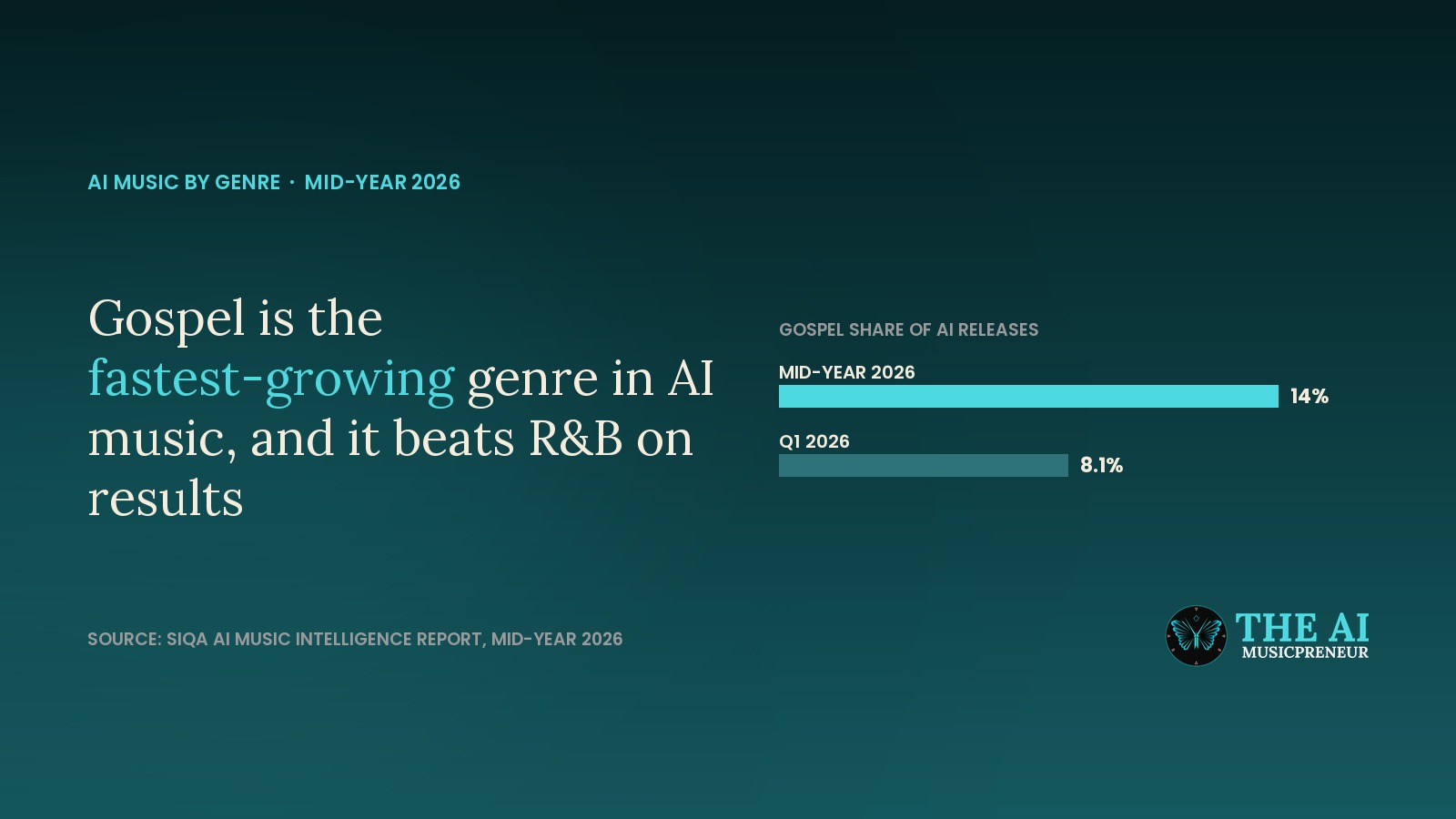
Gospel nearly doubled its share of AI music releases between January and August 2026, from 8.1% to 14.0%. No other genre grew faster. The numbers come from the Sonic Intelligence Academy’s Mid-Year 2026 report, covering 1,743 verified releases across 20 chart weeks.
The more useful number is what that output converts into. Gospel took 25% of the most popular AI songs in the final 10 chart weeks. R&B/Soul, which makes more than twice as much music, took the same 25%.
Gospel overtook R&B/Soul in the most popular AI songs
Averaged across all 20 weeks, R&B/Soul held 44% of the top slots and Gospel 19%. Those averages hide a reversal that happened inside the period.
Split it in half and it reads differently:
- First 10 weeks, April 7 to June 9: R&B/Soul held 63% of the top slots, Gospel 13%
- Last 10 weeks: both sat at 25%
- From Week 22 on June 30, Gospel held more top positions than R&B/Soul in 6 of the final 8 weeks
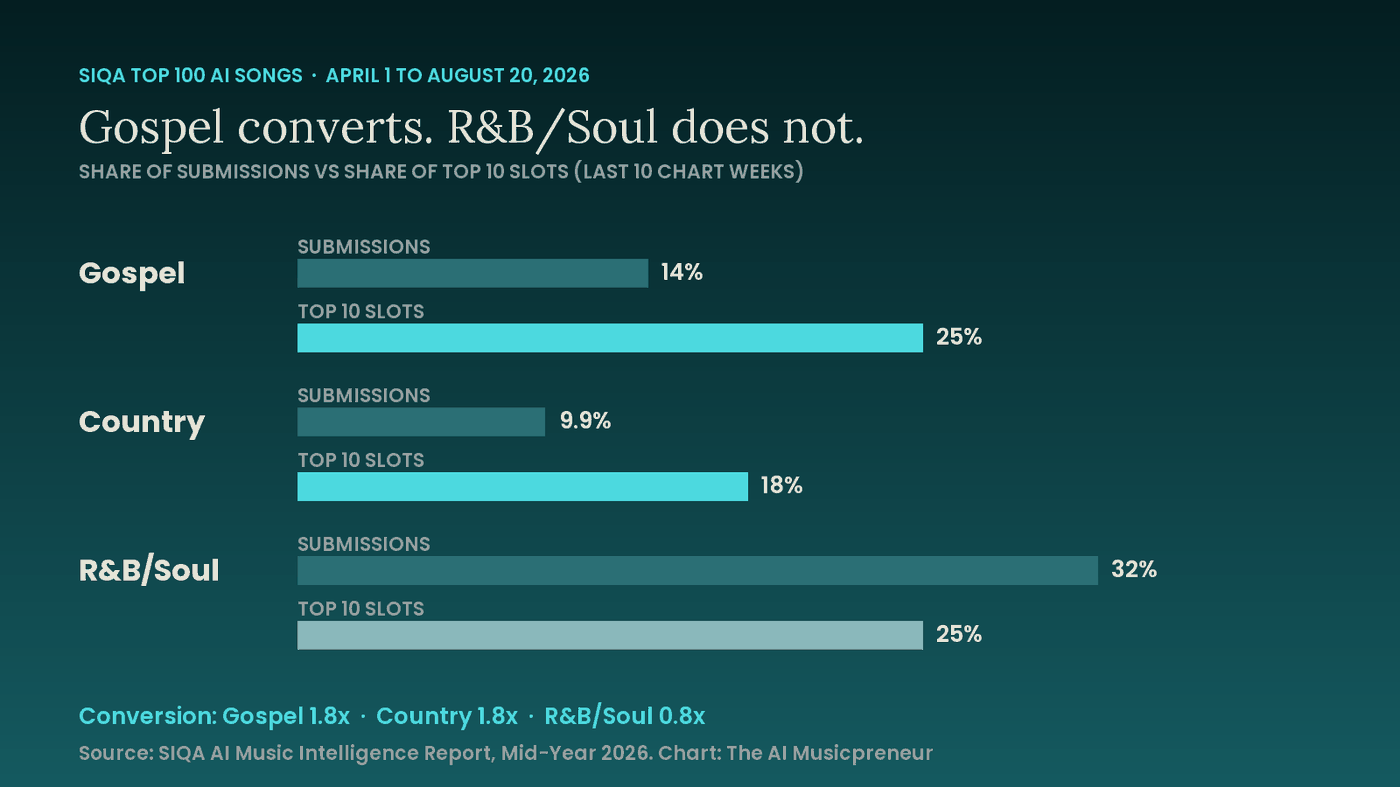
Country ran the same arc at smaller scale, tripling its share of top slots from 6% to 18% on the strength of Dust & Harmony’s “You Problem”. The slots Gospel and Country gained came almost entirely out of R&B/Soul.
This is the second reporting period running where Gospel converts above its weight. In Q1 it was 8.7% of releases and 21.2% of chart positions. One period is a statistic. Two is a pattern.
Why gospel works for AI music when rap does not
Nothing about these tools got more gospel-shaped between April and August. The tools stayed the same, so the movement is an audience signal rather than a product one.
Gospel’s form fits what AI music does well. The lyric carries the song, the vocal is the performance, and the arrangement sits underneath rather than out front. Faith communities also share music directly, person to person, without waiting for an editorial playlist to validate it.
There is a second reason worth saying plainly. An AI vocal singing about faith does not trigger the authenticity argument that the same vocal triggers in rap, where who is speaking is most of the point.
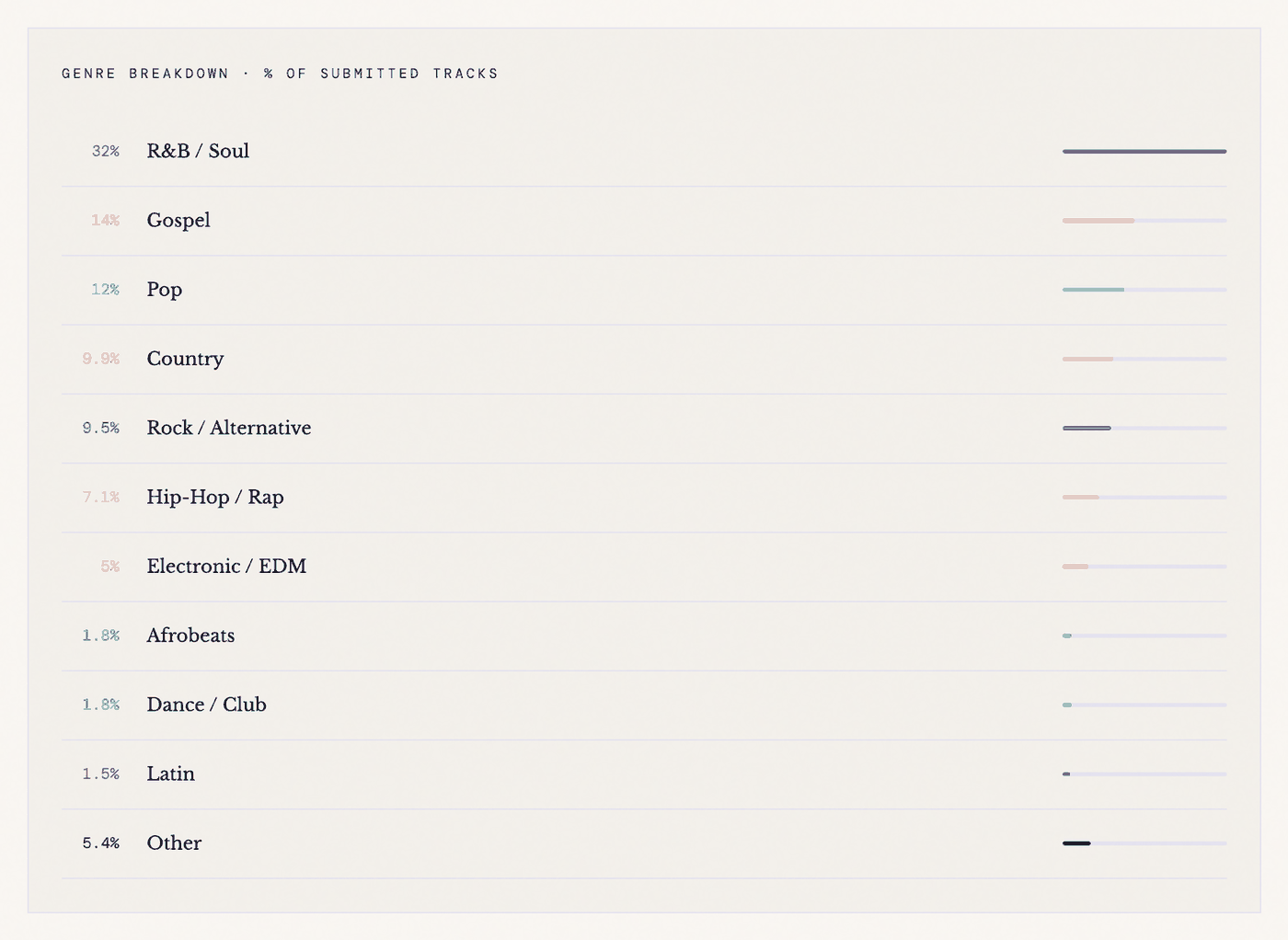
The counterpart nobody is discussing is Hip-Hop/Rap. It fell from 11.8% of releases to 7.1% and stayed the category’s biggest underperformer across both reports. Fewer people are making AI rap, and the ones who do still struggle to find listeners.
The AI gospel artists behind the numbers
Thompsxn Therapy’s “DON’T PLAY WITH ME” anchored the genre for the whole period and was still inside the top 10 in its 27th consecutive week.
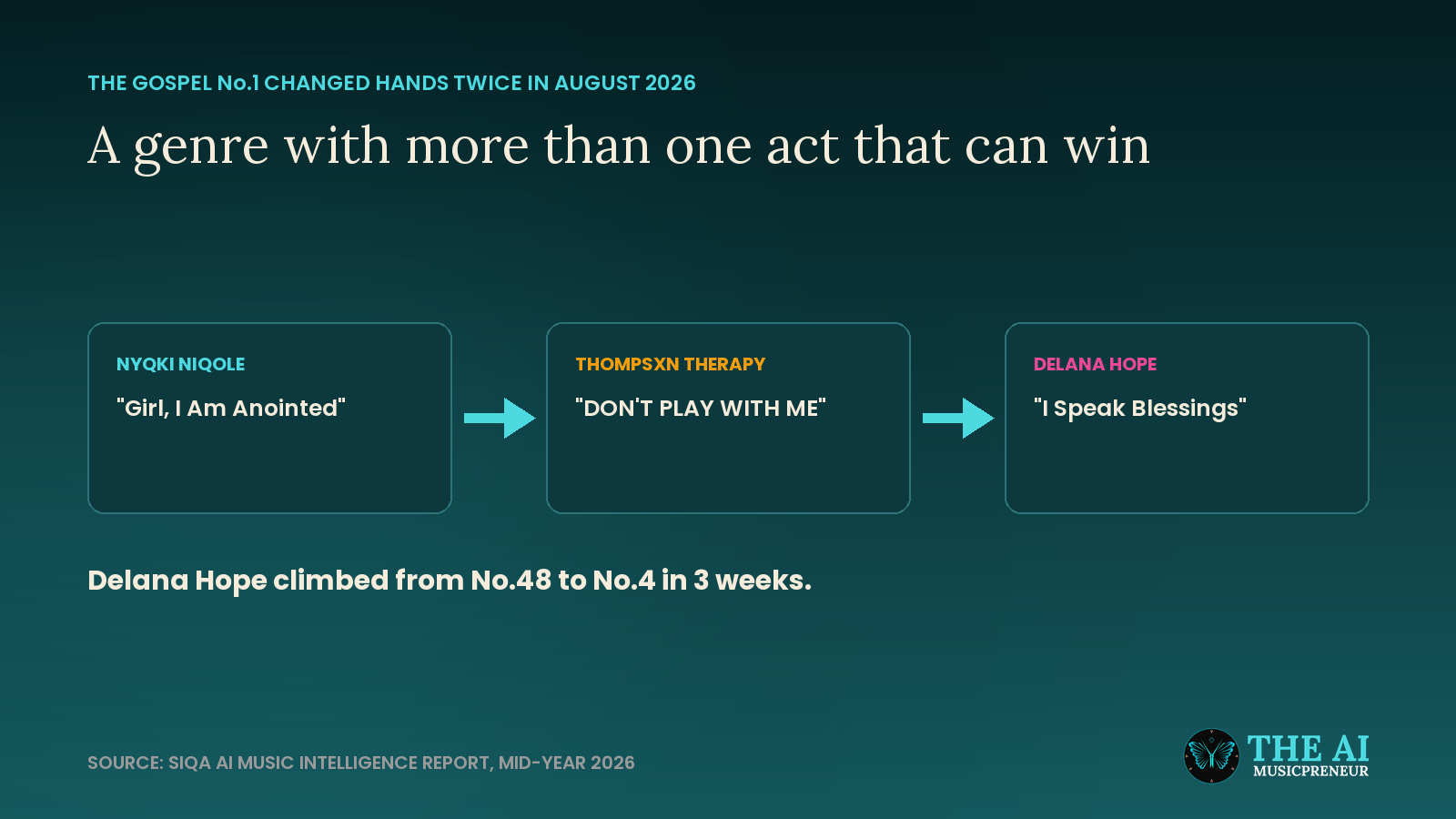
The Gospel number 1 changed hands twice in August. Nyqki Niqole’s “Girl, I Am Anointed” took it, Thompsxn Therapy took it back, then Delana Hope’s “I Speak Blessings” climbed from number 48 to number 4 in 3 weeks. Delana Hope’s own bio states a human writes every lyric while an AI voice sings them, and her catalogue has passed 13 million Spotify streams.
For anyone in A&R, publishing or sync asking where AI music actually finds an audience rather than a novelty click, the answer this year is faith-based and country. Not the genres the industry assumed it would be.
If you make music with AI, I’d read that as permission to stop chasing the crowded lane. R&B is where everyone is pointing their tools, and it is now the genre where output and results have come furthest apart.
Frequently asked questions
Which genre grew fastest in AI music during 2026?
Gospel. Its share of AI music releases went from 8.1% in SIQA's Q1 2026 report to 14.0% at mid-year, the largest proportional gain of any genre in the dataset. Country grew too, tripling its share of top chart slots from 6% to 18% between the first and last 10 weeks of the period.
Why does AI gospel music perform better than AI hip-hop?
SIQA does not answer the why, it reports the gap. Gospel took 25% of the most popular AI songs on 14% of releases, while Hip-Hop/Rap fell to 7.1% of releases and stayed the category's biggest chart underperformer across both reporting periods. Gospel's strengths line up with what these tools do well: the lyric carries the song, the vocal is the performance, and faith audiences share music directly rather than waiting for playlists.
Which AI gospel artists charted during SIQA's mid-year 2026 period?
Thompsxn Therapy anchored the genre for the entire period with DON'T PLAY WITH ME. The Gospel number 1 changed hands twice in August, first to Nyqki Niqole's Girl, I Am Anointed, then back to Thompsxn Therapy, then to Delana Hope's I Speak Blessings, which climbed from number 48 to number 4 on the Top 100 in 3 weeks.
How much of AI music is gospel in 2026?
Gospel accounted for 14.0% of the 1,743 verified AI releases in SIQA's Mid-Year 2026 report, covering April 1 to August 20, 2026. R&B/Soul leads at 32.0%, followed by Pop at 12.0%, Country at 9.9%, Rock/Alternative at 9.5% and Hip-Hop/Rap at 7.1%.
About the author

Covering AI music tools, industry shifts, and news for music creators and professionals. Twice-weekly newsletter at aimusicpreneur.com.