8 insights from Musixmatch CEO Max Ciociola on lyrics, Suno and AI licensing
My stack My fav 6 tools for AI music after testing 70+
-
 ElevenMusic · Music generation
 -
 Moises · Stem separation
 -
 Controlla · Voice swap & cloning
 -
 Cryo Mix · Mixing + mastering
 -
 Neural Frames · Music videos
 -
 ONCE · Distribution
Some links are affiliate links — I earn a commission at no cost to you. Every tool here is one I run myself and truly believe in. This stack is proven.

Max Ciociola thinks the way you find music is about to change, and that lyrics will be the thing that decides it.
The founder and CEO of Musixmatch sat down with Tim Ingham for a Music Business Worldwide interview published on September 28, 2026. His headline line: lyrics are becoming “the LLM of the music industry.”
Musixmatch is the company whose lyrics scroll under songs on Spotify, YouTube, Apple Music and Instagram. It’s also the company that now screens Suno prompts for copyrighted lyrics, which puts it in the middle of the AI licensing fight.
Here are 8 insights from the interview that matter if you write, publish or release music.
The 8 insights from Max Ciociola’s MBW interview
I’ve kept Ciociola’s own words in quotes and marked where MBW is describing rather than quoting him. The first 4 cover AI and licensing, the last 4 cover songwriters and the wider industry.
1. Musixmatch now calls itself a fintech company that processes royalties
Ciociola still agrees lyrics are the bedrock of Musixmatch. But he describes the business as something else now.
“We have evolved into a kind of fintech company – our main job is processing royalties,” he told MBW.
The scale behind that claim:
- Almost 250,000 rightsholders, large and small, get paid through Musixmatch.
- More than 80 million people use it worldwide.
- It archives and polices lyrics in over 250 languages.
His next step is bigger again. “The focus now is becoming a multi-agent rights administration company, helping protect rightsholders, and helping songwriters protect their own work.”
2. Ciociola says prompts will replace music search, with lyrics at the centre
Ciociola’s biggest claim is about how you’ll find music.
In the language of AI, lyrics are becoming the LLM of the music industry. They are literally the language of the music.
Ciociola predicts search and discovery as we know them will “be forever gone” within a few years. Instead of typing a song title, you’ll prompt: build me a playlist of songs about heartbreak.
That’s already starting. Spotify’s AI playlist beta and YouTube’s Ask Music both let you ask for music in plain words.
And a prompt about heartbreak only works if something knows which songs are about heartbreak. That’s the lyrics. Yet the National Music Publishers’ Association estimated lyrics licensing made up just 1% of publisher and songwriter revenue in 2024. Ciociola thinks that number badly undersells what lyrics are worth once discovery runs through AI.
3. Sentinel checks a Suno prompt for copyrighted lyrics in under 100 milliseconds
Musixmatch announced Sentinel in March 2026. It’s a real-time copyright check, built after investment from Musixmatch backer TPG, that spots even partial lyric infringement while someone is still typing a prompt.
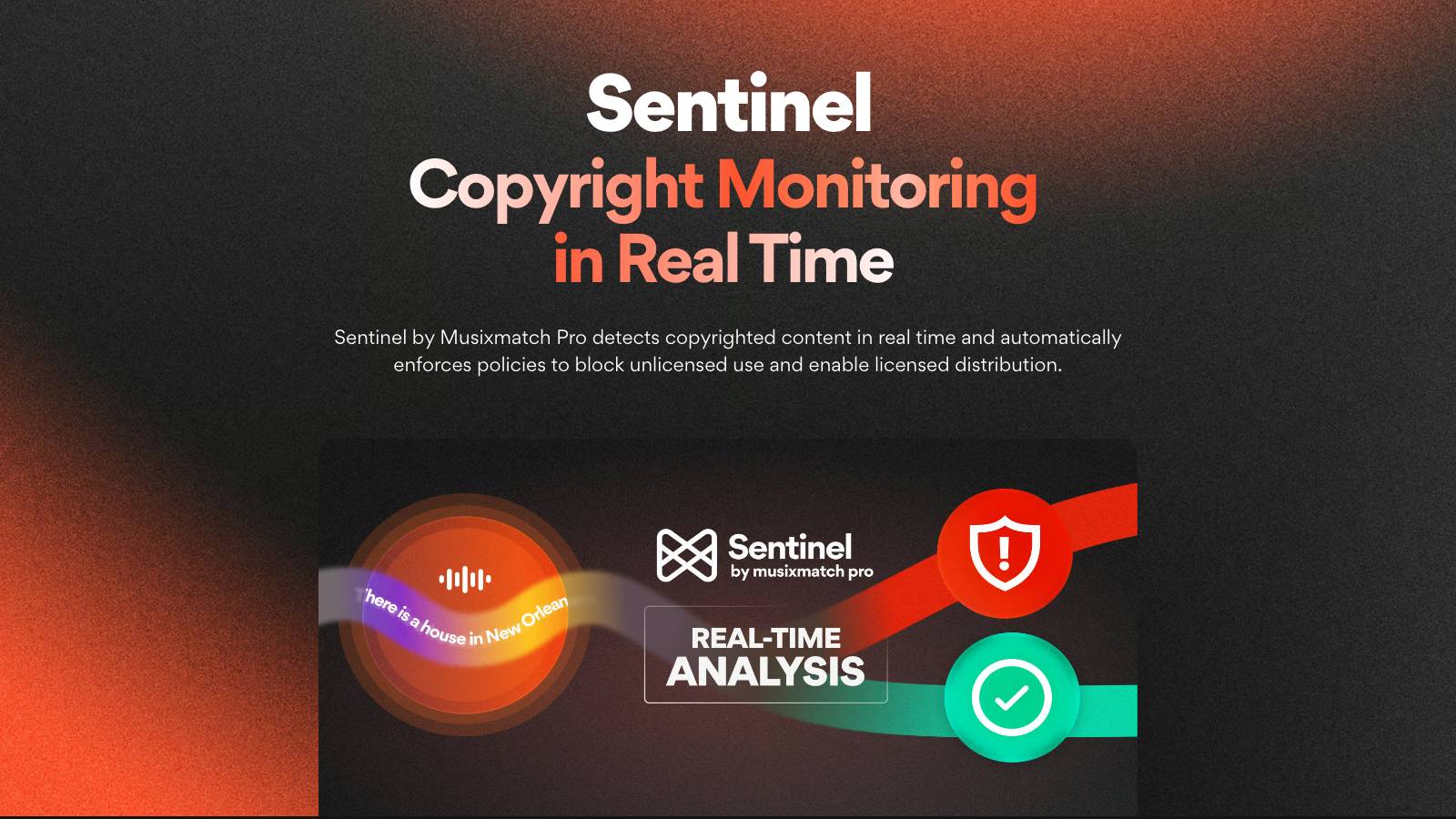
Suno confirmed in August that it uses Sentinel, which I covered when Suno became its first customer. If you paste someone else’s copyrighted lyrics into Suno, Sentinel is what catches it.
Here’s what Sentinel does beyond the prompt box, per MBW:
- It scans finished AI music and user-generated music more widely, on YouTube for example, for copyrighted lyric fragments.
- It gives publishers and labels a near-instant way to find cover versions on UGC platforms and claim against them.
- It returns a verdict in under 100 milliseconds.
Musixmatch plans to expand Sentinel beyond lyrics into a wider menu of copyright identification services. MBW ties the timing to regulation: the EU AI Act pushes AI developers to show they respect copyright, and US takedown rules push platforms to act fast.
4. Musixmatch sells the same check to rightsholders and AI companies
MBW’s read is that Sentinel lets Musixmatch supply both camps at once: the rightsholders policing their catalogs, and the AI companies trying to stay legal.
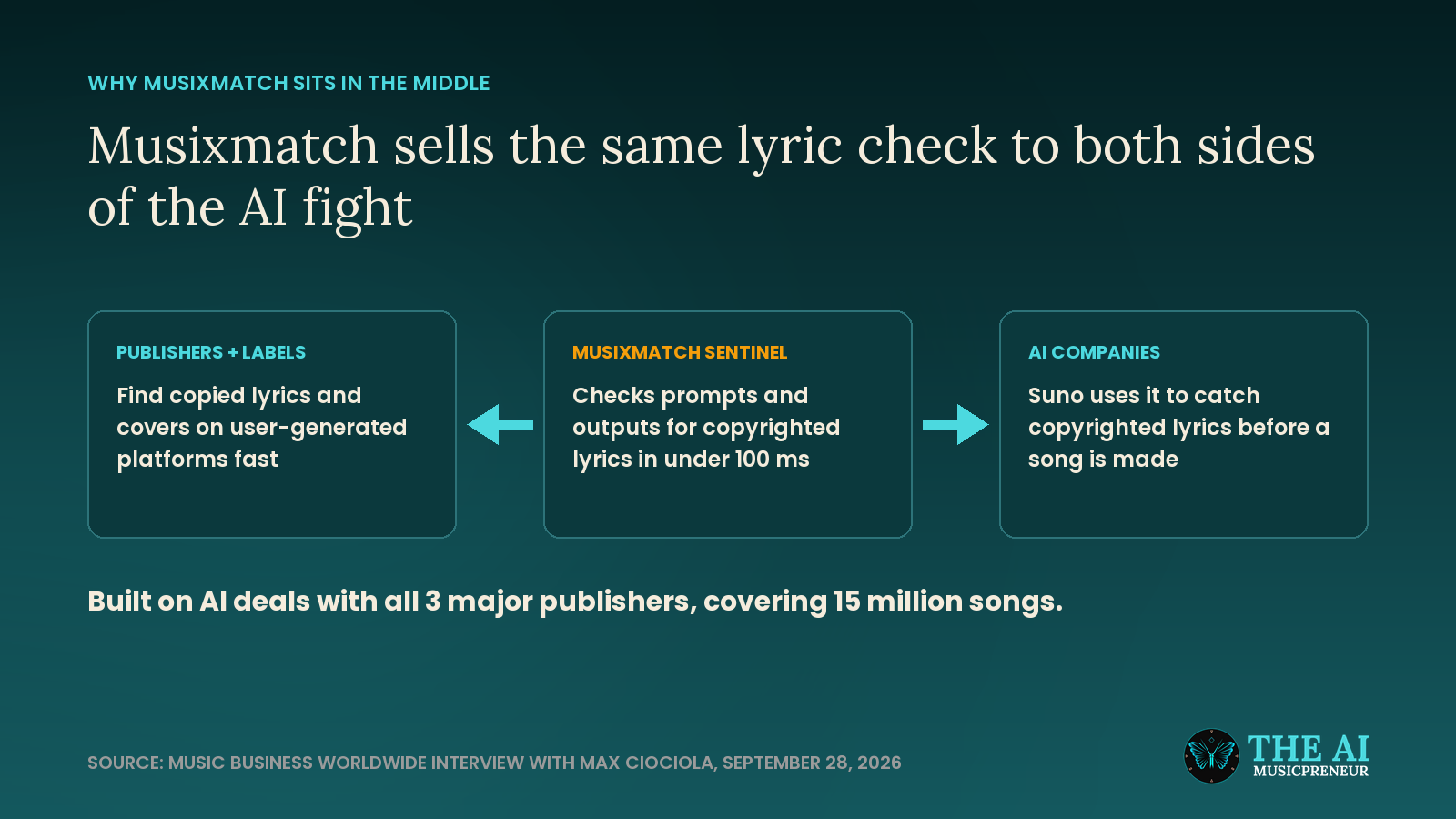
That position rests on deals made before the AI boom got loud. In October 2025, Musixmatch signed AI innovation deals with all 3 major music publishers, covering 15 million songs.
The AI side keeps moving towards licensing too. Warner was the first major to license Suno, and BMG followed this summer, even as Universal and Sony keep suing.
Rio Caraeff, the Vevo founder who joined Musixmatch in 2023 and is now its Co-President, calls the Suno deal a sign of a “broader landscape” that needs “robust infrastructure to help platforms understand what is being created and whether copyrighted material is being submitted.”
5. Music Lens lets a publisher ask its own catalog questions
Built alongside Sentinel, Music Lens is what Musixmatch calls the world’s first AI “music agent.” It reads the meaning, mood, sentiment and context in a publisher’s catalog metadata, even across millions of compositions.
Here’s what that looks like in use, according to MBW:
- Surfacing royalty insights on songs that are trending.
- Pulling AI-picked catalog matches for a sync brief from a potential licensee.
It’s a similar idea to Chartmetric’s Flow agent for music data, pointed at songs instead of streams.
Ciociola also credits AI with how fast Musixmatch ships now. “When you pair AI coding with the best engineers, you can suddenly transform a company’s vision into working [prototypes] much faster. It’s like Aladdin’s lamp!”
6. Ciociola sides with IP owners and expects Anthropic to settle
Musixmatch sells to Suno, but Ciociola didn’t hedge on training data.
“I fully stand on the IP owners’ side,” he said. On AI companies scraping and pirating books to train their models: “It’s wrong. All of these things need to be fixed. And if you’re an IP owner, you’re right to be mad – it’s like entering a famous museum and stealing things for your own gallery.”
On Anthropic, which music publishers have been suing over lyrics since 2023, he expects settlements with the rightsholders. “They absolutely have to fix it, and they will.”
He still thinks lawsuits are the wrong tool between companies that need each other. In that situation, he said, “litigation is a failing moment,” adding: “It always wastes time and costs a ton of money.” He points to Google and YouTube, where most of the early anger from rightsholders got solved by technology.
One footnote MBW adds: Musixmatch is itself being sued by rival LyricFind, which accuses it of anticompetitive practices over an exclusive Warner Chappell licence. Musixmatch calls the claim “without merit,” and the two sides recently told the court they won’t mediate.
7. Songwriters lose money at 4 stages, and Musixmatch wants to close each one
Ciociola came to music as a technologist. He built and sold an early mobile business, and later sat on the European Commission’s high-level expert group on AI. Early on, he concluded the part of the industry leaking the most value was also the most essential one: songwriters.
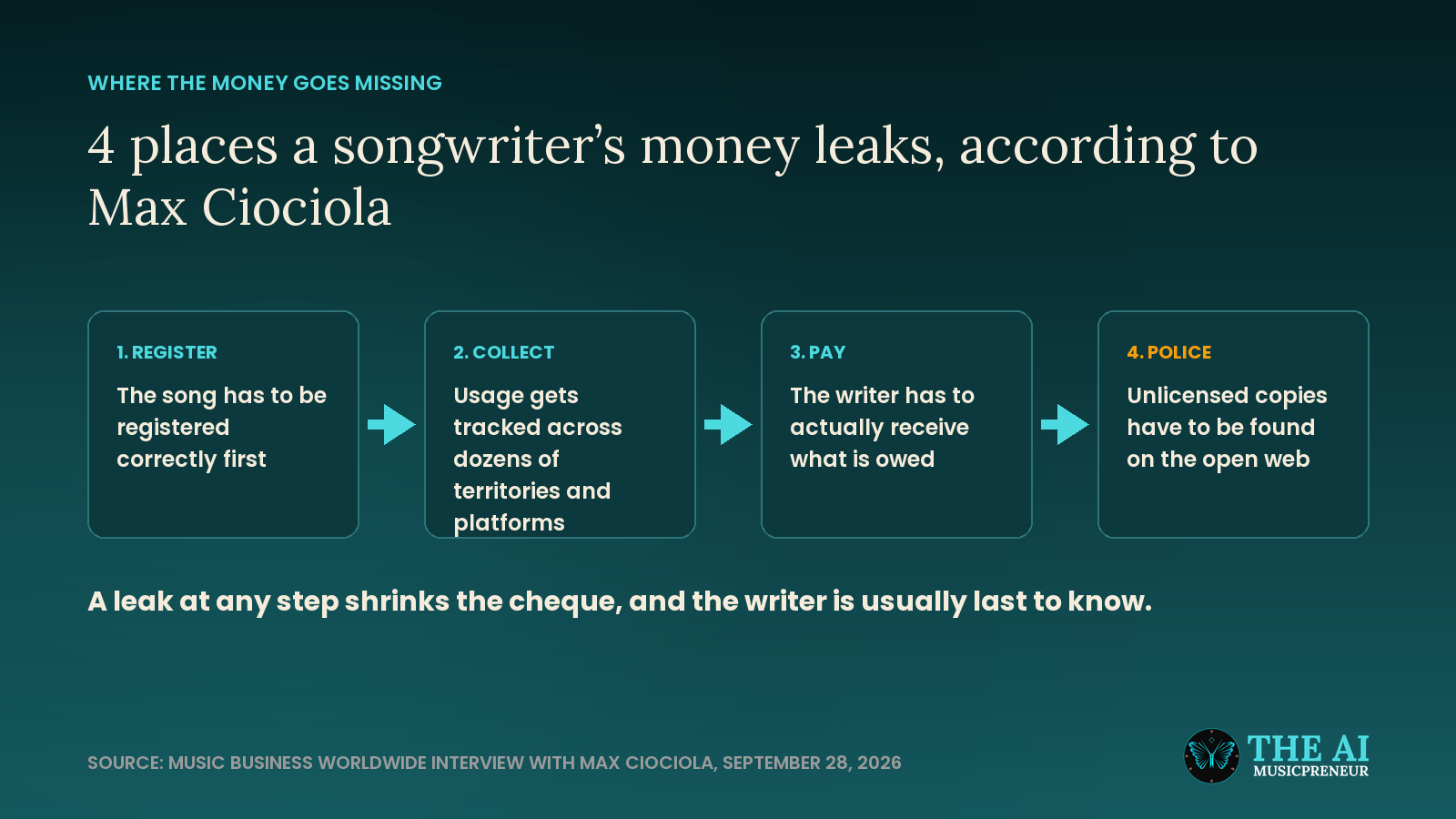
Ask him what a songwriter is up against and he walks through the chain: getting a work registered correctly, having its usage collected across dozens of territories and platforms, actually being paid what’s owed, then policing the open web for unlicensed copies. MBW sums up his view: value leaks at every stage, and the writer is often the last to see it.
“When there is an amazing painting, we talk about the painter,” Ciociola said. “But when there is a song, we so often only talk about the performer – not about the songwriter.”
8. Publishers, labels and collecting societies have “no excuses” not to modernise
Ciociola thinks music has let its technology drift. “We need more curiosity,” he said. “We need to be under review every single day.”
Here’s what he expects rights businesses to run on by now:
- APIs that expose their data.
- Real-time reports for rightsholders, instead of statements that take months.
- AI agents wired into finance and catalog management.
The building blocks are cheap and available, in his telling, so “there are no excuses” not to modernise.
He’s also worried about who builds the next tools. In 2010, Musixmatch launched alongside Daniel Ek at Spotify, Alex Ljung and Eric Wahlforss at SoundCloud, and the teams behind Songkick and The Echo Nest. “I don’t see young talent breaking through with fresh [music-tech] ideas like that today, and that worries me.”
Quick recap of Max Ciociola’s 8 insights
- Musixmatch calls itself a fintech company now, paying almost 250,000 rightsholders.
- Ciociola says prompts will replace search, and lyrics will decide what a prompt finds.
- Sentinel checks Suno prompts for copyrighted lyrics in under 100 milliseconds.
- Musixmatch sells that check to both rightsholders and AI companies.
- Music Lens turns a publisher’s catalog into something you can question like an agent.
- Ciociola backs IP owners and expects Anthropic to settle with publishers.
- Songwriter money leaks at registration, collection, payment and policing.
- He says rights businesses have “no excuses” not to run on APIs and real-time data.
Ciociola’s bet is that the 1% lyrics line in the NMPA’s numbers won’t stay at 1% once people find music by prompt.
Frequently asked questions
When and where did Max Ciociola found Musixmatch?
Max Ciociola founded Musixmatch in Bologna, Italy, and the company launched in 2010. Before music, he built and sold an early mobile business, and he later served on the European Commission's high-level expert group on AI.
Who is Rio Caraeff at Musixmatch?
Rio Caraeff is the founder of Vevo. He joined Musixmatch in 2023 and is now its Co-President.
How much of music publishers' revenue came from lyrics licensing in 2024?
The National Music Publishers' Association estimated that lyrics licensing made up just 1% of publishers' and songwriters' revenues in 2024. The NMPA has since folded lyrics income into an 'Other' category.
When did TPG invest in Musixmatch?
Private equity firm TPG invested in Musixmatch in 2022. Ciociola told MBW the deal was less about cash than about entering 'a new league' with backers who knew how to scale a tech company. TPG's other music-adjacent investments include Spotify, CAA and Fender.
How many songs did Musixmatch's 2025 AI deals with the major publishers cover?
In October 2025, Musixmatch signed AI innovation deals with all 3 major music publishers, covering a catalog of 15 million songs to build tools for responsible AI development.
About the author

Covering AI music tools, industry shifts, and news for music creators and professionals. Twice-weekly newsletter at aimusicpreneur.com.