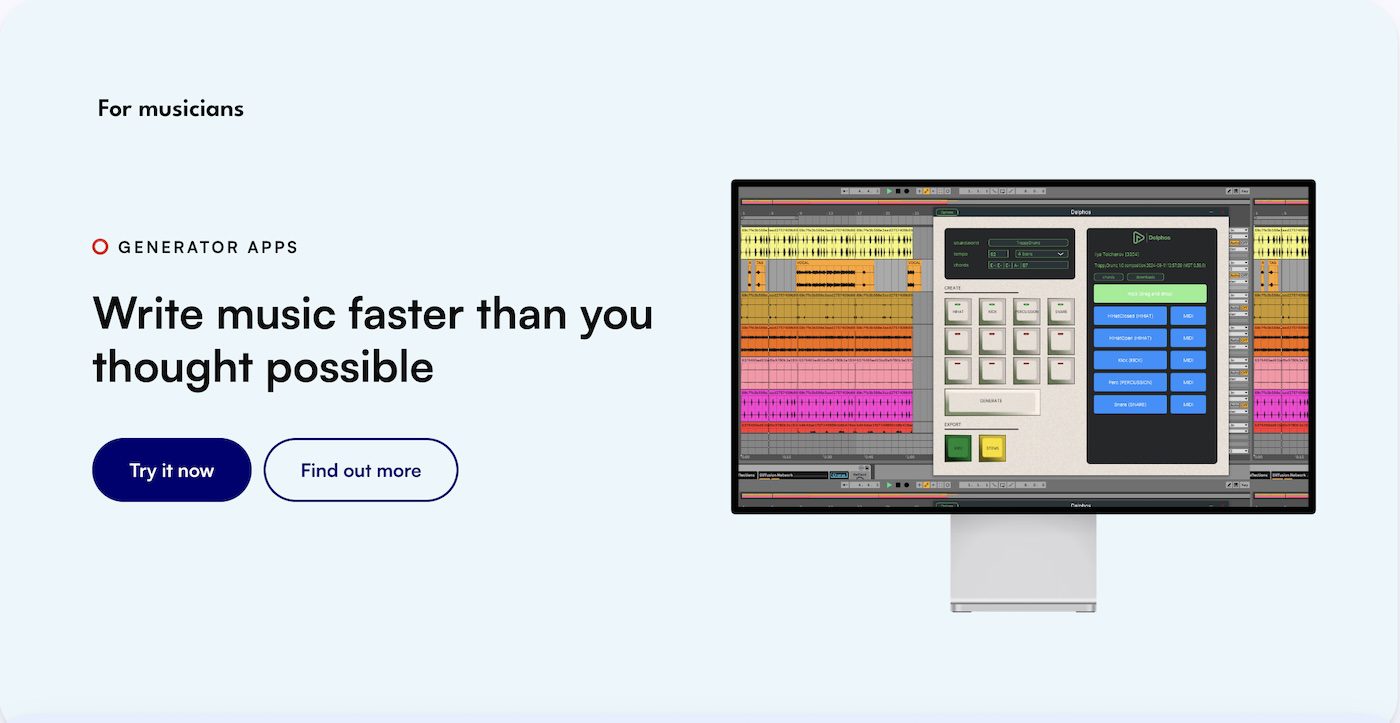
77% of producers fear AI kills creativity: Delphos Copilot generates MIDI and audio you can edit note by note:
My stack My fav 6 tools for AI music after testing 70+
-
 ElevenMusic · Music generation
 -
 Moises · Stem separation
 -
 Controlla · Voice swap & cloning
 -
 Cryo Mix · Mixing + mastering
 -
 Neural Frames · Music videos
 -
 ONCE · Distribution
Some links are affiliate links — I earn a commission at no cost to you. Every tool here is one I run myself and truly believe in. This stack is proven.
Key highlights
- A 2026 Sonarworks survey of 1,194 creators found 77% fear AI will damage their creativity, yet only 21% currently use it for composition
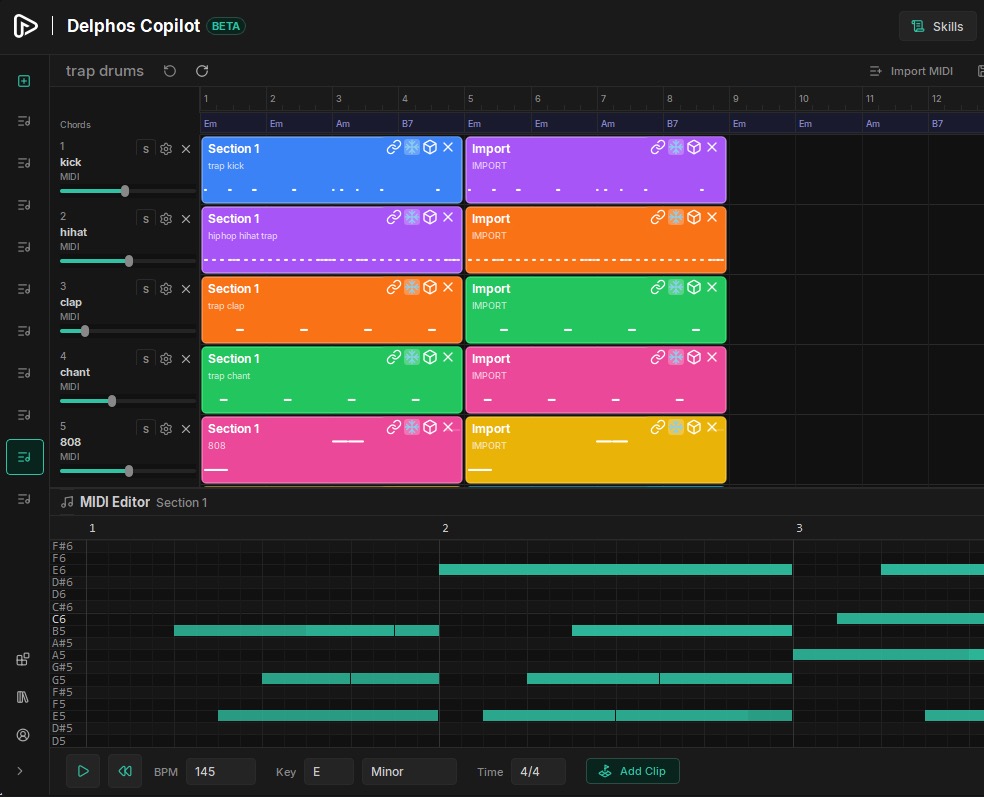
- Delphos Copilot generates MIDI clip by clip from text prompts, lets you edit every note in a piano roll, and renders professional audio stems
- Soundworlds are style models trained exclusively by their copyright owners, who earn per transaction and retain full control
77% of producers fear AI. Delphos is built to change that.
A Sonarworks survey of 1,194 creators published in 2026 found that 77% fear AI will damage their originality and creativity. Loss of creative control ranked as the primary concern, ahead of job displacement. Only 20.9% currently use AI for composition at all.
Producers don’t reject AI outright. They reject tools that make decisions for them. The same survey found 57.9% want AI as an assistive tool, not an autonomous one. They’ll use it for stem separation and audio restoration. They won’t hand it the composer’s chair.
Delphos Copilot is built on exactly that distinction.
What Delphos Copilot actually does
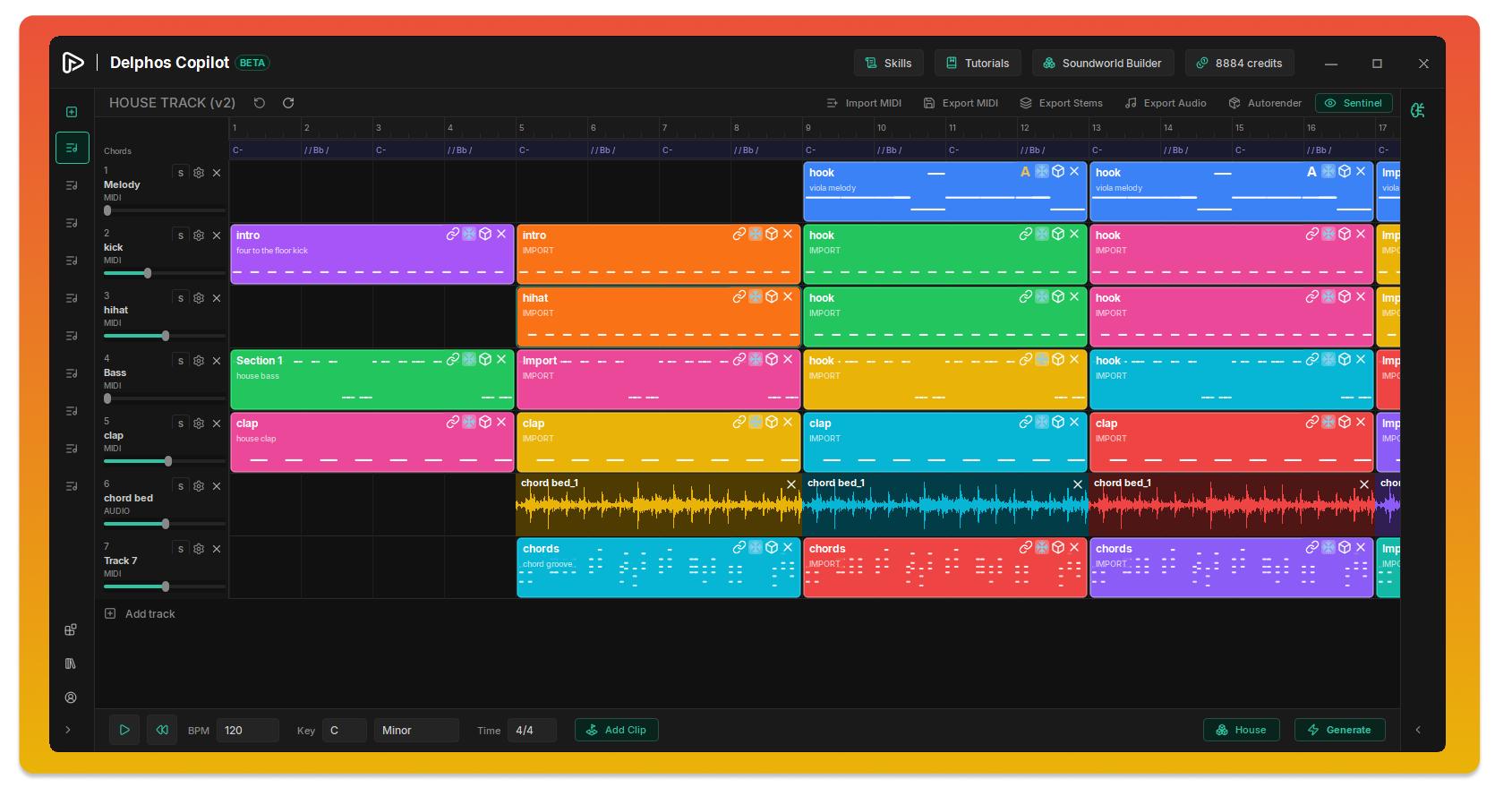
Copilot is a downloadable composition workstation, currently in beta on Windows (Mac coming). It generates MIDI and audio from text prompts, clip by clip. You place a clip on the timeline, type a description (a jazzy bassline, a Baroque chord sequence, a driving hi-hat pattern), and hit Generate.
The result lands in a piano roll where you edit individual notes.
When you’re done, render to professional audio stems or push the MIDI to your DAW.
The Copilot agent isn’t a command interface. It’s a conversation. You ask it to harmonise a melody. It detects the key, offers you D minor or F major, and waits for your answer before it does anything. Composition decisions stay with you.
Ilya Tolchenov, CEO and co-founder, told Music Business Worldwide in October 2024: “It’s like collaborating with yourself on your best day.”
Soundworlds solve the copyright problem before it starts
The style engine behind Copilot is Soundworlds. Each Soundworld is a generative MIDI model trained by a single composer on their own music. The creator owns it and retains full control.
That’s a structural answer to the debate that surrounds tools like Suno. There’s no scraped training data. No fair-use reliance. If you want, build your own: the Enterprise tier includes Soundworld Builder, where you train a custom model on your own compositions and license it to others for revenue.
“Delphos Music takes a very strong position regarding copyright ownership and supporting musicians, no matter what legislation regarding so-called fair use may exist.” This is stated directly on their website.
Built by people who understand music composition

Delphos was founded by a father-and-son team with Anglo-Ukrainian roots. Roman Tolchenov (CTO) brings 30+ years of technology development and a background in theoretical physics. Ilya Tolchenov (CEO) is a mathematician, professional singer, and composer of sacred Orthodox choral music. He founded Orarion before Delphos, a notation tool built on the same principle: give composers better tools, not fewer decisions.
The takeaway: Ilya said in a March 2026 interview: “Musical thinking is beyond general-purpose AI for the time being.” Delphos addresses that with “Structured Thinking,” a proprietary musical logic layer that handles theory, voicing rules, and genre conventions. The AI handles execution. The musical intelligence is built in-house.
What this means for your workflow
Copilot is free to download on Windows. Credits cost $0.05 each. The free tier includes 100 credits per month. Pro is $50/month for 1,000 credits, the full Soundworld library, and custom workflows. Enterprise is $500/month and adds Soundworld Builder plus API access.
If you’ve avoided AI composition tools because you didn’t want to give up the piano roll, this is where to start. The question of who owns AI-generated music has a cleaner answer when you own the training data.
Producers concerned about AI replacing their role will find Delphos designed specifically for the skills the Sonarworks survey identified as irreplaceable: musicality, critical listening, arrangement, and emotional judgment. The Patreon CEO’s “bloodbath” framing for AI training practices makes the contrast sharper: Delphos doesn’t train on your music without permission. It trains on your music because you told it to.

For a full picture of where AI-generated tracks can be distributed, see the AI music platform rules for 2026. For background on why the 77% fear figure reflects something structural, not irrational, read why producers fear AI.
Frequently asked questions
Frequently asked questions
What is Delphos Copilot and how does it work?
Delphos Copilot is a downloadable AI composition workstation. You place clips on a timeline, describe each one in natural language, generate MIDI, edit notes in a piano roll, and render to audio. The Copilot agent converses with you, confirms decisions before executing, and can analyze existing MIDI or suggest variations.
Does Delphos generate audio or only MIDI?
Both. Delphos generates MIDI from text prompts, which you can edit note by note. You then render that MIDI to professional audio stems directly inside the app, or export the MIDI to your DAW and trigger your own instruments.
What are Soundworlds and who owns them?
Soundworlds are generative MIDI style models trained by individual composers on their own music. Owners earn per transaction, retain full copyright, and can retract access at any time. Enterprise users can build and license their own Soundworld via Soundworld Builder.
Is Delphos Copilot free to use?
The app is free to download on Windows. The free tier includes 100 credits per month. Credits cost $0.05 each. Pro is $50/month for 1,000 credits. Enterprise is $500/month and includes Soundworld Builder, API access, and on-device rendering.
How is Delphos different from AI generators like Suno?
Suno produces finished audio tracks you can’t decompose or edit at the note level. Delphos generates editable MIDI, keeps creative decisions with the producer, and trains only on music owned by the Soundworld creator. There’s no reliance on scraped training data.
About the author

Covering AI music tools, industry shifts, and news for music creators and professionals. Twice-weekly newsletter at aimusicpreneur.com.