Cyanite's Tagging 2.0 reads a track every 10 seconds and turns catalogues into something an LLM can query
My stack My fav 6 tools for AI music after testing 70+
-
 ElevenMusic · Music generation
 -
 Moises · Stem separation
 -
 Controlla · Voice swap & cloning
 -
 Cryo Mix · Mixing + mastering
 -
 Neural Frames · Music videos
 -
 ONCE · Distribution
Some links are affiliate links — I earn a commission at no cost to you. Every tool here is one I run myself and truly believe in. This stack is proven.
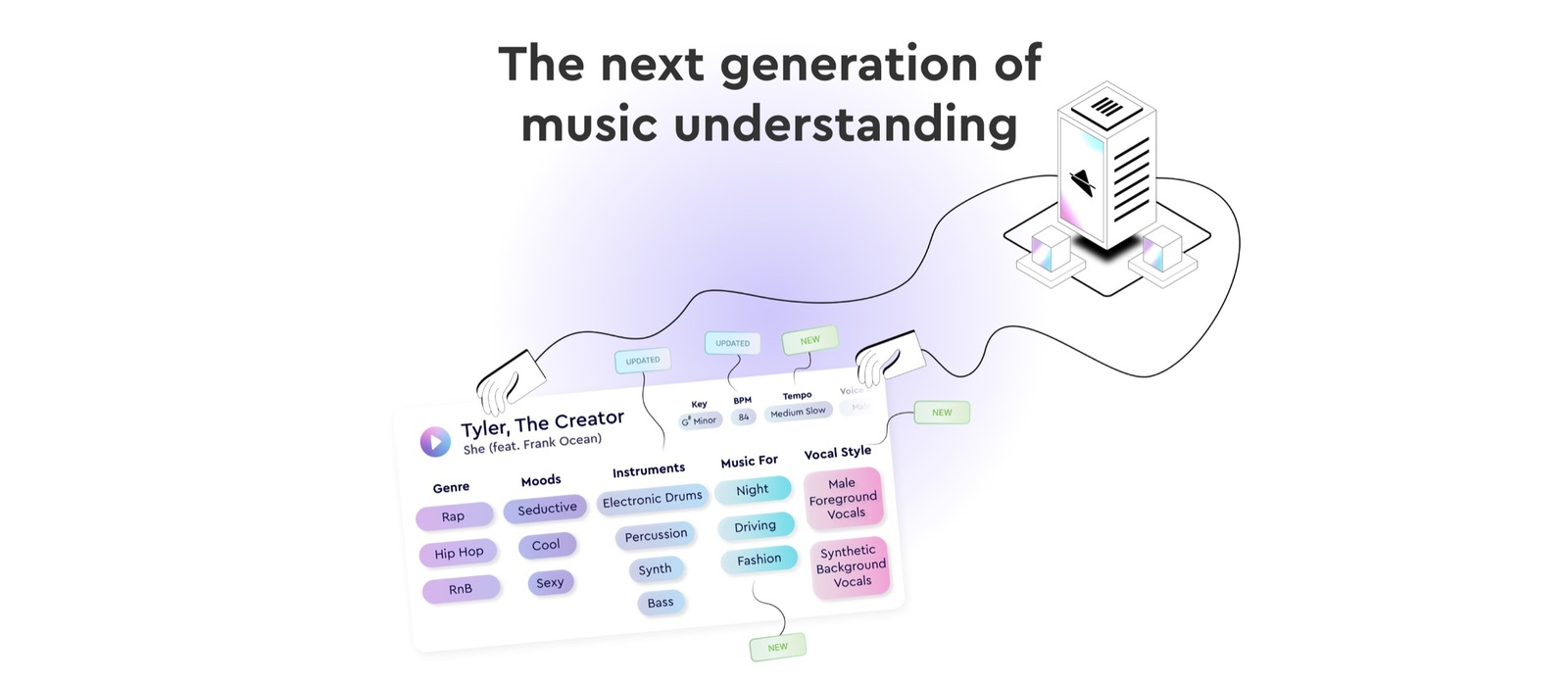
Cyanite announced Tagging 2.0 from Berlin on August 18, and the headline change is resolution. The system now analyses music in 10-second segments rather than 15, which produces up to 2,500 data points per minute of music, and it does that across a set of models that got noticeably wider.
New in this release are Lyric Analysis, Tempo, Vocal Style, Music For and Use Case, and Structural Segmentation. The existing BPM and Instruments models were reworked rather than left alone.
What changes when a catalogue is being read by software instead of a person
Cyanite’s framing of this release is worth reading carefully, because it is a bet on who the customer for metadata actually is now. Music catalogues used to be searched by humans, so tags existed to help a sync agent or a curator find something. That job has not gone away, but a second one has arrived on top of it.
Conversational search, recommendation, catalogue automation and assistants all need to reason about music they cannot listen to. What they can read is structure, and structure is what tagging produces. Cyanite’s argument is that the quality of any of those AI workflows is capped by the quality of the music understanding sitting underneath.
AI is changing how the music industry works with music catalogues. But these new workflows are only as good as the music understanding behind them. With Tagging 2.0, we're strengthening that understanding layer, the foundation that makes intelligent music workflows possible.
The release ships with a new REST API built for higher throughput, sized for catalogues running from thousands of tracks to millions. Free Text Search and Similarity Search both inherit the richer context, which Cyanite says makes recommendations more transparent because there is more musical detail attached to every result.
Who is already running it, and what the scale tells you
Four names are in the launch: US marketplace BeatStars, Dutch distributor The Source, Japanese label Rambling Records and US sonic branding agency Human Worldwide. That spread across marketplace, distribution, label and branding is the tell, because these are four different jobs that now want the same underlying data.
BeatStars gives the clearest picture of why throughput matters.
“Every month, we process hundreds of thousands of new tracks, so both metadata quality and platform reliability are critical. Cyanite’s Tagging 2.0 gives us the music understanding we need to create a better discovery experience for our creators.”
Anirudh Mani, Chief Science Officer at BeatStars
More than 200 music companies use Cyanite across its products, a list that includes Epidemic Sound, Warner Chappell, LANDR and APM Music, and the company says it has analysed more than 55 million songs.
For working producers and songwriters the effect arrives indirectly, through better matching. A marketplace that can read vocal style, use case and song structure at 10-second resolution can place your track against a brief far more precisely than one working from three genre tags, which cuts both ways: the ceiling for discovery goes up, and so does the number of competing tracks the system can now describe as accurately as yours.
There is also a live question about what a richer understanding layer does for the detection problem next door. Cyanite already sells AI music detection alongside tagging, and Anghami’s COO argued this week that tools trained on Western catalogues misread Arabic music in both creation and detection. Deeper structural analysis is the plausible route to fixing that, and it is worth asking whether the new models were benchmarked outside Western repertoire.
Frequently asked questions
What is new in Cyanite Tagging 2.0?
Tagging 2.0 adds music understanding models for Lyric Analysis, Tempo, Vocal Style, Music For and Use Case, and Structural Segmentation, and significantly improves the existing BPM and Instruments models. It also increases tagging granularity from 15-second to 10-second segments and ships a new REST API built for higher throughput.
How many data points does Cyanite Tagging 2.0 generate per minute of music?
Up to 2,500 data points per minute of music. That comes from the move to 10-second analysis segments, down from the 15-second segments the previous version used, which gives a more detailed read of how a track changes across its running time.
Which companies are already using Cyanite Tagging 2.0?
Cyanite names US music marketplace BeatStars, Dutch distributor The Source, Japanese label Rambling Records and US sonic branding agency Human Worldwide as early adopters. Across all products, more than 200 music companies use Cyanite, including Epidemic Sound, Warner Chappell, LANDR and APM Music.
What did BeatStars say about processing volume with Cyanite?
Anirudh Mani, Chief Science Officer at BeatStars, said the company processes hundreds of thousands of new tracks every month, which makes both metadata quality and platform reliability critical. He said Tagging 2.0 gives BeatStars the music understanding it needs to build a better discovery experience for its creators.
Does Tagging 2.0 change Cyanite's search products?
Yes. Cyanite says Tagging 2.0 also improves Free Text Search and Similarity Search by attaching richer musical context to every search result. The stated aim is to make recommendations more transparent and to give AI applications structured data they can reason over.
About the author

Covering AI music tools, industry shifts, and news for music creators and professionals. Twice-weekly newsletter at aimusicpreneur.com.