Vickie Nauman says game developers and gamers resist AI music, and most games want only 10 to 50 songs
My stack My fav 6 tools for AI music after testing 70+
-
 ElevenMusic · Music generation
-
 Moises · Stem separation
-
 Controlla · Voice swap & cloning
-
 Cryo Mix · Mixing + mastering
-
 Neural Frames · Music videos
-
 ONCE · Distribution
Some links are affiliate links — I earn a commission at no cost to you. Every tool here is one I run myself and truly believe in. This stack is proven.
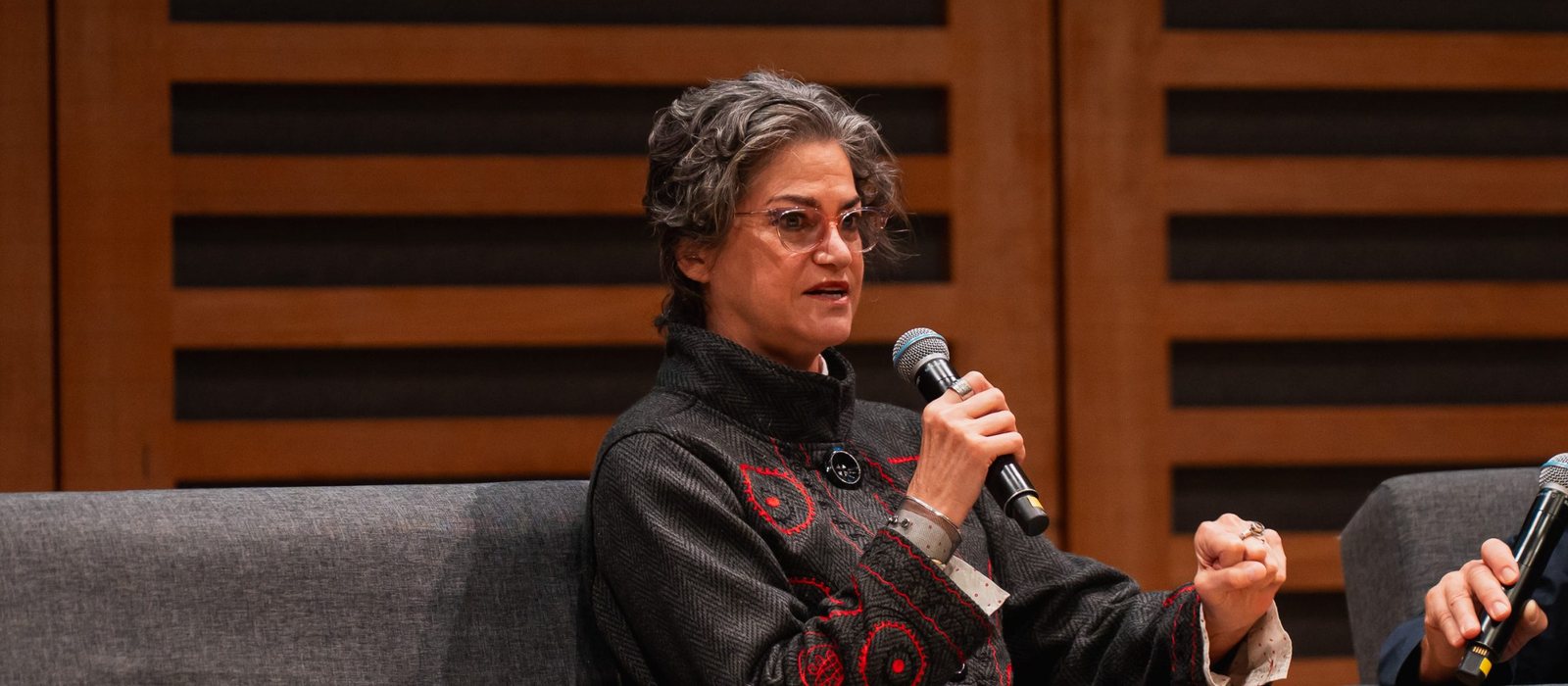
Game developers and gamers are pushing back on AI-generated music, says Vickie Nauman, the CEO of CrossBorderWorks and one of the main go-betweens for music rightsholders and games companies.
She said it on stage at the Music Ally Publishing Summit 2026 at Kings Place in London on October 12, in a keynote interview with Music Ally CEO Paul Brindley. Music Ally published its write-up of the session on November 2.
Her other numbers explain why games matter to music at all. 3.3 billion people play games, she said, and most games want between 10 and 50 songs. Sync deals clear those songs relatively easily, and public performance rights are where the deals get stuck.
Why game developers and gamers resist AI-generated music, says Vickie Nauman
Brindley asked whether AI-generated music is a threat to human music-licensing deals in gaming. Nauman said she sees resistance, not demand.
There is resistance against any kind of AI-generated music, AI-generated characters. Both game developers and gamers really love the human aspect.
“I’m not seeing a lot of interest, and in fact, more resistance against any kind of generative music in games,” she added.
The characters part has a recent example. In June, Sega brought Tupac Shakur into Stranger Than Heaven as a character, built with his estate’s permission and without AI.
Roblox data points the other way. Audioscape found that AI made 46% of the 1,000 most-liked DistroKid tracks on Roblox and earned 58% of the likes. Roblox’s music comes in bulk from DistroKid and the production library APM, though, not picked song by song by a studio.
So if not in games, where does Nauman think AI music is headed?
Why Vickie Nauman worries more about AI drones than AI music
She doesn’t see much demand for songs made from a prompt alone.
“I think AI and generative music is going to evolve into a whole suite of tools that are going to be artist tools, songwriter tools, mixing tools,” she said. “I think if you take streaming fraud out of the equation, right now I don’t know how much of a use-case there is in just truly ‘prompt-to-generative-music’.”
The fraud she set aside has already reached court. In March, Michael Smith pleaded guilty to an $8M AI streaming fraud that ran AI songs through 1,040 bot accounts.
Then came the line Music Ally put in its headline. Nauman said she has “a ton of confidence that the music industry is going to hold these companies accountable,” because she has been around since the early days of digital disruption. “I’m more worried about AI drones and weaponry and surveillance than this!”
“Yes,” Brindley replied. “The killing of all humanity is a slightly bigger concern…”
Earlier that day, songwriter Karen Poole opened the summit by explaining how she uses AI to hear her demos in a male voice. Much of Nauman’s session, though, was about what games actually want from music, and it isn’t a catalogue.
Why most games license 10 to 50 songs instead of a full catalogue
“Gaming is really, really different than anything else that’s out there,” Nauman said. “It’s not like film and TV synchronisation licensing. It’s also not like a mini-DSP…”
A streaming service needs the whole catalogue. Most games want between 10 and 50 songs.
In her September guest column for Music Ally, she gave the practical reasons. Many games are mobile or downloaded and play back on the device, so you can’t embed terabytes of music.
Games often need perpetual rights, because you can’t rip a track out once a player has downloaded the game. Most launch worldwide on day one, and more songs often arrive later as add-on packs.
The audience is huge. “There’s 3.3 billion people who play games around the world,” she said, citing a Deloitte study from “a couple of years ago” that found 49% of them want more music.
I couldn’t find that 49% in Deloitte’s published research. The closest numbers I found are in a January 2022 Deloitte Insights piece: 42% of Gen Z gamers listen to other music while gaming, and 34% hear music in a game and then look it up to stream or buy.
Small catalogues can pay, too. Nauman licensed Imagine Dragons songs for the VR rhythm game Beat Saber on an advance plus revenue share, and the last holdout publisher only agreed after she promised never to come back if the advance didn’t recoup. It recouped within the first quarter.
How does music licensing for video games work?
Most games don’t license songs at all. They hire composers and buy the music outright.
“There’s nothing on the back-end. They pay for it once, and then they get to use it in the game in perpetuity,” Nauman said.
That’s why she calls the usual question from her music clients, how to get games companies to pay more, “the wrong question.” She sees an “experimental stage” right now, where studios are trying music from artists who have a community.
When a game does license a song, 3 rights are in play:
- The song (publishing rights): cleared with the music publisher through a sync licence.
- The recording (master rights): cleared with the label that owns it, often in perpetuity.
- Public performance: the right to play a song to the public, collected by PROs (performing rights organisations) like ASCAP and BMI in the US or PRS for Music in the UK, and by collecting societies (CMOs) elsewhere.
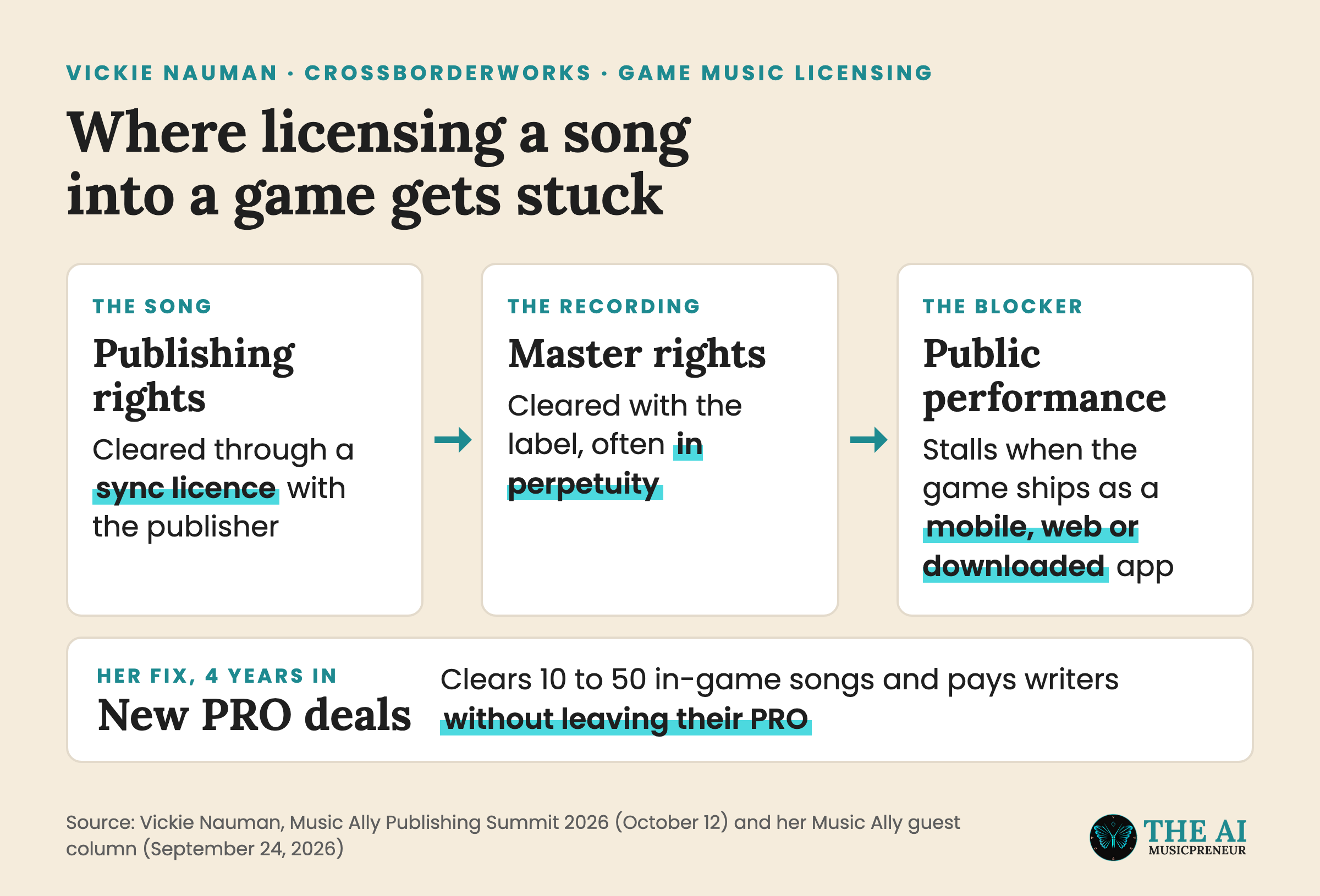
Small collections are “relatively easy to do with sync deals, but then it’s public performance that creates an issue,” Nauman told the summit. In her column she was more specific: when a game ships as a mobile app, a web app or a downloaded client, public performance becomes “a major blocking issue,” and “many gaming legal departments simply say no.”
She has spent 4 years with PROs in the US and societies abroad on a fix. “We need a model that doesn’t require the artist or the writer to exit from a PRO,” she said, adding that people warned her the societies would never be open to it, “but they’ve proven them wrong.”
Can you use AI-generated music in a video game?
Legally, 2 things decide it. The AI tool’s plan decides whether you can use the track commercially, and copyright law decides whether you own anything to license.
On the plan side, Suno attaches commercial rights only to downloads made on Pro or Premier, and my AI music generator roundup lists the terms tool by tool. On the copyright side, the US Copyright Office said in January 2025 that purely AI-generated material can’t be copyrighted, while the human parts can. More on that in whether AI music is copyrighted.
The hurdle Nauman described is a different one: the people who make and play games. A major-label AI deal in gaming from October keeps human recordings at the centre. UMG became the first major label to license TYGER, whose AI reshapes licensed songs to follow live gameplay and doesn’t generate new music.
Nauman’s own column ends on the open question behind all of this: “Is this a billion-dollar line of business for music? It’s unclear.”
Frequently asked questions
Who is Vickie Nauman of CrossBorderWorks?
Vickie Nauman is the founder and CEO of CrossBorderWorks, which she started 12 years ago to advise on new digital opportunities for music. Her focus is gaming, the metaverse and emerging tech, and she works as a bridge between music rightsholders and games companies.
How did Vickie Nauman get Imagine Dragons songs into Beat Saber?
Vickie Nauman licensed Imagine Dragons songs for the VR rhythm game Beat Saber on an advance plus revenue share. The last major publisher holding out only agreed after she promised never to come back about the game if the advance didn't recoup, and it recouped within the first quarter.
Who interviewed Vickie Nauman at the Music Ally Publishing Summit 2026?
Music Ally CEO Paul Brindley interviewed Vickie Nauman in the 11:30am keynote, titled Where Music Grows Next, at Kings Place in London on October 12, 2026. The session covered gaming, AI, and music's overlap with social media and brands.
Where does Vickie Nauman's figure that 49% of gamers want more music come from?
Vickie Nauman attributed it to a Deloitte study from a couple of years ago. Deloitte's January 2022 Insights piece on music and gaming reports that 42% of Gen Z gamers listen to other music while gaming and 34% look up music they hear in a game, but the 49% figure itself does not appear in it.
About the author

Covering AI music tools, industry shifts, and news for music creators and professionals. Twice-weekly newsletter at aimusicpreneur.com.