YouTube starts auto-labeling AI music videos, even if you don't disclose
My stack My fav 6 tools for AI music after testing 70+
-
 ElevenMusic · Music generation
 -
 Moises · Stem separation
 -
 Controlla · Voice swap & cloning
 -
 Cryo Mix · Mixing + mastering
 -
 Neural Frames · Music videos
 -
 ONCE · Distribution
Some links are affiliate links — I earn a commission at no cost to you. Every tool here is one I run myself and truly believe in. This stack is proven.
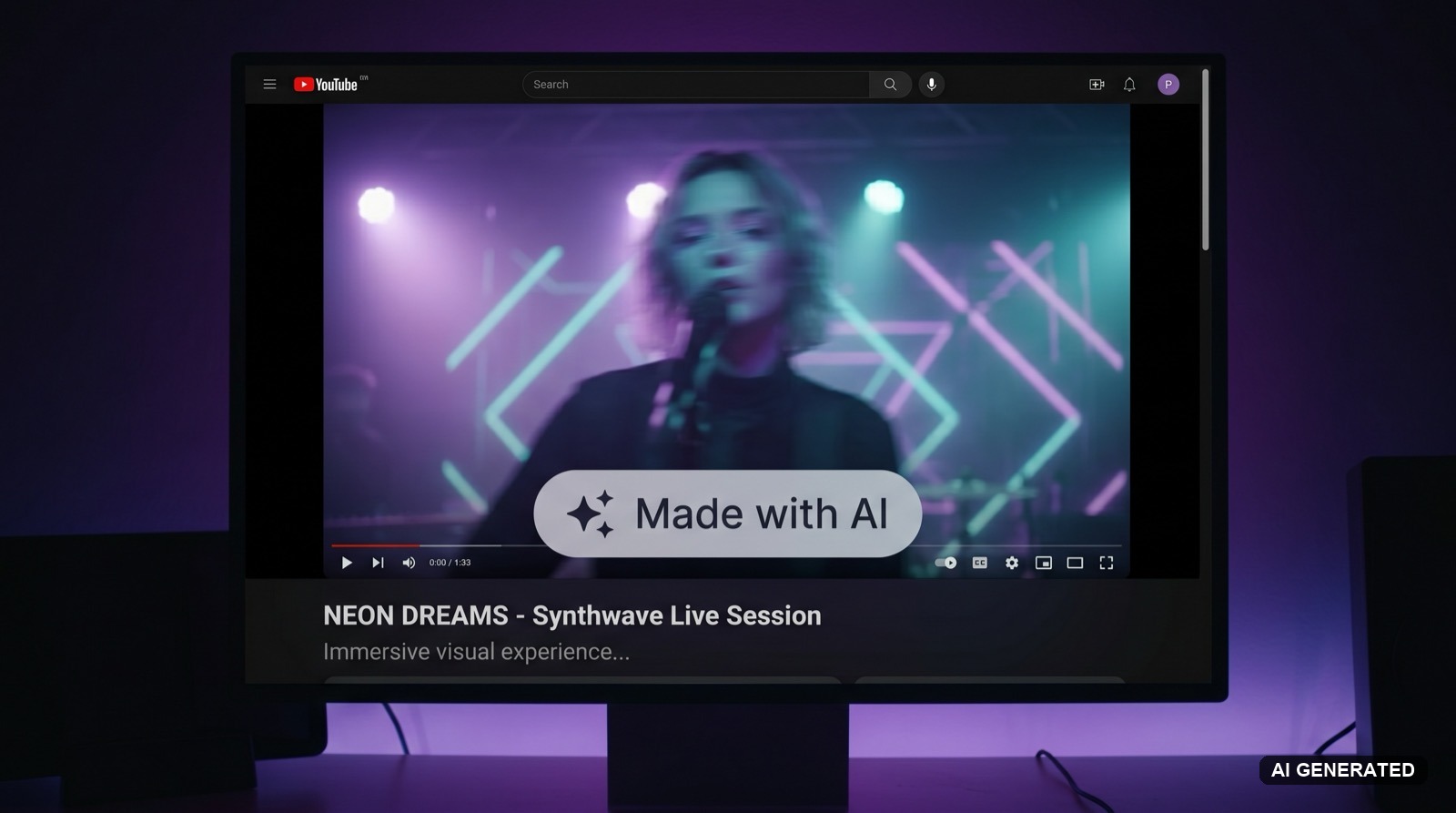
YouTube will start automatically flagging videos that use significant photorealistic AI on May 27, 2026, even when the creator does not check the disclosure box. The label moves out of the expanded description to a prominent pill below the player on long-form videos, and to an on-video overlay on Shorts. The change ends a two-year honor system that asked creators to self-tag AI work, a policy first put in place in late 2023. For music creators, the cut is narrower than it looks.
Animated videos slip past the new rule
Photorealistic only. The auto-detect rule fires only on videos YouTube classifies as photorealistic and meaningfully altered or generated. The company spelled out the carve-out in its own announcement: “For content that is unrealistic, animated, or slightly altered, viewers can find this disclosure in the expanded description.” A Veo-generated photoreal performance picks up the gray pill below the player. A stylized Neural Frames or Runway visual, an animated lyric video, or a hand-drawn AI piece keeps its disclosure buried where most viewers never look.
Two cases stay permanent. Content built with Veo or Dream Screen, YouTube’s own AI tools, carries the label for life. Content tagged with C2PA provenance metadata (the cross-industry standard for marking synthetic media) also locks in. Creators can appeal a misflag inside YouTube Studio, but the Veo and C2PA cases do not come off, Variety reported.
What it means for music creators
A photoreal Veo music video earns the prominent pill from upload day. The Arctic Monkeys Veo collaboration is the kind of release that will carry the new label by default. An animated AI lyric video will not. The label is a transparency signal, not a downrank. Your video stays searchable, ranked, and monetizable.
The shift gets sharper on auto-generated assets. YouTube’s “Provided by” auto-videos (the still-image art tracks generated from your distributor’s audio delivery) sit fine when the still is a real photo. A photo-style AI thumbnail likely trips the threshold. Animated lyric videos do not. MBW noted the implicit incentive: artists experimenting with AI visuals now have a real reason to lean animated. The disclosure gap on the Taylor Swift impostor video is the kind of case the new system is meant to catch on the way in.
Frequently asked questions
How does YouTube's new automatic AI label work?
YouTube's new system uses internal signals to detect significant photorealistic AI use in uploads. When the system flags a video, YouTube applies the disclosure label even if the creator did not check the AI box at upload. Creators can appeal a misflag in YouTube Studio.
Which AI tools trigger a permanent YouTube AI label?
Content built with YouTube's own AI tools, Veo and Dream Screen, locks the label in for life. Content carrying C2PA provenance metadata that marks the file as fully AI-generated also carries a permanent disclosure. Other auto-applied labels can be appealed in YouTube Studio.
Does YouTube's auto-label apply to animated AI music videos?
No. YouTube limits the new auto-detect rule to photorealistic and meaningfully altered or generated videos. Animated, stylized, or only slightly altered AI music videos still get a disclosure, but it sits inside the expanded description rather than under the player.
About the author

Covering AI music tools, industry shifts, and news for music creators and professionals. Twice-weekly newsletter at aimusicpreneur.com.