Boy George's AI 'Karma Chameleon', explained: how it was made and who owns it
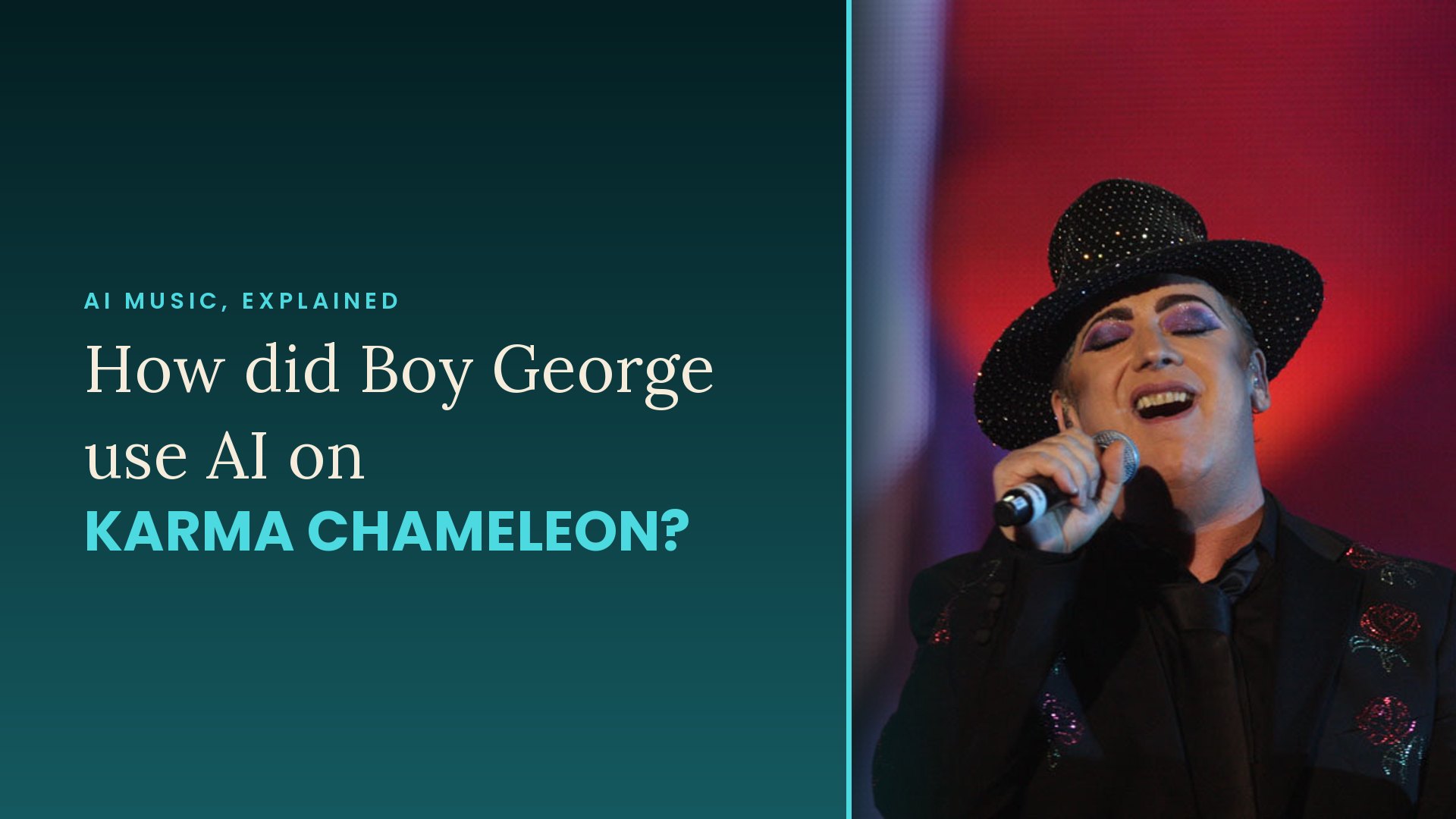
Boy George and Culture Club re-recorded their 1983 hit “Karma Chameleon” using AI, and the result is one of the clearest tests yet of whether AI can hand artists back control of their own songs. George sang a new vocal, then an AI model trained on the original 1983 recordings reshaped it to match his younger voice. The release is timed to his 65th birthday and launches a new company, Artist Included.
This page explains how the AI was used, whether the track is a clone or a re-recording, and who owns “Karma Chameleon.” For the dated report on the launch, see the news piece on Boy George re-recording “Karma Chameleon” with AI.
What did Boy George do to “Karma Chameleon”?
He made a new recording of the song and used AI to make it sound like the 1983 original. The new version was produced by JJ Blair and Culture Club. It has a warmer vocal tone and sits slightly lower in the mix, but it stays close enough to the original to play like a remaster.
This is not the old recording with effects on top. It is a fresh performance, captured today, then shaped to carry the sound of the hit people remember. The track is out on digital and on red, gold, and green vinyl, the three colors named in the lyrics.
How was AI used on “Karma Chameleon”?
The AI work sits on the vocal. Boy George recorded the song again at 64, then the team used an AI model to recreate the characteristics of his 1983 voice and apply them to the new take.
That model was trained on archival recordings the song’s original producer, Steve Levine, kept from the 1983 sessions, so the AI had a reference for how George sounded when “Karma Chameleon” first charted. The output keeps George’s real performance and phrasing, with the tone pulled back toward his younger self.
The voice model runs on technology from Syntiant, the AI company that powers Artist Included’s music platform. For a plain-English primer on the underlying tech, see our explainer on what an AI voice is.
Is the new “Karma Chameleon” an AI clone or a re-recording?
It is a re-recording. The distinction matters, because the two are built in opposite ways.
A voice clone produces a vocal the singer never sang. The model generates the performance from scratch in the artist’s voice. The unauthorized clones labels have spent two years fighting work like this, which is why artists like Lionel Richie are trying to trademark their voices.
An AI-assisted re-record starts with a real performance. George sang the whole song, and AI shaped the sound. Nothing was faked, and George signed off on every step as the artist and the rights holder of the new master. It is not a deepfake either, since a deepfake fabricates a performance the artist never gave.
Who owns “Karma Chameleon,” and why does that matter?
Boy George wrote and sang one of the biggest songs of the 1980s, and for 40 years he had little control over it. He never owned the master recording, so the money and the licensing decisions sat with the rights holders.
The catalyst was a sync deal. Richard Branson licensed “Karma Chameleon” for a Virgin Voyages campaign, and the payout flowed to the owners of the master and the publishing, not to George. Of the roughly $4 million, about $2 million went to the master rights holders alone.
Four million changed hands. George didn't get anything at all.
A re-record changes that math. George now controls a master of his signature song for the first time, which is the same reason he told Rolling Stone his answer for doing it was one word: control.
What is Artist Included?
Artist Included is an artist-first AI music company that helps legacy artists re-record and reclaim the songs they no longer control. It was co-founded by George’s longtime manager Paul Kemsley and attorney and producer Jeremy Rosen, with George as creative director, and it put out the “Karma Chameleon” re-record through a partnership with BMG.
The pitch flips the usual AI story. Labels have spent two years fighting AI that strips value from artists. Artist Included wants to use the same technology to give value back, by helping legacy artists re-record and reclaim the songs they no longer control. “Karma Chameleon” is the first test case, announced through The Hollywood Reporter.
Can other artists use AI to reclaim their songs?
In theory, yes, and that is the whole point of Artist Included. Any artist who sang a hit they do not own could, in principle, record it again and use AI to match the original sound.
There are limits. A re-record gives the artist a new master they own. It does not claw back the original recording, and it does not change who holds the publishing. Taylor Swift proved the demand for this with her re-recordings, but she did it by hand, song by song. The AI version aims to make the sound-alike part faster and closer to the original.
The open question is how labels, the original master owners, and fans react when an artist puts a near-identical version into the market to compete with the one they do not control.
Where can you hear the AI “Karma Chameleon”?
The re-record is out now on streaming and on colored vinyl through Culture Club’s official release page. The vinyl comes in red, gold, and green, with reimagined cover art.
If you know the 1983 version, the new one will sound familiar on purpose. It is meant to pass as the song you remember, with one difference that does not reach your ears: this time, Boy George owns it.
Frequently asked questions
Did Boy George use his real voice on the AI "Karma Chameleon"?
Yes. Boy George sang a new vocal performance for the re-record. An AI model trained on the original 1983 recordings then reshaped that performance to match the characteristics of his younger voice. The result is an AI-assisted re-record, not a fully synthetic vocal.
Is the new "Karma Chameleon" an AI voice clone?
No. A voice clone generates a performance the singer never gave. Boy George performed the song himself, and AI was used to color the vocal toward his 1983 tone. The team frames it as an AI-assisted re-recording rather than a clone or a deepfake.
Why did Boy George re-record "Karma Chameleon" with AI?
For control. Boy George has never owned the master recording of his biggest song, so he had little say over where it gets licensed. Re-recording it with AI gives him a version he owns and can control.
Who owns the rights to "Karma Chameleon"?
The original 1983 master is owned by the recording's rights holders, and the song's publishing is held separately by its writers and publishers. Boy George owns this new AI-assisted re-record, but the original master and the publishing rights are unchanged.
What is Artist Included?
Artist Included is a music technology company co-founded by Boy George's manager Paul Kemsley and attorney and producer Jeremy Rosen, with Boy George as creative director. It aims to help legacy artists re-record and reclaim control of their signature songs using AI.
About the author

Covering AI music tools, industry shifts, and news for music creators and professionals. Twice-weekly newsletter at aimusicpreneur.com.