
UK music-tech funding fell to £68.8M in 2025, a new MTUK report warns
My stack My fav 6 tools for AI music after testing 70+
-
 ElevenMusic · Music generation
 -
 Moises · Stem separation
 -
 Controlla · Voice swap & cloning
 -
 Cryo Mix · Mixing + mastering
 -
 Neural Frames · Music videos
 -
 ONCE · Distribution
Some links are affiliate links — I earn a commission at no cost to you. Every tool here is one I run myself and truly believe in. This stack is proven.
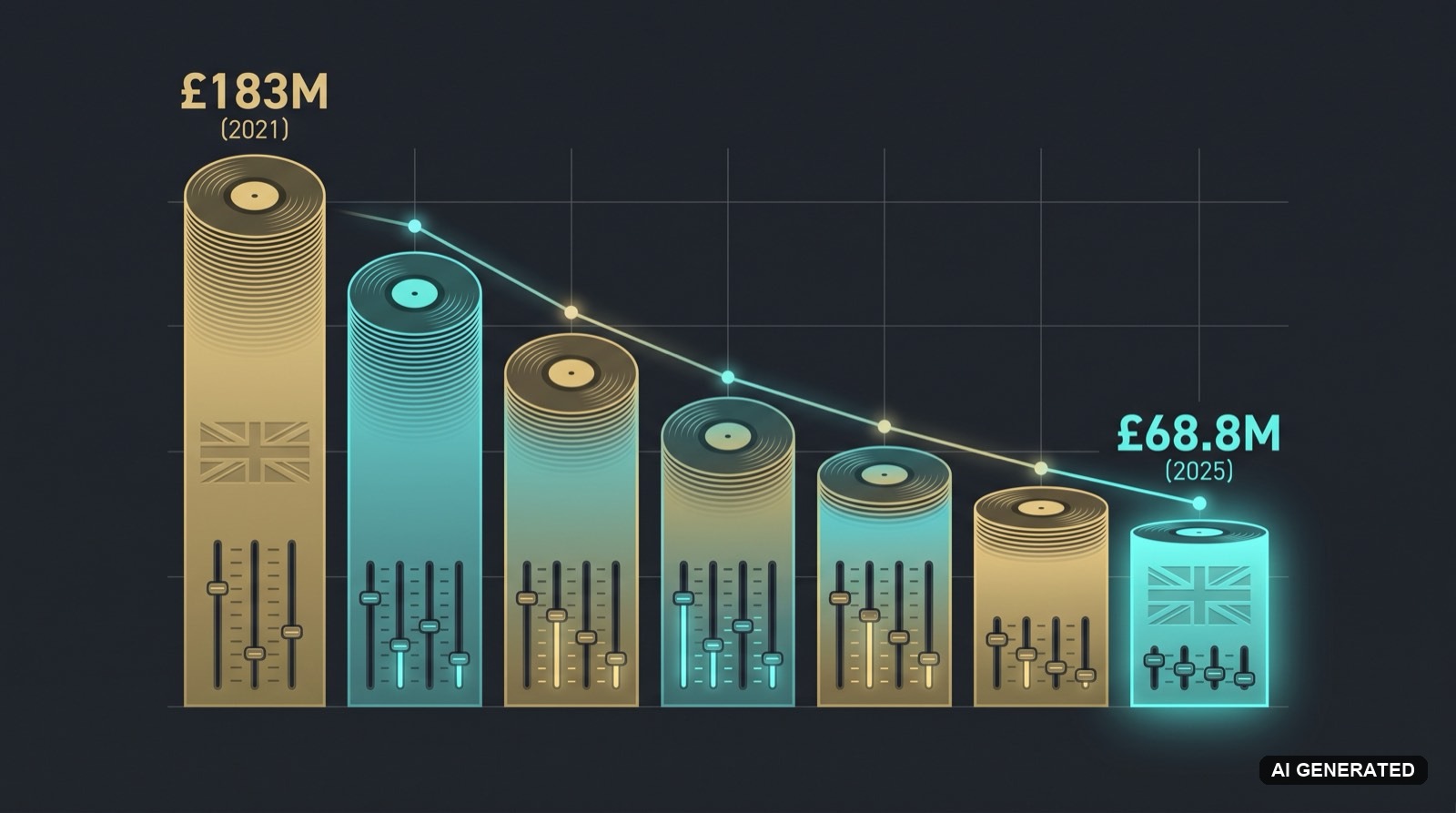
The money behind UK music-tech is drying up, and a new report puts a number on it. Sound Investments 2026: Back the Sector, the second annual study from trade association Music Technology UK (MTUK), says funding peaked at £183m in 2021 and fell to just £68.8m in 2025.
The drop stands out because the wider market held up. Over the same period, overall UK tech funding fell only 4.4%. Music-tech fell far harder than the sector around it.
The gap is at growth stage
The report does not show founders giving up on music-tech. Seed-stage investment grew from £8.4m in 2020 to £22.1m in 2025.
The problem comes after the seed round. Growth-stage funding, the larger checks that turn a working product into a real business, is where the money pulled back — it plunged 90% between 2020 and 2025. Startups can get started and then stall.
MTUK released the figures as SXSW London opened, a week built around music and tech in the capital.
Why the report keeps pointing at AI
MTUK does not frame this as a quiet funding story. The report, produced with research firm Beauhurst and built on six years of data across 922 UK music-tech companies, argues that generative AI has changed who wants to buy these businesses. It describes a new kind of music-tech buyer — platforms that need licensed music data, rights infrastructure and proprietary content pipelines — and warns that UK firms building exactly there keep getting acquired before they can scale at home. US investors took part in 14% of all deals, fuelling what the report calls “premature acquisitions” by foreign buyers.

When we published the first Sound Investments report last year, we argued that UK music tech was undervalued, underinvested, and underrepresented. A year on, that is changing — but not fast enough.
MTUK’s headline argument is that AI raises the stakes for government action. It wants music-tech written explicitly into the UK’s creative-industries policy now, before more companies building rights infrastructure and music data leave British hands.
Why this reaches working artists
Tools do not appear from nowhere. The mixing assistants, stem splitters, and AI co-writers that artists lean on come from small companies that need capital to ship and survive.
When growth funding dries up, fewer of those tools reach maturity. The ones that do tend to be the products with a major backer or a big-tech parent. That narrows what independent musicians get to use, and who controls it.
Frequently asked questions
How much did UK music-tech funding fall in MTUK's 2026 Sound Investments report?
From a £183m peak in 2021 to £68.8m in 2025, according to Music Technology UK's second annual Sound Investments report. Over the same window, overall UK tech funding fell only 4.4%.
Did UK seed-stage music-tech funding also drop in MTUK's 2026 Sound Investments report?
No. Seed-stage investment grew from £8.4m in 2020 to £22.1m in 2025. The shortfall is at growth stage, where funding for UK music-tech firms plunged 90% between 2020 and 2025.
Who produced the Sound Investments 2026: Back the Sector report?
Music Technology UK (MTUK), with research firm Beauhurst and lead sponsor KPMG UK. It analyses six years of investment data across 922 UK music-tech companies and launched as SXSW London opened in June 2026.
About the author

Covering AI music tools, industry shifts, and news for music creators and professionals. Twice-weekly newsletter at aimusicpreneur.com.