1. Jamu brings AI voice control to Ableton Live

Jamu launched today as an AI co-producer that runs alongside Ableton Live. You type or speak plain English instructions. It executes them directly in your session.
The tool handles complex routing, vocal splitting, device configuration, automation drawing, and project organization. Say “add a reverb to the vocal bus with a long tail” and it configures the device for you. All actions remain editable and reversible.
This follows the AI-as-interface trend gaining traction across music production. Tools like ChatM4L and AbletonGPT pioneered this category. Jamu pushes it further with real-time session control.
Self-taught producers who fight UI friction will see the biggest gains. Experienced users get a faster prototyping layer. The tool positions itself alongside options like Output Co-Producer in the emerging AI music tools category. Pricing isn’t public yet. Visit Jamu’s site for waitlist access.
2. RaagaPay launches first ethical AI dataset for Hindustani classical music
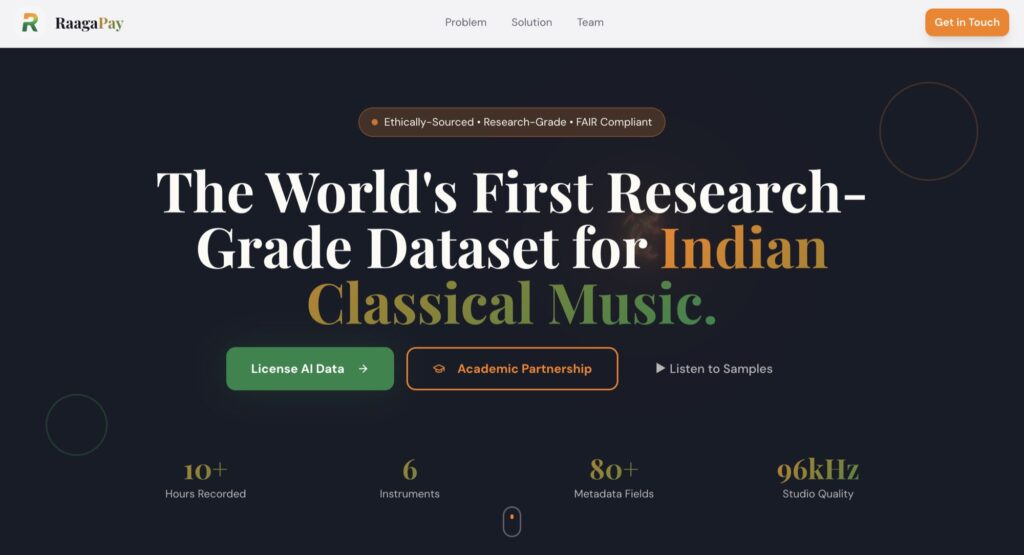 Credit: RaagaPay website
Delhi-based startup RaagaPay launched in October 2025 to fix a problem you might not know exists. When you ask Suno AI for a raga, you get a Western approximation. Founder Debjit Mitra claims AI models hallucinate 40% of the time when generating Indian classical music.
The structural gap is massive. Hindustani classical music requires 80 metadata parameters to describe accurately. Western datasets use 12-15. RaagaPay captures raga classification, taal rhythmic cycles, rasa emotional frameworks, and gharana lineage affiliations.
Artists receive lifetime royalties each time their recordings are licensed for AI training. This mirrors the consent-based approach seen in Pozalabs ethical dataset development and aligns with Fairly Trained certification standards. The startup targets 1,000 hours from 100+ performers by 2028.
If you work with clients in raga, maqam, or makam traditions, treat current AI music tools as unreliable. Do not use them for reference tracks without manual correction from a trained musician.
3. Six Korean music organizations form AI rights coalition

Six major Korean music organizations formed the K-Music Rights Organizations Mutual Growth Committee on February 26. They called it a “declaration of war” against unauthorized AI training.
The coalition includes KOMCA, the Recording Industry Association of Korea, and four other bodies representing composers, performers, producers, and labels. Their 6-point plan demands training data transparency, AI output labeling, and blockchain infrastructure linking ISWC, ISRC, Content ID, and UCI identifiers for automated royalty tracking.
If you have K-pop co-writes, Korean co-productions, or sync deals with Korean media, monitor KOMCA policy changes in Q2-Q3 2026. A new licensing framework could generate unexpected royalty revenue or create compliance obligations. Consider registering AI-assisted works now to ensure proper documentation.
In 2004, KOMCA forced file-sharing platforms to pay blanket licensing fees. That precedent went global. History suggests this coalition means business.
4. GEMA vs Suno hearing concludes, ruling set for June 12th
Oral proceedings wrapped up this week in GEMA’s copyright infringement action against Suno. A ruling is expected June 12th. This German case moves faster than US litigation and operates under stricter copyright laws.
GEMA’s counsel presented side-by-side comparisons showing AI outputs that “”closely match world-famous works”” in melody, harmony, and rhythm. A GEMA win would confirm that AI platforms need authorization to train on copyrighted music. This follows the court’s November 2025 victory in an infringement suit against OpenAI.
GEMA’s AI licensing framework aims to make training data a compensable usage. This licensing-agreement push will likely increase subscription fees for AI platforms. Budget for higher costs if you rely on these tools.
When licensing deals close, payouts will flow through existing registration records. If your works aren’t properly registered with GEMA, ASCAP, or PRS, you’ll be invisible to distribution algorithms. Review your Suno workflow now and ensure your catalog metadata is flawless before the June 12th ruling drops.
5. Independent Musicians Sue Google Over AI Training Theft

A coalition of independent musicians filed a lawsuit against Google on March 9. They allege the company used YouTube uploads to train its Lyria text-to-music model without permission.
The complaint claims Google stripped copyright data from millions of songs, then distributed AI-generated tracks as “legal” through ContentID and YouTube. “Google owns the platform where independent musicians distribute their music. Google runs the system that identifies who owns it,” said attorney Ross Kimbarovsky of Loevy + Loevy. “No other defendant in any AI copyright case had this kind of access.””
The lawsuit cites Digital Millennium Copyright Act violations for removing copyright management information. Plaintiffs seek class certification to represent all affected artists. A successful class action could establish compensation frameworks for millions of independent musicians.
Songs you uploaded years ago could be embedded in Lyria 3’s training data. Audit your distribution agreements for AI training clauses before your next release. Understand your copyright fundamentals to position yourself for potential class membership. Consider Fairly Trained certification standards when evaluating AI tools you use.