The current AI music debate mirrors several historical disruptions that transformed the music industry, revealing a pattern of resistance, adaptation, and eventual transformation. This pattern continues today, as evidenced by Sony Music’s recent warning to over 700 AI companies about unauthorized content use, demonstrating how major labels are following historical patterns of resistance.
1. Radio revolution (1920s)

In the 1920s, radio emerged as the first major technological disruptor, fundamentally changing how music reached audiences. Just as today’s AI companies including Suno and Udio argue for fair use, radio stations initially faced strong opposition from record labels concerned about losing control over music distribution.
Radio ultimately became a critical driver of the music industry, shaping public taste and driving record sales. These concerns about control and distribution mirror Universal Music’s growing concerns about AI-generated content spreading online, highlighting how the industry’s historical resistance to new technologies continues to shape its responses.
2. Sampling controversy (1980s):

The sampling era of the 1980s and 1990s presents striking parallels to current AI training debates. Like today’s AI companies, early sampling artists faced fierce resistance from record labels and copyright holders. The industry’s response was similar – establishing committees to track infringement and demanding explicit permissions.
The argument that sampling was “just learning from existing music” mirrors current AI companies’ claims about training models. This debate has intensified recently, as metal icon Dani Filth’s compelling perspective on how AI threatens the soul of music creation draws stark parallels between current AI debates and past technological disruptions.
3. MP3 disruption (1990s):
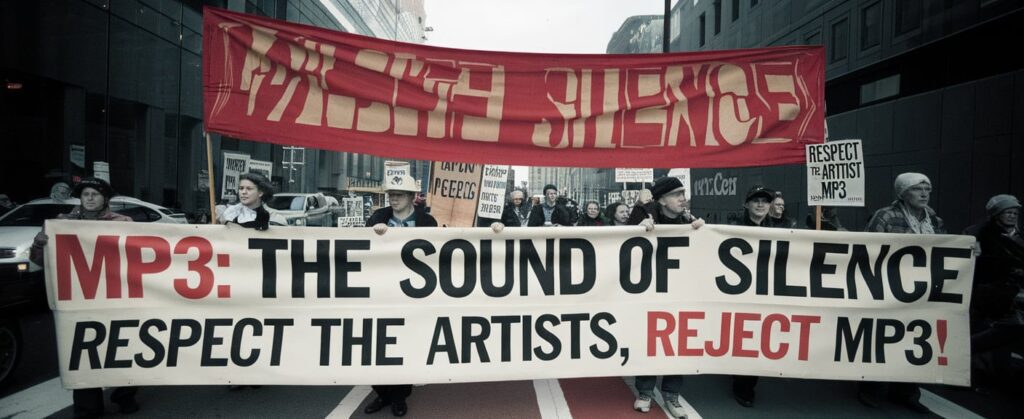
The MP3 revolution of the late 1990s perhaps most closely resembles the current AI situation. This format fundamentally changed the industry’s business model and sparked intense debates about copyright and fair use. Like current AI technology, MP3s democratized music creation and distribution while simultaneously threatening established industry structures. The format led to:
- Radical changes in distribution models
- Debates over intellectual property rights
- Concerns about artist compensation
- Transformation of consumer behavior
The economic implications of these changes continue today, with research indicating the AI music market could reach $3 billion by 2028, though 71% of musicians worry about their future earning potential – echoing concerns that arose during the MP3 era.
4. Streaming revolution (2010s):

The streaming era has fundamentally transformed the music industry, now constituting over two-thirds (67.3%) of the market with more than 667 million paid subscriptions worldwide1. Like previous disruptions, streaming has:
- Democratized Access: Similar to MP3s, streaming services have lowered barriers to entry, allowing independent artists to reach global audiences without major label backing.
- Sparked revenue debates: The shift to per-stream payments and complex royalty models echoes previous disruptions’ compensation challenges.
- Changed consumer behavior: Just as radio shaped public taste and MP3s changed ownership patterns, streaming has revolutionized how people discover and consume music through personalized playlists and unlimited access.
The streaming revolution follows the same pattern of resistance and adaptation seen in previous disruptions:
- Initial Industry Opposition: Traditional stakeholders initially resisted the streaming model, concerned about revenue cannibalization.
- Business Model Transformation: The industry has been forced to adapt, with streaming now accounting for 80% of revenue in major markets.
- Democratization vs. Control: Like previous disruptions, streaming has created tension between democratized access and industry control over distribution.
The streaming era thus represents a natural continuation of our historical analysis, showing how the industry continues to follow patterns of resistance, adaptation, and transformation when faced with technological change.
Common patterns:
These historical disruptions share key patterns with today’s AI debate:
- Initial Resistance: Each innovation faced strong opposition from established industry players.
- Copyright battles: All four disruptions triggered intense legal debates about intellectual property rights.
- Democratization: Each technology made music creation and distribution more accessible.
- Business model disruption: All innovations forced the industry to adapt its revenue models.
Present parallels
Today’s AI music debate echoes these historical patterns. Just as sampling raised questions about creative appropriation and MP3s challenged distribution models, AI technology is forcing the industry to reconsider fundamental aspects of music creation and ownership. The industry’s current emphasis on explicit authorization for AI training data mirrors past demands for sampling clearance. This divide within the music community is particularly evident in the recent discussion by Miss Krystle about why musicians are divided over AI’s role in music production.
The historical pattern suggests that while AI will likely transform the music industry significantly, it will ultimately lead to new business models and creative possibilities, just as radio, sampling, and MP3s did before it. However, the scale and speed of AI’s potential impact may make this transformation more dramatic than previous disruptions.