Key Highlights:
- Google’s Project Genie lets users create interactive 3D worlds from text prompts
- Available now to Google AI Ultra subscribers in the US for $249.99/month
- Gaming stocks dropped sharply after the announcement, signaling industry disruption
- Music professionals face both opportunities and threats as media shifts from streaming to simulation
Google launched Project Genie 3, an experimental prototype that generates explorable virtual environments from text and images. Genie 3 creates paths in real time as users move through generated spaces.
“This experimental research prototype lets users create, explore and remix their own interactive worlds,” Google stated in its announcement.
The market reacted immediately. Share prices at Take-Two Interactive, Roblox, and Unity dropped sharply after the news broke.
Why Google’s Project Genie matters for music
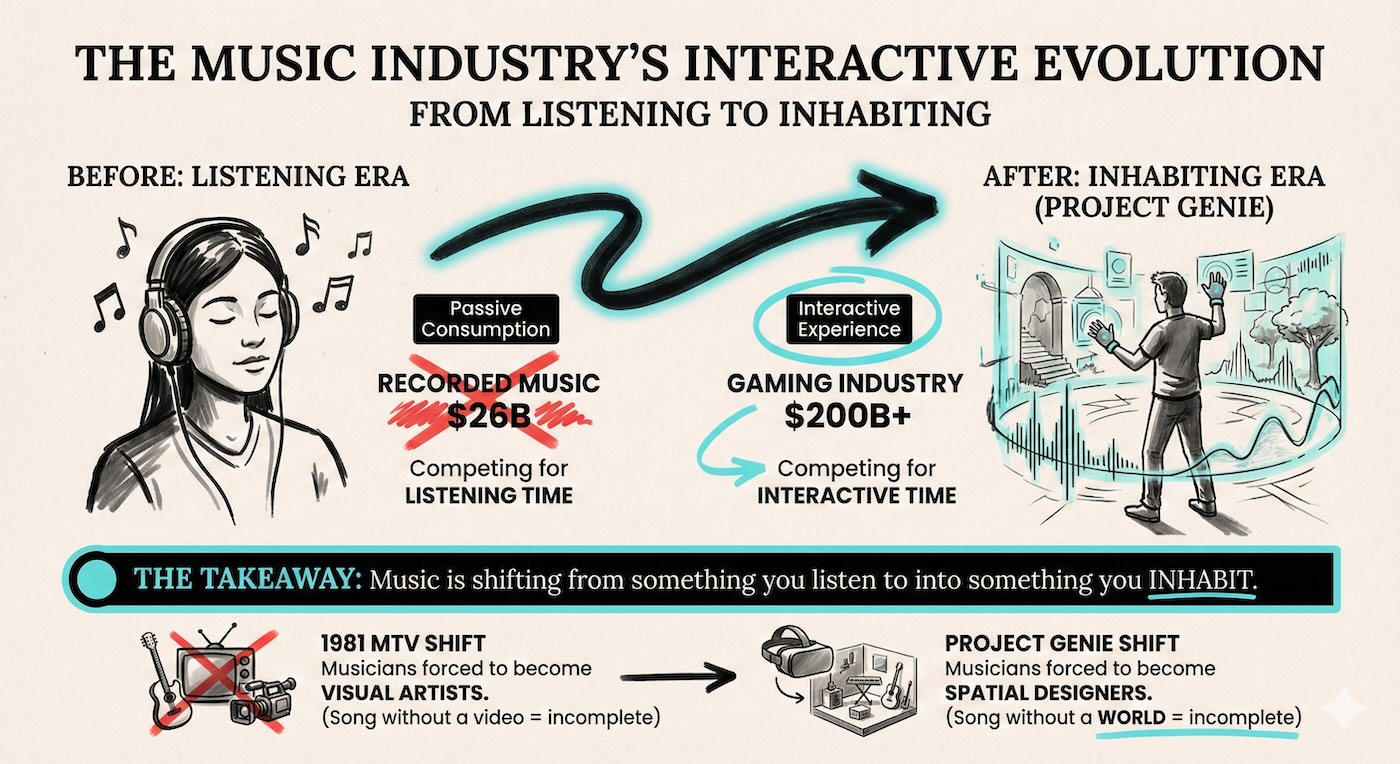
The takeaway: Music is shifting from something you listen to into something you inhabit.
The gaming industry generates $200B+ annually, dwarfing recorded music’s $26B. Project Genie lowers the barrier to “game creation” to zero, meaning music professionals now compete for interactive time, not listening time.
This mirrors MTV’s 1981 launch, which forced musicians to become visual artists. Project Genie forces them to become spatial designers. A song without a “world” attached to it will soon feel as incomplete as a single without a video did in 1990.
Artists like David Gilmour and The Orb have already explored interactive AI music projects where fans customize music and visuals through prompts. Project Genie takes this concept further.
Opportunities and Risks using immersive tech
For artists, this is a double-edged sword:
- Opportunity: Release “Playable LPs” where every song becomes a distinct, explorable world generated from lyrics or artwork
- Risk: Fans busy generating their own worlds spend less time consuming artist content unless that content seeds their creations
For labels, album art and song lyrics (for storytelling) becomes a “Style Seed.” Rights holders could license an artist’s visual aesthetic as a prompt filter for user-generated worlds.
For venues, the threat is real. Digital experiences compete with physical concerts. Smart operators will use this tech to let ticket buyers “walk through” venues before purchasing seats.
Platforms like Rosebud AI vibe coding and Meta’s WorldGen text-to-3D show this is an industry-wide shift, not a single company’s experiment.
How to build an interactive music world with Project Genie 3
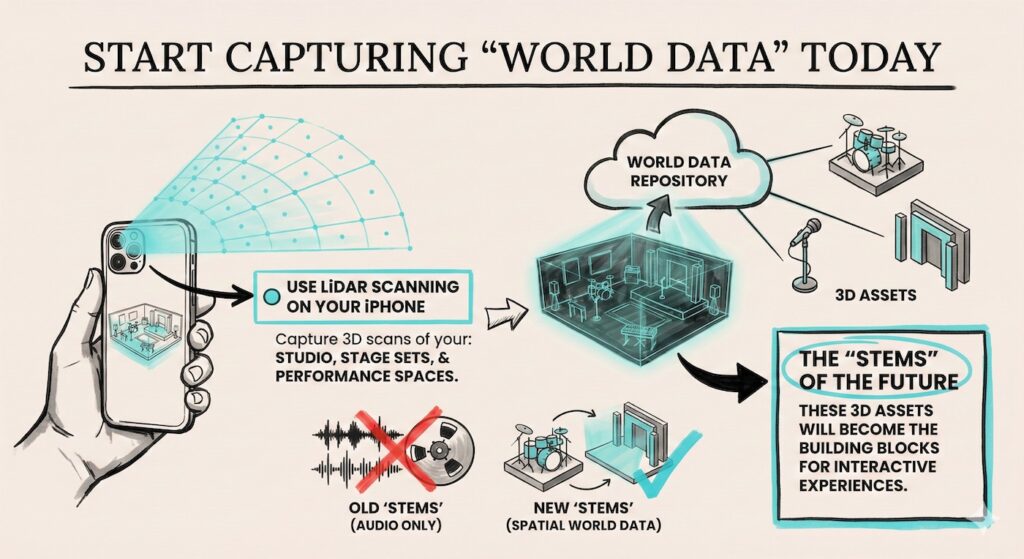
Start capturing “World Data” today. Use LiDAR scanning on your iPhone to capture 3D scans of your studio, stage sets, and performance spaces. These 3D assets will become the “stems” of the future.
The $250/month price tag creates a temporary premium tier. Early adopters who master this technology will define how music experiences evolve.
Within two years, expect Spotify or YouTube Music to integrate a “Step Inside” button. Album covers will become playable lobbies. “World Designer” will appear as a standard credit on liner notes.
As generative AI for emerging musicians becomes more accessible, the artists who adapt fastest will define the next era of music.